volume attenuator relay

Ya’akov

Joined Jan 27, 2019
10,235
A motorized dual volume control like was used in some stereo receivers for remote control would be smaller and simpler to control and allow a continuously variable setting, with the added advantage of also working for local control with a knob. That motor/geartrain was just a small bit larger than the control and added about an inch and a half to the length. And that receiver was unique in havil both a digital frequency display AND a slide-rule readouot. And the tuning was also remoted. Older technology, I am sure.
https://www.ebay.com/itm/ALPS-motor...control-board-with-display-C8-44/143746743209
 

MisterBill2

Joined Jan 23, 2018
27,530
I had already tried to do it like this but it doesn't work.
That is a similar concept, but if it does not work then it is not close enough. If iit was actually connected correctly then probably the resistance was all wrong. And since I saw no mention of the resistance then certainly it would be the wrong value, which is typical for most products sold on ebay and amazon. And the seller usually knows less about the product than the cashier at your local convenience store.
 

MisterBill2

Joined Jan 23, 2018
27,530
Like what? Which post # are you referring to?

ak
I am presuming that the TS is referencing that ebay offering, which I just examined with the zoom function. I see the label on the pot as "100K x4.. That implies that somehow the variable resistor is a 100,000 ohm device, or perhaps there are a total of four of the 100K ohm devices. That is the wrong value for the application. But of course the seller does not provide that information, probably because they do not know the difference between an ohm and a lockwasher.
For a nominal 0.7 volt audio line the driving and loading ends are closer to 1000 ohms, or in the older braodcast systems, often a 600 ohm impedance. So a 100,000 ohm control would be unable to provide the desired control function.
 

Thread Starter

arivel

Joined Mar 4, 2018
47
Too many schematics, too late at night. Let's try this again.

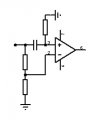
This is a re-work of the post #20 schematic. I like it better than the post #1 schematic because the logic part of the circuit is not using Vee as its GND potential. The #1 schematic shows a CMOS counter, so the output signal voltage range should be enough to drive the 358 into both positive and negative saturation.

The schematic comments from post #51 still apply. R2-R3 give the opamp circuit a gain of two. This keeps the output saturated long enough for the relay to respond. The effective pulse width at the relay coil, which is a bit longer than the opamp saturation period, should be approx. R1 x C1. Note that neither this circuit nor the relay will respond to rapidly-changing signals.

The LM358 is a good-enough part for this application, very robust, and very cheap. The LM324 is a quad version of the same part. Since you are using six of these circuits per audio channel, it seemed like a good place to start. Depending on the relay coil current requirements, you might be able to go with a more rail-to-rail type part, for more equal positive and negative pulse amplitudes.

So, what did I miss this time - ?

ak

View attachment 235905
I cannot find the notes of the circuit I had tried.
it's been a while but I remember trying the same configuration as you but with some different components. C1 from 1 micro and R1 from 1K instead R2 and R3 were the same as your scheme. i don't remember which opamp i had used.
in both impulses there was a large spike on the second front of both impulses.
anyway I get the opamp 324 and then I try it.
 

Thread Starter

arivel

Joined Mar 4, 2018
47
I think there is a problem.
when the capacitor goes to V + its voltage corresponds to (V + ground) when instead the capacitor goes to V- it charges at (V + V-) that is double the previous voltage and the opamp input sees two ranges of voltages of which one is double the other.
you confirm?
 

MisterBill2

Joined Jan 23, 2018
27,530
I think there is a problem.
when the capacitor goes to V + its voltage corresponds to (V + ground) when instead the capacitor goes to V- it charges at (V + V-) that is double the previous voltage and the opamp input sees two ranges of voltages of which one is double the other.
you confirm?
For controlling relays it really makes more sense to use a comparator and not a linear device. A realy switch is either off oor on, there is no use for any intermediate voltage. And biasing comparators is simpler.
 

MisterBill2

Joined Jan 23, 2018
27,530
can you give me an example?
Many others have used comparators that have an open collector output to drive a transistor to operate a relay. The benefit is that the comparator with the open collector output floats when it is not pulling down. And an LM339 has 4 comparators in that cheap package.
 

Thread Starter

arivel

Joined Mar 4, 2018
47
would you be kind enough to give me the circuit diagram?
you do not need to calculate resistance and capacitor values.
configuration only
 

MisterBill2

Joined Jan 23, 2018
27,530
A comparator circuit diagram looks a lot like an opamp diagram except for no negative feedback resistor. A comparator is intended to switch on and off, like an opamp will do if it has no negative feedback. And controlling a relay the normal intent is to have it either on or off, not to ever be at some intermediate state. Look up the applications of an LM339 comparator and you will see how it works.
 

Thread Starter

arivel

Joined Mar 4, 2018
47
if you use an open collector comparator you need a pull-ap resistor.
having said this if we take the circuit of intervention number 54 as a reference, two different reference voltages will appear at the input (V-) of the opamp and consequently the positive impulses will have a different amplitude compared to the negative impulses
 
Last edited:

MisterBill2

Joined Jan 23, 2018
27,530
If a comparator with an NPN open collector is used to pull down the base of a PNP transistor to switch it on, then the pull up resistor will only need to keep the base leakage current from switching the transistor on. That is a quite small amount of current.
Or is the discussion still considering a magnetic latching relay?
 

Thread Starter

arivel

Joined Mar 4, 2018
47
I think there is a problem.
when the capacitor goes to V + its voltage corresponds to (V + ground) when instead the capacitor goes to V- it charges at (V + V-) that is double the previous voltage and the opamp input sees two ranges of voltages of which one is double the other.
you confirm?
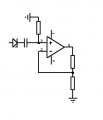
maybe i can solve by adding a zener diode with Vz that corresponds to (V + ground) in front of the capacitor.
do you agree?
 

Attachments

Top