Voltage too high

Thread Starter

Arenare

Joined Aug 23, 2020
11
Greetings,
Searched for a beginner's electronics forum and came upon this one. I am truly a beginner. Pre-beginner might describe me better...
I have a 2.4v battery charger that has a 12.5v output.
Would putting a small pot inline with the "+" output lead work?
Thanks
 

dl324

Joined Mar 30, 2015
18,326
Welcome to AAC!
I have a 2.4v battery charger that has a 12.5v output.
Would putting a small pot inline with the "+" output lead work?
No. That would most likely cause more problems because the charger won't be able to detect state of charge.

What kind of batteries is it for? I'm not aware of any 2.4V batteries...

Is it some type of universal charger that can charge battery packs?
 

Audioguru again

Joined Oct 21, 2019
6,826
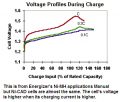
There is no "2.4V" battery charger. The datasheets for Ni-Cad and Ni-MH battery cells show that they charge to 1.4V to 1.55V each which is 2.8V to 3.1V for two cells in series. The maximum charging voltage depends on the charging current.
Your battery charger with a 12.5V output might explode two cells in series.
A pot in series limits the current, not the voltage.

Here is a graph of charging voltage and the "C" is the amount of rated capacity for the charging current:
 

Attachments

Thread Starter

Arenare

Joined Aug 23, 2020
11
Welcome to AAC!
No. That would most likely cause more problems because the charger won't be able to detect state of charge.

What kind of batteries is it for? I'm not aware of any 2.4V batteries...

Is it some type of universal charger that can charge battery packs?
Thanks for the welcome and rapid reply.
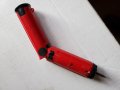
It's a Milwaukee charger for a Milwaukee screwdriver that's sometimes used by assemblers. The driver articulates in the middle allowing for angled approach as needed. One speed, forward and reverse w a rocker sw and has an adjustable clutch. Mine is at least 20 yo and the charger quit recently.
Bought a used one on ebay and put a meter on the output terminals before sticking a battery in it.
 

Thread Starter

Arenare

Joined Aug 23, 2020
11
There is no "2.4V" battery charger. The datasheets for Ni-Cad and Ni-MH battery cells show that they charge to 1.4V to 1.55V each which is 2.8V to 3.1V for two cells in series. The maximum charging voltage depends on the charging current.
Your battery charger with a 12.5V output might explode two cells in series.
A pot in series limits the current, not the voltage.

Here is a graph of charging voltage and the "C" is the amount of rated capacity for the charging current:
 

Attachments

Thread Starter

Arenare

Joined Aug 23, 2020
11
Thanks for the welcome and rapid reply.
It's a Milwaukee charger for a Milwaukee screwdriver that's sometimes used by assemblers. The driver articulates in the middle allowing for angled approach as needed. One speed, forward and reverse w a rocker sw and has an adjustable clutch. Mine is at least 20 yo and the charger quit recently.
Bought a used one on ebay and put a meter on the output terminals before sticking a battery in it.
Any suggestions on how to correct this voltage-- In beginner's language?
 

Externet

Joined Nov 29, 2005
2,630
I have the same exact Milwaukee screwdriver. Had two NiCd cells in series in each battery pack until died and I replaced them with a single 18650 Li, modified the charger to supply 4.20V
 

Tonyr1084

Joined Sep 24, 2015
9,744
On the subject of batteries, I have some cordless phones (not cell phones) that are 3.6V. They consist of three Ni-Cad's in series. So 1.2 volts per cell, 2.4V batteries is not impossible.

If the batteries in hand are NiCad's their charging is not so critical. Li-Ion's and Li-Po's must be charged properly or they can be damaged. Or worse, can cause a fire. It's also critical of the two afore mentioned battery types that their voltage not be allowed to drop below specific limits.

With NiCad's, charging them (@2.4V) with a cell phone charger and CLOSE monitoring you should be able to put some power back into the batteries. But that approach is HIGHLY ILL ADVISED. If you have a second set of 2.4V batteries, combine them in series forming a 4.8V battery. Then you can probably put them on a cell phone charger. The extra 0.2V won't harm them in the short term. It's been a very long time since I messed with NiCad's and don't recall all the charging characteristics with them. So I really could only suggest you google "charging NiCad batteries". In fact, I think I'll do that right now myself.
 

Tonyr1084

Joined Sep 24, 2015
9,744
Apparently after looking at THIS web page, I've forgotten a lot about charging NiCad's. Check it out - um - if your batteries are NiCad's. It also appears between the 1980's and now charging NiCad's have become more of a science.
 

Thread Starter

Arenare

Joined Aug 23, 2020
11
I have the same exact Milwaukee screwdriver. Had two NiCd cells in series in each battery pack until died and I replaced them with a single 18650 Li, modified the charger to supply 4.20V
Thanks for the info. However I wouldn't know where to begin doing what you did. Besides, the screwdriver is designed for 2.4V- will nearly doubling that voltage not lead to other concerns?
 
Last edited:

Tonyr1084

Joined Sep 24, 2015
9,744
I still think we're discussing NiCad batteries. Can someone clarify if I've missed something?

Here's a "Cut N Paste" from Wikipedia on the subject of charging NiCad's:

Ni–Cd batteries can be charged at several different rates, depending on how the cell was manufactured. The charge rate is measured based on the percentage of the amp-hour capacity the battery is fed as a steady current over the duration of the charge. Regardless of the charge speed, more energy must be supplied to the battery than its actual capacity, to account for energy loss during charging, with faster charges being more efficient. For example, an "overnight" charge, might consist of supplying a current equal to one tenth the amperehour rating (C/10) for 14–16 hours; that is, a 100 mAh battery takes 10 mA for 14 hours, for a total of 140 mAh to charge at this rate. At the rapid-charge rate, done at 100% of the rated capacity of the battery in 1 hour (1C), the battery holds roughly 80% of the charge, so a 100 mAh battery takes 125 mAh to charge (that is, approximately 1 hour and fifteen minutes). Some specialized batteries can be charged in as little as 10–15 minutes at a 4C or 6C charge rate, but this is very uncommon. It also greatly increases the risk of the cells overheating and venting due to an internal overpressure condition: the cell's rate of temperature rise is governed by its internal resistance and the square of the charging rate. At a 4C rate, the amount of heat generated in the cell is sixteen times higher than the heat at the 1C rate. The downside to faster charging is the higher risk of overcharging, which can damage the battery. and the increased temperatures the cell has to endure (which potentially shortens its life).

The safe temperature range when in use is between −20 °C and 45 °C. During charging, the battery temperature typically stays low, around the same as the ambient temperature (the charging reaction absorbs energy), but as the battery nears full charge the temperature will rise to 45–50 °C. Some battery chargers detect this temperature increase to cut off charging and prevent over-charging.

When not under load or charge, a Ni–Cd battery will self-discharge approximately 10% per month at 20 °C, ranging up to 20% per month at higher temperatures. It is possible to perform a trickle charge at current levels just high enough to offset this discharge rate; to keep a battery fully charged. However, if the battery is going to be stored unused for a long period of time, it should be discharged down to at most 40% of capacity (some manufacturers recommend fully discharging and even short-circuiting once fully discharged), and stored in a cool, dry environment.
 

Thread Starter

Arenare

Joined Aug 23, 2020
11
Apparently after looking at THIS web page, I've forgotten a lot about charging NiCad's. Check it out - um - if your batteries are NiCad's. It also appears between the 1980's and now charging NiCad's have become more of a science.
Thanks for the info Tony. Very interesting link as well. I like the idea of using a cell phone charger with two battery packs in series.
FYI, I posted a pic above of my charger & a batt pack.
 

Thread Starter

Arenare

Joined Aug 23, 2020
11
I still think we're discussing NiCad batteries. Can someone clarify if I've missed something?

Here's a "Cut N Paste" from Wikipedia on the subject of charging NiCad's:

Ni–Cd batteries can be charged at several different rates, depending on how the cell was manufactured. The charge rate is measured based on the percentage of the amp-hour capacity the battery is fed as a steady current over the duration of the charge. Regardless of the charge speed, more energy must be supplied to the battery than its actual capacity, to account for energy loss during charging, with faster charges being more efficient. For example, an "overnight" charge, might consist of supplying a current equal to one tenth the amperehour rating (C/10) for 14–16 hours; that is, a 100 mAh battery takes 10 mA for 14 hours, for a total of 140 mAh to charge at this rate. At the rapid-charge rate, done at 100% of the rated capacity of the battery in 1 hour (1C), the battery holds roughly 80% of the charge, so a 100 mAh battery takes 125 mAh to charge (that is, approximately 1 hour and fifteen minutes). Some specialized batteries can be charged in as little as 10–15 minutes at a 4C or 6C charge rate, but this is very uncommon. It also greatly increases the risk of the cells overheating and venting due to an internal overpressure condition: the cell's rate of temperature rise is governed by its internal resistance and the square of the charging rate. At a 4C rate, the amount of heat generated in the cell is sixteen times higher than the heat at the 1C rate. The downside to faster charging is the higher risk of overcharging, which can damage the battery. and the increased temperatures the cell has to endure (which potentially shortens its life).

The safe temperature range when in use is between −20 °C and 45 °C. During charging, the battery temperature typically stays low, around the same as the ambient temperature (the charging reaction absorbs energy), but as the battery nears full charge the temperature will rise to 45–50 °C. Some battery chargers detect this temperature increase to cut off charging and prevent over-charging.

When not under load or charge, a Ni–Cd battery will self-discharge approximately 10% per month at 20 °C, ranging up to 20% per month at higher temperatures. It is possible to perform a trickle charge at current levels just high enough to offset this discharge rate; to keep a battery fully charged. However, if the battery is going to be stored unused for a long period of time, it should be discharged down to at most 40% of capacity (some manufacturers recommend fully discharging and even short-circuiting once fully discharged), and stored in a cool, dry environment.
Tony, thanks again for the interesting info. At present though, I'm mostly interested in fixing my 2.4V charger (if possible) that's putting out 12.5V.
 

Externet

Joined Nov 29, 2005
2,630
...The screwdriver is designed for 2.4V- will nearly doubling that voltage not lead to other concerns?
Shhhhh be quiet ! . Do not tell / let the screwdriver know it has a Li 18650 transplant and will work just fine. Cannot remember how I modified the charger. If one of these days I open it, will come back with details. Meanwhile, if you photograph/sketch its guts we can suggest the surgery. Removing the original cells from the insertion pack was not easy as its black cap is glued. Been working 2 years on lithium and my tool does not know it at all :rolleyes:

Or go the standard way by buying the battery for $9 at ebay. Ignore the voltage measured at the charger, use a new battery pack.
 
Last edited:
Top