Voltage that switches on a MOSFET

Thread Starter

Kinka-Byo

Joined Apr 22, 2019
11
I have a doubt. Consider an N-MOSFET: which is the voltage that can switch on it? The voltage between Gate and? Sometimes I read "between Gate and Bulk", sometimes "between Gate and Source", sometimes the ambiguous sentence "Gate voltage".

Then I have another question, related to the previous one. Consider the following pass transistor circuit:


How can the signal at the Gate activate the MOSFET? It must be high with respect to what point (moreover in this circuit Drain and Source are not fixed points)?
 

MrChips

Joined Oct 2, 2009
34,630
You need to be looking at the Gate pin voltage with respect to the Source pin voltage (N-channel MOSFET).

You have shown a MOSFET connected as a high side switch, i.e. it switches Vi to the load. In this scenario, the gate voltage must be as high as Vi. The gate voltage has to be 3-5V above Source pin.

If you connect the load to the source and the MOSFET between the load and ground, you create a low side switch, i.e. the MOSFET sinks current.
The gate voltage has to be 3-5V above ground.
 

Thread Starter

Kinka-Byo

Joined Apr 22, 2019
11
You need to be looking at the Gate pin voltage with respect to the Source pin voltage (N-channel MOSFET).

You have shown a MOSFET connected as a high side switch, i.e. it switches Vi to the load. In this scenario, the gate voltage must be as high as Vi. The gate voltage has to be 3-5V above Source pin.
So, if for instance I want to switch on/off the MOSFET according to a clock signal, should I connect the clock signal's terminals between Gate and Source (and not between source and GND)?
 

crutschow

Joined Mar 14, 2008
38,326
should I connect the clock signal's terminals between Gate and Source (and not between source and GND)?
The choice is between gate-source, and gate-ground (you normally don't drive the source to control a MOSFET as a switch), but it's always the gate-source voltage that determines whether the MOSFET is ON or OFF.
 

Tonyr1084

Joined Sep 24, 2015
9,744
As drawn: Suppose your supply is at 12 volts (positive). To turn on the gate you need 15 to 17 volts on the gate.

As recommended, you put the switch (MOSFET) after the load. To turn it on you only need a signal of 3 to 5 volts on the gate. 3 volts (depending on the FET) turns it on and zero volts turns it off. You can't leave it floating. It has to be tied either to a high or low signal to change states. If you leave it floating it can do all kinds of weird things.

Took a MOSFET and wired it up with the gate connected to an insulated wire not connected to anything else. Connected a 12 volt supply to a motor and then through the FET to ground. I could grab the insulated wire and make the motor spin faster and faster until it reached full speed. I could then put my wrist strap on and touch the insulated wire and the motor would slow down to a stop. Depending on the level of static generated, the voltage induced through the insulation would make the gate react. When left untouched the motor maintained whatever speed it was at. If I touched the bare wire the motor would go full on. When grounded, touching the bare wire completely shut down the FET.
 

dl324

Joined Mar 30, 2015
18,220
I have a doubt. Consider an N-MOSFET: which is the voltage that can switch on it? The voltage between Gate and? Sometimes I read "between Gate and Bulk", sometimes "between Gate and Source", sometimes the ambiguous sentence "Gate voltage".
It would be helpful if you cited references.

Datasheets specify Vgs(th) which is the voltage that the device just starts to turn on. They never mention Vgb(th). If you happened to have an N channel MOSFET that didn't have it's bulk connected internally to the source, you'd have the flexibility to tweak body bias, but there are limits to the voltage you can apply to bulk.
 

dl324

Joined Mar 30, 2015
18,220
So, if for instance I want to switch on/off the MOSFET according to a clock signal, should I connect the clock signal's terminals between Gate and Source (and not between source and GND)?
It depends. If you're still referring to N channel MOSFETs, when used as a switch the source is typically grounded. In that case, you'd connect signal ground to the source terminal.

You're new here, but you should get into the habit of posting schematics when discussing circuits. That eliminates people having to guess at what you mean.
 

Thread Starter

Kinka-Byo

Joined Apr 22, 2019
11
It would be helpful if you cited references.

Datasheets specify Vgs(th) which is the voltage that the device just starts to turn on. They never mention Vgb(th). If you happened to have an N channel MOSFET that didn't have it's bulk connected internally to the source, you'd have the flexibility to tweak body bias, but there are limits to the voltage you can apply to bulk.
For instance, let's consider what wikipedia says about the MOS structure (and I read the same thing in some semiconductors textbooks):


So, according to this description, the channel is activated by VGB. Therefore, according to it, the MOSFET working principle should be: "the channel is activated by an high value of VGB (for an N-channel) and then, if we apply a positive voltage VDS, a current will flow on it". But we know that the voltage that switches on a MOSFET is the VGS, not VGB, and this can be easily seen by observing the equations of a MOSFET. I do not understand the link between these two statements, and so why we say that the control voltage is VGS.
 

Thread Starter

Kinka-Byo

Joined Apr 22, 2019
11
Most Mosfets have the bulk tied to the Source.
But in digital integrated circuits I read that the bulk if an N channel Mosfet is connected to GND, which is generally different from Source (for instance in the pass transistor circuit I showed in the first post).
 

Bordodynov

Joined May 20, 2015
3,430
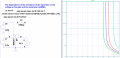
The threshold voltage of the transistor depends on the voltage of the Source-Substrate. The dependency parameter is Gamma. When Gamma = 0, there is no change in the threshold. In the figure, this is the first curve. You can see that the drop in resistance starts at 3.5 V. This is 2.5 + 1. When Gamma> 0, the inclusion of the transistor occurs later, due to the fact that the threshold is increased. I took 4 gamma values: 0, 0.25, 0.5, 1. Learn the theory of MOS transistors. At least Level = 1.
 
Top