Do dimmer switches "leak" voltage?

Thread Starter

mrmr1313

Joined Oct 25, 2019
3
I was installing a pendant light today in my home in a location which was already wired and capped. The light being installed is controlled by a dimmer switch. With the switch turned off, I checked the voltage at the location where I would install the light and my DMM read about 40 VAC. Just to be sure I had the right switch, I turned it on and saw 120 VAC. My question is: Is this normal? Do dimmer switches have voltage differential across their outputs, even when off? Or is this switch defective and needing replacement?

I completed the job (after switching off power to the circuit at the circuit breaker so that I saw 0 VAC where I'd be working instead of 40 VAC) and when the switch is off, there is no light emitted by the bulb at the pendant.

By the way, this is an old style dimmer switch, not LED compatible.
 

LesJones

Joined Jan 8, 2017
4,511
When it is in the fully off position the circuit is probably broken by a mechanical switch. Try disconnecting one of the wires to the dimmer switch AT THE SWITCH ITSELF. I suspect the reading you are getting is due to capacitance between the wires going to the switch. Show use EXACTLY how the wires are run to the light fitting and switch including which wires are close together. I.E run in the same conduit, capping or ducting.

Les.
 

DickCappels

Joined Aug 21, 2008
10,661
Does the switch have an action separate from the dimming action. For example does the actuator turn to dim and push for on/off, or is there a click at the end of rotation, or a separate switch? If not, then turning it off might only mean turning the dimmer to minimum, in which case you will the 120 VAC through the leakage of the traic.

Looking at the datasheet for a 1 amp triac, it says that there can be as much as 20 microamps of leakage through the device while it is off. What is the input impedance of the instrument (DMM?) that you used to measure the voltage?
 

Thread Starter

mrmr1313

Joined Oct 25, 2019
3
Does the switch have an action separate from the dimming action. For example does the actuator turn to dim and push for on/off, or is there a click at the end of rotation, or a separate switch? If not, then turning it off might only mean turning the dimmer to minimum, in which case you will the 120 VAC through the leakage of the traic.
The switch itself is a slide switch with a click at the bottom of the slide mechanism to turn it fully off. In addition, there is a "nightlight" feature built into the switch, i.e. a small light built into the switch that gets dimmer as the slide pushes more power to the output.

Looking at the datasheet for a 1 amp triac, it says that there can be as much as 20 microamps of leakage through the device while it is off. What is the input impedance of the instrument (DMM?) that you used to measure the voltage?
Not sure about the DMM impedance. I don't see that listed on the device. It is a Radio Shack hand held, battery operated DMM. Cat. No. 22-810
 

DickCappels

Joined Aug 21, 2008
10,661
I have several and the cheapest is 1 Meg Ohm, though I did not know that at the time :-( .

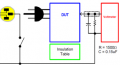
Maybe the only question left is whether there is enough leakage current to worry about.
1572073004587.png
The setup above can be used to measure leakage (use the AC volts scale), it can be used to measure from Line or Neutral to Ground or between Line and Neutral.

Personally, I greatly dislike even the mildest shock and even though workers at my house work on the line while it is hot, I always pull the main breaker when I have to do things like change lamp ballasts or replace light switches. Better to be safe than dead.
 

Thread Starter

mrmr1313

Joined Oct 25, 2019
3
Thanks for your help with this. It sounds like the voltage reading I measured was likely from leakage current, not a faulty dimmer switch, which was my primary concern. Like you, when I saw a voltage reading on the line, I shut down the circuit at the breaker to eliminate it. Yesterday, I helped a neighbor replace a chandelier that was also on a dimmer and found that my DMM measured roughly the same VAC on the output of their dimmer when it was off (before flipping the circuit breaker), so that furthered my confidence that my dimmer switch wasn't defective.
 
Top