Voltage sources in nodal analysis

Thread Starter

Benjamin Stjerndorff

Joined May 17, 2018
2
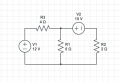
Hello, I'm trying to wrap my head around nodal analysis. Whenever I find a voltage source in some situation I haven't encountered I can't seem to confidently figure out a strategy to my analysis. I attached a png of an example. Usually with practice you get some intuition for what's going on but electronics/circuit analysis is elusive to me.

I forgot labelling the nodes in the png but let's say I got node a, b, c on the top and ground, d, on the bottom and I'm supposed to solve for voltage on node b. I start writing an expression for node b but get stuck on the 10V and 2ohm resistor: (Va - Vb)/4 + (Vb-Vd)/6 + (??) = 0. I try supernodes around the voltage sources but then I just end up with two equations that are the same. I guess next I could try superposition but this problem isn't supposed to involve that.

A pointer to where I should begin on this or anything would be great!

EDIT: About resistors and voltage: if a resistor is before or after a voltage source, does the expression differ? Afaik the current should be the same through the branch, right?
 

Attachments

Last edited:

WBahn

Joined Mar 31, 2012
32,706
Hello, I'm trying to wrap my head around nodal analysis. Whenever I find a voltage source in some situation I haven't encountered I can't seem to confidently figure out a strategy to my analysis. I attached a png of an example. Usually with practice you get some intuition for what's going on but electronics/circuit analysis is elusive to me.

I forgot labelling the nodes in the png but let's say I got node a, b, c on the top and ground, d, on the bottom and I'm supposed to solve for voltage on node b. I start writing an expression for node b but get stuck on the 10V and 2ohm resistor: (Va - Vb)/4 + (Vb-Vd)/6 + (??) = 0. I try supernodes around the voltage sources but then I just end up with two equations that are the same. I guess next I could try superposition but this problem isn't supposed to involve that.

A pointer to where I should begin on this or anything would be great!

EDIT: About resistors and voltage: if a resistor is before or after a voltage source, does the expression differ? Afaik the current should be the same through the branch, right?
You need to show more work in order for us to spot where your difficulty lies.

The equation you give above also has an error in it. The first term gives the current flowing toward not b but the second term is the current flowing away from node b. Remember that nodal analysis is just a systematic way of aplying KCL to a circuit. So decide up front if you are going to solve for the sum of the currents entering the node or the sum of the currents leaving the node, and then be consistent about it. Most people sum the currents leaving the node because that makes that node's voltage positive in every (normal) term.

If you swap V2 and R2 you can then solve for the node voltages of the modified circuit. The currents will be the same as the original circuit, but the node voltages, in general, won't. But once you know the currents, it's a straightforward matter to go back to the original circuit and get its node voltages.

To work with a supernode, draw a boundary around the nodes that make up the supernode. Then apply KCL to that boundary, using the proper node voltages for each node that leaves it. Then write auxiliary equations that apply the constraints between the various nodes that cross the boundary.

Give it a try and post your work (not just the bottom line).
 
Last edited:

Thread Starter

Benjamin Stjerndorff

Joined May 17, 2018
2
You need to show more work in order for us to spot where your difficulty lies.

The equation you give above also has an error in it. The first term gives the current flowing toward not b but the second term is the current flowing away from node b. Remember that nodal analysis is just a systematic way of aplying KCL to a circuit. So decide up front if you are going to solve for the sum of the currents entering the node or the sum of the currents leaving the node, and then be consistent about it. Most people sum the currents leaving the node because that makes that node's voltage positive in every (normal) term.

If you swap V2 and R2 you can then solve for the node voltages of the modified circuit. The currents will be the same as the original circuit, but the node voltages, in general, won't. But once you know the currents, it's a straightforward matter to go back to the original circuit and get it's node voltages.

To work with a supernode, draw a boundary around the nodes that make up the supernode. Then apply KCL to that boundary, using the proper node voltages for each node that leaves it. Then write auxiliary equations that apply the constraints between the various nodes that cross the boundary.

Give it a try and post your work (not just the bottom line).
Thanks for the reply. I did as you said and switched places on the voltage source and resistor on the right-hand branch and I was able to solve for the voltage on node b with correct results.

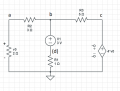
I moved on with another problem with a dependent voltage source and more confusion.

I switched places on the 3V and the 1ohm resistor, node (d) stays, and wrote expressions for the top middle node
Node b: (Vb)/5 + (Vb-Vd)/1 + (Vb-Vc)/5 = 0
with Vc = 4v_0, Vd = 3V

I get stuck at the v_0 dependence. I tried expressing it in terms of Vb:
Vb/5 = I_a =>
I_a*2 = v_0 =>
8Vb/5=v_0
and substituting into above but I get the wrong voltage.
 

Attachments

WBahn

Joined Mar 31, 2012
32,706
Thanks for the reply. I did as you said and switched places on the voltage source and resistor on the right-hand branch and I was able to solve for the voltage on node b with correct results.
That fine up to a point. What are you going to do when you get a problem on the exam where you can swap them and make it a lot simpler. You can pretty much count that they are going to give you a problem for which they expect you to demonstrate that you can use a supernode.

I moved on with another problem with a dependent voltage source and more confusion.
Which may indicate that you moved on too soon -- or it could be completely unrelated.

I switched places on the 3V and the 1ohm resistor, node (d) stays, and wrote expressions for the top middle node
Node b: (Vb)/5 + (Vb-Vd)/1 + (Vb-Vc)/5 = 0
with Vc = 4v_0, Vd = 3V

I get stuck at the v_0 dependence. I tried expressing it in terms of Vb:
Vb/5 = I_a =>
I_a*2 = v_0 =>
8Vb/5=v_0
and substituting into above but I get the wrong voltage.
Always ask if the answers (including intermediate answers) make sense.

You are claiming that v_o is significantly larger than Vb. Does that make sense?
 

shteii01

Joined Feb 19, 2010
4,644
(Va-12)/4+(Va-0)/6+(Va-10)/2=0

Two nodes.
One node is reference node so it is 0V.
That means you only have one "active" node that gets an equation.

One equation, one unknown, factor out the unknown, solve the equation for unknown. DONE!
 
Top