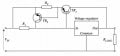
Voltage regulator with transistors

Thread Starter

bizuputyi

Joined Aug 3, 2014
21
What is the function and operation of R1, R2, TR1 and TR2?

I would say TR2 and R2 act as overcurrent protection and TR1 is a pass transistor. When the voltage drop in R2 gets large enough it turns on TR2 and controls base-emitter voltage of TR1.

Is this correct? How would you describe this neatly? And where does R1 come in?

Thank you for anyone's reply.
 

Attachments

studiot

Joined Nov 9, 2007
4,998
Listen to Alex and then look at both TR1 and TR2 and ask yourself what sets their base, emitter and collector voltage differences.
 

Thread Starter

bizuputyi

Joined Aug 3, 2014
21
As Vin increases, voltage across R1 increases, so does across R2, that turns on TR2, now current is diverted from the base of TR1, so collector-emitter resistance of TR1 will increase which will reduce load current to a value just enough to keep up voltage across R2 at turn-on value.
So the function of R1 is to control TR1 with the aid of R2, TR2 over-current protection.
How does that sound?
 

studiot

Joined Nov 9, 2007
4,998
As Vin increases, voltage across R1 increases,
Why?

How about As Iin increases, voltage across R1 increases, instead?

Try thinking about this.

1) Remove TR2 and short R2.

Can you see how this circuit works as a current booster for the regulator IC?

2)Now short the load.

What happens?

3)Now unshort the load and put TR2 and R2 back and again short the load.

What is different?
 
Last edited:

Thread Starter

bizuputyi

Joined Aug 3, 2014
21
Ohh, right, I'm getting there. Thank you for your new aspect. If R2 was shorted, TR2 wasn't there and the load was shorted it would probably irreversible damage the components. But R1 still drives TR1 (via R2, TR2) as Iin increases VR1 increases and will turn TR1 on to pass. Is that satisfactory in addition to the #1 comment?
 

studiot

Joined Nov 9, 2007
4,998
Ohh, right, I'm getting there. Thank you for your new aspect. If R2 was shorted, TR2 wasn't there and the load was shorted it would probably irreversible damage the components. But R1 still drives TR1 (via R2, TR2) as Iin increases VR1 increases and will turn TR1 on to pass. Is that satisfactory in addition to the #1 comment?
Yeah! you are getting there that is all exactly right

Now for the next bit about TR2
 

Thread Starter

bizuputyi

Joined Aug 3, 2014
21
So, the question is how TR2 protects the circuit from over-current. I guess when the load is shorted all the current will flow through R2 resulting in a voltage drop across it to turn TR2 on which will shorten its collector-emitter so no current will flow through R2. Is that correct?
 
Top