Voltage regulation and capacitor ground problem

Thread Starter

r92001r

Joined Oct 22, 2023
24
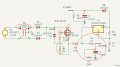
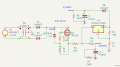
Revision after lan0 assist. Simplified some things and added bleeder resistors. I'm going to have to double check the voltage readings on the meter... these will work but the 3.9v zener should drop 3.9v instead of 10-15v... the ground issue is solved though.
PowerSupplyX2.png
 

Ian0

Joined Aug 7, 2020
13,131
Revision after lan0 assist. Simplified some things and added bleeder resistors. I'm going to have to double check the voltage readings on the meter... these will work but the 3.9v zener should drop 3.9v instead of 10-15v... the ground issue is solved though.
View attachment 305929
The total voltage drop across Q1 will be Vzener+Vgs, taking the value of Vgs from the graph in the datasheet of Vgs vs. I’d, and bearing in mind that Vgs can vary by as much as ±2V in addition to the variation due to the current.
What are you trying to achieve with the MOSFET circuit? If you want some sort of 24V pre-regulator circuit, use a 27V zener and interchange D2 and R1.
 

Thread Starter

r92001r

Joined Oct 22, 2023
24
The mosfet is allowing me to use a low power normal zener instead of bolt on expensive ones- this will have about 2A going through to feed a Class D power amp. Are you saying to remove the mosfet? would that require a 27v 60w zener?
 

Thread Starter

r92001r

Joined Oct 22, 2023
24
Your schematic drawing style (wire backtracks, extraneous connection dots, unusual component orientation/flow) makes it difficult to follow what you're trying to do.

Examples circled in red:
View attachment 305943
Sorry - backtracks and dots due to being new to kicad (less than a few hours use) and finding some of it nonintuitive. Component flow - I just draw it like I imagine it, and do not know what the proper accepted flow / orientation is. I’m still learning- hopefully.
 

Thread Starter

r92001r

Joined Oct 22, 2023
24
Sorry - backtracks and dots due to being new to kicad (less than a few hours use) and finding some of it nonintuitive. Component flow - I just draw it like I imagine it, and do not know what the proper accepted flow / orientation is. I’m still learning- hopefully.
In short I’m trying to take a 48vct transformer with 2-3 amps available, and create both a 29v and 18v rail. The 18v rail needs to handle 2-3amps. That’s it really.
 

Ian0

Joined Aug 7, 2020
13,131
The mosfet is allowing me to use a low power normal zener instead of bolt on expensive ones- this will have about 2A going through to feed a Class D power amp. Are you saying to remove the mosfet? would that require a 27v 60w zener?
Power amplifiers very rarely require a regulated supply.
If you use a linear regulator of any kind, you immediately lose all the advantages of a class-D amplifier. Regardless of what method you use to reduce the supply voltage , it will always generate the same amount of heat.
If you want a 29V supply, then use a 22-0-22V transformer.
 

dl324

Joined Mar 30, 2015
18,326
backtracks and dots due to being new to kicad (less than a few hours use) and finding some of it nonintuitive. Component flow
Hand drawn schematics are acceptable.
I just draw it like I imagine it, and do not know what the proper accepted flow / orientation is. I’m still learning- hopefully.
  1. The preferred flow is primarily left-to-right and top-to-bottom.
  2. Wires multiples of 90 degrees unless other angles make more sense (like bridge rectifiers, flip flops, etc).
  3. Don't draw wires over components or text. In general, don't overlap things.
  4. Use connection dots or humps consistently. If you use humps, don't use connection dots (thankfully that style went out of favor about 50 years ago).
  5. On functional blocks, inputs should be primarily on the left and outputs primarily on the right.
  6. Monochromatic schematics with no grid. In general, color coding wires and components looks amateurish and is a distraction if the colors don't mean anything.
  7. Components would typically be placed vertically, but there are cases where horizontal makes more sense.

You learn by being taught how or by emulating well drawn schematics. Datasheets are usually a good resource, but I've seen some "professionally" drawn schematics that were lacking.
In short I’m trying to take a 48vct transformer with 2-3 amps available, and create both a 29v and 18v rail.
That 29V circuit seems like a hack to me. I'd've gone with a commercial regulator. If the input voltages are too high, there are some generally accepted ways to drop the voltage (power zener diodes, pre-regulators, etc).
 
Last edited:

Thread Starter

r92001r

Joined Oct 22, 2023
24
Hand drawn schematics are acceptable.

  1. The preferred flow is primarily left-to-right and top-to-bottom.
  2. Wires multiples of 90 degrees unless other angles make more sense (like bridge rectifiers, flip flops, etc).
  3. Don't draw wires over components or text. In general, don't overlap things.
  4. Use connection dots or humps consistently. If you use humps, don't use connection dots (thankfully that style went out of favor about 50 years ago).
  5. On functional blocks, inputs should be primarily on the left and outputs primarily on the right.
  6. Monochromatic schematics with no grid. In general, color coding wires and components looks amateurish and is a distraction if the colors don't mean anything.
  7. Components would typically be placed vertically, but there are cases where horizontal makes more sense.

You learn by being taught how or by emulating well drawn schematics. Datasheets are usually a good resource, but I've seen some "professionally" drawn schematics that were lacking.
That 29V circuit seems like a hack to me. I'd've gone with a commercial regulator. If the input voltages are too high, there are some generally accepted ways to drop the voltage (power zener diodes, pre-regulators, etc).
Thank you for all that info!! Yes it’s a hack I suppose- I guess I could have gone for an lm338 for the 29v. Any issues with using and lm350 to get the 18v after the lm338?
 

Thread Starter

r92001r

Joined Oct 22, 2023
24
Power amplifiers very rarely require a regulated supply.
If you use a linear regulator of any kind, you immediately lose all the advantages of a class-D amplifier. Regardless of what method you use to reduce the supply voltage , it will always generate the same amount of heat.
If you want a 29V supply, then use a 22-0-22V transformer.
Well part of the whole purpose is to make use of a 58VCT heavy transformer I already have. I don’t particularly need regulated voltage, just a 29v and 18v rail. Is there a better method to meet the objective using rc filters? Something else? Any value suggestions for the r and c? No matter what this is teaching me stuff so is a worthwhile effort.
 

Ian0

Joined Aug 7, 2020
13,131
Well part of the whole purpose is to make use of a 58VCT heavy transformer I already have. I don’t particularly need regulated voltage, just a 29v and 18v rail. Is there a better method to meet the objective using rc filters? Something else? Any value suggestions for the r and c? No matter what this is teaching me stuff so is a worthwhile effort.
Is it 58V with a centre tap, as in 29-0-29V or is it 58-0-58V?
 

dl324

Joined Mar 30, 2015
18,326
I guess I could have gone for an lm338 for the 29v. Any issues with using and lm350 to get the 18v after the lm338?
What current do you need from each voltage?

You said the 29V didn't need to be well regulated. What voltage range do you want?

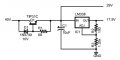
EDIT: Here's a simple circuit. Protection diodes and caps omitted for clarity.
1698352189876.png
Power zener circuit from National Semiconductor.

Q1, R1, D1 form a power zener that will drop the unregulated input by 11V. Q1 will carry the full current and TIP30 is only rated for 1A, and it needs a heatsink (as does the voltage regulator).

I noticed you had a diode on the output of the voltage regulator. That's a bad idea. If you need to lower the voltage, change R4. If a standard value won't get you the voltage you want, use a pot or parallel resistors.
 
Last edited:

Thread Starter

r92001r

Joined Oct 22, 2023
24
What current do you need from each voltage?

You said the 29V didn't need to be well regulated. What voltage range do you want?

EDIT: Here's a simple circuit. Protection diodes and caps omitted for clarity.
View attachment 305978
Power zener circuit from National Semiconductor.

Q1, R1, D1 form a power zener that will drop the unregulated input by 11V. Q1 will carry the full current and TIP30 is only rated for 1A, and it needs a heatsink (as does the voltage regulator).

I noticed you had a diode on the output of the voltage regulator. That's a bad idea. If you need to lower the voltage, change R4. If a standard value won't get you the voltage you want, use a pot or parallel resistors.
Awesome! The 29v only needs 500mA max. It’s the 18v that needs 2-3A
 

dl324

Joined Mar 30, 2015
18,326
Awesome! The 29v only needs 500mA max. It’s the 18v that needs 2-3A
A TIP150 will handle 7A. You don't need the high voltage breakdown, but that's what came to mind because I use them in some of my designs.

The transistor and regulator will both be dissipating up to 30W, so they'll need appropriate heat sinks.
 

Ian0

Joined Aug 7, 2020
13,131
The fixed-voltage-drop circuit (Q1,D1,R1) makes the voltage regulation worse, rather than better. A ±6% variation on the mains supply will give a ±2.5V variation on the output from the transformer, which is still a ±2.5V variation on the 29V DC supply, which is now an 8.5% variation.
 

Thread Starter

r92001r

Joined Oct 22, 2023
24
The fixed-voltage-drop circuit (Q1,D1,R1) makes the voltage regulation worse, rather than better. A ±6% variation on the mains supply will give a ±2.5V variation on the output from the transformer, which is still a ±2.5V variation on the 29V DC supply, which is now an 8.5% variation.
Well thats a little yucky. Aside from buying the right transformer or using bolton $20 zeners is there a solution with a little less voltage swing? I think I read somewhere it is not a good idea to use 2 regulators in one circuit i.e. say an lm338 to go from 40v to 29v and then an lm350 to go from 29v to 18v... Side note- If needed I have a few giant heatsinks that came from the same device the transformer came from (old Bogen solid state).
 

Ian0

Joined Aug 7, 2020
13,131
Well thats a little yucky. Aside from buying the right transformer or using bolton $20 zeners is there a solution with a little less voltage swing? I think I read somewhere it is not a good idea to use 2 regulators in one circuit i.e. say an lm338 to go from 40v to 29v and then an lm350 to go from 29v to 18v... Side note- If needed I have a few giant heatsinks that came from the same device the transformer came from (old Bogen solid state).
What are you trying to achieve with the MOSFET circuit? If you want some sort of 24V pre-regulator circuit, use a 27V zener and interchange D2 and R1.
 
Top