Voltage inverter

Thread Starter

Kelvin Lee

Joined Oct 22, 2018
111
Dear Sir/Madam,

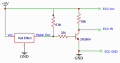
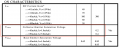
Due to my special requirement, I need to have a pedal to provide a range of voltage to an ECU, unfortunately, the pedal provides 5V when not step down, I need to have a circuit to invert the voltage output from the pedal before the ECU. A friend gave me a circuit but I tried and the voltage output can only several amounts of mA, I refer to the datasheet of 2N3904, the Vce can only provide max 0.4V, I think I have to change another transistor but don't know which one is suitable to my case, do any once can help?

Best regards,

KelvinScreenshot 2019-08-27 at 11.59.27 AM.png
Screenshot 2019-08-27 at 12.39.44 PM.png
 

crutschow

Joined Mar 14, 2008
38,504
Tell us exactly what ECU voltage you need for the voltage from the pedal out.
Do you want 0V for a 5V pedal and 5V for a 0V pedal?

What is the ECU load resistance or current requirement?
 

Picbuster

Joined Dec 2, 2013
1,058
Dear Sir/Madam,

Due to my special requirement, I need to have a pedal to provide a range of voltage to an ECU, unfortunately, the pedal provides 5V when not step down, I need to have a circuit to invert the voltage output from the pedal before the ECU. A friend gave me a circuit but I tried and the voltage output can only several amounts of mA, I refer to the datasheet of 2N3904, the Vce can only provide max 0.4V, I think I have to change another transistor but don't know which one is suitable to my case, do any once can help?

Best regards,

KelvinView attachment 184847
View attachment 184846
The 2n3904 has a saturation of 0.4V at an ib of 5mA.
Meaning: the voltage between Emitter and Collector can't get lower than .4V
That includes with a 5V power supply the E-C voltage could run from 0.4V to 5V.
Running from zero is, using circuit above, not possible.
We need more info as requested by Crutschow.

Picbuster
 

Bordodynov

Joined May 20, 2015
3,431
The problem can be solved using single element logic. For example, the SN74AHC1G14 Schmidt trigger. Instead of two resistors and a transistor, one small chip. And "zero, low signal" you will have 0 volts.
 

Thread Starter

Kelvin Lee

Joined Oct 22, 2018
111
Tell us exactly what ECU voltage you need for the voltage from the pedal out.
Do you want 0V for a 5V pedal and 5V for a 0V pedal?

What is the ECU load resistance or current requirement?
Sorry for my late reply. I use the multimeter to test from step up to down, the voltage change from 3.736V to 0.802V and current is from 2.48mA to 0.54mA, I need to invert the voltage from low to high when stepping up to down.

Please note the power supply for the pedal is from the ECU which is 4.565V

Why can't you just do the inversion in software?
Yes, I did it using Arduino but now we need to have a circuit to do.

The problem can be solved using single element logic. For example, the SN74AHC1G14 Schmidt trigger. Instead of two resistors and a transistor, one small chip. And "zero, low signal" you will have 0 volts.
Thanks, Bordodynov, this is the first time I hear about it, may I know if I give 4V input what is the output voltage?
 
Last edited by a moderator:

Bordodynov

Joined May 20, 2015
3,431
With a power supply of 4.565 V and an input signal of 4 V, the output of the microcircuit will be 0 V. If you need a digital output and some specific threshold, then you can use a comparator. Another possibility when using the Schmidt trigger is to eliminate switching bounce. To do this, you need to put a capacitor at the input of the microcircuit and that's it.
 

Thread Starter

Kelvin Lee

Joined Oct 22, 2018
111
With a power supply of 4.565 V and an input signal of 4 V, the output of the microcircuit will be 0 V. If you need a digital output and some specific threshold, then you can use a comparator. Another possibility when using the Schmidt trigger is to eliminate switching bounce. To do this, you need to put a capacitor at the input of the microcircuit and that's it.
Thanks, but it is too complicated to me.
 

BobTPH

Joined Jun 5, 2013
11,515
An opamp is far superior to any transistor circuit you are likely to make. Basically you would have to make an opamp from transistors to do what you want using discrete components.

Bob
 

Thread Starter

Kelvin Lee

Joined Oct 22, 2018
111
An opamp is far superior to any transistor circuit you are likely to make. Basically you would have to make an opamp from transistors to do what you want using discrete components.

Bob
Thanks, Bob but I am a newbie to this, no idea to the opamp you mentioned.
 

BobTPH

Joined Jun 5, 2013
11,515
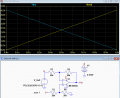
An opamp is the triangle in @crutschow’s circuit in post #10. They come in many flavors. You would need a single supply opamp like the LM358. The circuit is easily adjusted to output 3.5-0V with 0-5V input.

Bob
 

Thread Starter

Kelvin Lee

Joined Oct 22, 2018
111
An opamp is the triangle in @crutschow’s circuit in post #10. They come in many flavors. You would need a single supply opamp like the LM358. The circuit is easily adjusted to output 3.5-0V with 0-5V input.

Bob
Many thanks, Bob, I understand the opamp solution is better than using a transistor, as this is a student project, it may not be the perfect solution but we do have limited resource, can we simply replace another transistor and make it done? This solution may not be accepted by the most experienced circuit designer.
 

Alec_t

Joined Sep 17, 2013
15,118
You would need a single supply opamp like the LM358. The circuit is easily adjusted to output 3.5-0V with 0-5V input.
..... but the LM358 input voltage must be at least a couple of volts (approx) below the +ve rail, implying you'd need a supply voltage >=7V.
 

crutschow

Joined Mar 14, 2008
38,504
can we simply replace another transistor and make it done? This solution may not be accepted by the most experienced circuit designer.
It's not a matter of acceptance.
It's performing that function reasonably well with just a couple transistors.

What is the exact input voltage range you have for a 0V to 3.5V output?
 
Last edited:

crutschow

Joined Mar 14, 2008
38,504
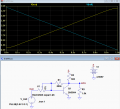
Okay, here's a single transistor quick and dirty circuit that will likely be frowned upon by many but it's simple.
The circuit function uses the value of transistor current gain (Beta) for its operation and is thus significantly affected by the gain of the particular transistor you use (since the gain can typically vary by a a 3:1 range unit-to-unit).
This means you will have to tweak the 250k Ω pot U1 and possibly the value of R1 to get the desired transfer function.
The circuit is also sensitive to ambient temperature so, if that varies significantly, the circuit may not perform satisfactorily for your application.

upload_2019-8-27_10-48-9.png
 
Last edited:
Top