voltage divider circuit with potentiometer, trouble finding a voltage drops

Thread Starter

groundcontrol

Joined Sep 1, 2015
24
Hi there,

I am trying to find out what the voltage drops are across RC. My confusion lies in the fact that the total current changes every time you adjust the potto a new position.. Is it possible to solve for individual branch current without knowing total current?

I am attempting to take 11 measurements; a 1K pot in 11 positions including the position '0' as 1st position.

I hope someone can help me out with this please..??

Here's the info..

RA (pot) 1Kohm
RB 470ohm
RC 3.8K

I've calculated that total current when the pot is lowest resistance (0 Ohms) IT MAX = 0.215A
I've calculated that total current when the pot is highest resistance (1K Ohms) IT MIN =0.006347A

I have solved for the voltage drops in all 11 positions across the pot RA but I can't seem to make this work no matter what I do.

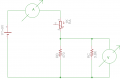
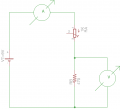
i've attached the circuit diagram
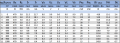
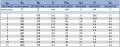
and also the table I'm creating so far (with a big empty column staring at me !!)
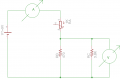
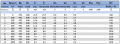
Combination Circuit Diagram vertical.png TABLE CIRCUIT 2  combo RB measured 1.png I hope someone is out there who is up for it !??

Thank you :)
 
Last edited:

Thread Starter

groundcontrol

Joined Sep 1, 2015
24
Hi, the parallel combination of RB and RC combined together I calculated as 418 ohms. I'm trying to figure out if you're asking me that or if its a hint ..?

thank you for looking at it for me
 

Thread Starter

groundcontrol

Joined Sep 1, 2015
24
I can see how VA + VB = 9V (series; VT = V1 + V2)

but I am struggling to see what VA has to do with VC's voltage .. KVL is about all equaling zero in a closed loop right.. but i can't see how VA and VC could be in the same closed loop as RB is separating them.. argh what am i missing?
 

KJ6EAD

Joined Apr 30, 2011
1,581
What am I missing?
Properties of parallel circuits (like RB & RC).

A Parallel circuit has certain characteristics and basic rules: A parallel circuit has two or more paths for current to flow through. Voltage is the same across each component of the parallel circuit. The sum of the currents through each path is equal to the total current that flows from the source.

You should have all you need. I have to go apply some of this at work now.
 

Thread Starter

groundcontrol

Joined Sep 1, 2015
24
Right so if VA = VB (rule; VT= V1 = V2 = V3 parallel)

VA + VB = VT (series rule)

since VA=VB then VA + VC = VA + VB which = VT.

Please let me know if I'm on the right path? Im still thinking about it all and trying to relate it. I should probably mention the reason I am doing this problem in the first place it to try and understand what happens with an unloaded voltage divider circuit vs a loaded one. I think the main ref point of interest is actually across the pot but I'm not sure and trying to cover all bases - and helpfully not thoroughly confuse myself along the way ...?!? heh .. Just in case I really am going off in a irrelevant direction .. not that there is really such a thing as irrelevant with all this tehe, its all enough to blow your mind and i've less than scratched the surface!
 

Thread Starter

groundcontrol

Joined Sep 1, 2015
24
hello again, I'm sorry but i have to go to bed now its 1:30am here, i've been at this all day (and week) and I have school tomorrow just really wanted to try and understand this circuit. Thank you so much for your time and hints, I will mull them over and keep going on it tomorrow and hopefully get there :) thanks again!
 

Thread Starter

groundcontrol

Joined Sep 1, 2015
24
Loaded TABLE 2 CIRCUIT 2 MASTER  combo RB measured 1 USE THIS.png Unloaded CIRCUIT 1 TABLE 1 MASTER.png
If VA is a voltage drop across a POT then Vbat = VA + VB or Vbat = VA + VC because VB = VC (parallel connected)
http://forum.allaboutcircuits.com/threads/voltage-divider.66769/#post-463335
Hi Jony130,
Thanks for this link and info. I have been able to apply this and complete my table of values, finally :)
I followed on in the thread of the link you suggested and would like to check that I am interpreting the results correctly if thats ok with you please..?

Unloaded vs Loaded Voltage divider circuits; here goes.. (you may recognise some of this info as this site is my main reference - i have learnt more here than in class, easily).

*All series circuits are voltage dividing circuits, similarly all parallel circuits are current diving circuits.
* Voltage drop across each resistor is proportional to its resistance, given that the current is the same through all resistors. The current increased when the load was applied (resistance decreased) therefor the voltage drop also .... THIS IS WHERE I NEED HELP PLEASE:


As the load increases the output voltage decreases in voltage. IF THE OUTPUT VOLTAGE DECREASES DOES THAT MEAN THE 'VOLTAGE DROP DECREASES'?

Unloaded = more voltage drop (voltage drop increases)
Loaded = less voltage drop (voltage drop decreases)


IS THIS RIGHT? I feel like somethings gone wrong here because in ohms law;


More current = more voltage
… but less resistance = less voltage.
The loaded voltage divider does both at the same time; less resistance and more current ..


Please help me clarify what’s happening here? Is voltage output the same as voltage drop?


Going from Q16.

Unloaded , voltage output = 2.5V
Loaded voltage output = 1.29V


The above loaded output voltage is a DECREASE in voltage drop compared to the Unloaded voltage output isn't it?? Because the volts have gotten smaller? Or is it that it’s a bigger voltage drop because its even further away from the source voltage value? Maybe that’s whats confusing me so much in trying to straighten this relationship out!?


OHMS Law says that;
Decrease in resistance, current stays same = decrease in voltage
Increase in current, resistance stays same = increase in voltage


Here is a copy of my (finished :D) UNLOADED Voltage Divider Circuit table of results Table 1, and my LOADED Voltage Divider Circuit Table of results Table 2. Even after all that I am having a hard time interpreting them solidly :/ sigh I MUST KNOW PLEASE HELP?


note, I am mainly basing this train of thought on my own experiment and also the results indicated from the help you gave regarding the below question (which was in the thread of the link you gave me - thanks again!

Question 16
I understand that the wiper @25% sets the equivalent resistance of the pot to 1K25Ω . I then used the voltage divider formula and got Vout to equal 4.44V.
However the answer given is 1.29V.


I'm really hoping that some of my thinking is correct. I really hope I can get to a point that this experiment ends up truly making sense in my brain. I hope you don't mind looking over this and helping me establish a few fundamentals a bit better. I've totally confused myself. Thanks again so much !!!
 

Thread Starter

groundcontrol

Joined Sep 1, 2015
24
I hope I'm not putting to much up to go through .... I hope its ok to add the two voltage divider circuit diagrams in question. I thought maybe they'd be helpful.. i hope so

Thanks again Combination Circuit Diagram vertical.pngSeries Circuit Diagram vertical.png
 

Jony130

Joined Feb 17, 2009
5,598
First of all
The "voltage drop" has two meanings.
1 - the "voltage drop" as a drop in voltage level, eg. the battery voltage drop by 0.1V when we connect a load resistance to it.
2 - "voltage drop" as a voltage present across an external component. So if we have a circuit with a 5V battery and one 10 ohm resistor connected across this battery. We can say that the voltage drop across the resistor is equal to 5V. Witch means that the voltage across the resistor is 5V
http://www.ittc.ku.edu/~jstiles/312/handouts/312_Introduction_package.pdf (page 3 to 11)

The current increased when the load was applied (resistance decreased) therefor the voltage drop also
Its depend on a circuit topology. In some places the current will increases but in some other part of a circuit the current will decrease.
As the load increases the output voltage decreases in voltage. IF THE OUTPUT VOLTAGE DECREASES DOES THAT MEAN THE 'VOLTAGE DROP DECREASES'?
"in voltage" this part is not needed.

Going from Q16.
Unloaded , voltage output = 2.5V
Loaded voltage output = 1.29V

The above loaded output voltage is a DECREASE in voltage drop compared to the Unloaded voltage output isn't it??
I would say that the output voltage drop from 2.5V to 1.29V after we connect the load resistance. Why? Because equivalent resistance drop in value.
Requ = R2||Rload. All this means that the current drown from the battery will also to increase. So the larger current will now flow through R1 resistor...larger current means larger voltage drop across R1 resistor. This means that there is a less voltage for (Vbat = V1 + V2) R2||RL and this is why Vout decrease. Or the output voltage drops because now IR1 current must divide into two branches (R2 and Rload).

Decrease in resistance, current stays same = decrease in voltage
Increase in current, resistance stays same = increase in voltage
Yes
 

Thread Starter

groundcontrol

Joined Sep 1, 2015
24
Thank you SO much for your response !!! I am running out the door I haven't stopped the last 24 hours or so , have printed your reply and will respond later on when I have something to say ... this is not my actual response but I just wanted to say THANK YOU :)
 

atferrari

Joined Jan 6, 2004
5,012
do you mean the way O've got it hooked up in the diagram, as in connected to the 1st and 2nd leg? I'm sorry I'm not sure what you mean by the OP ..? sorry can you reword that please?
Hola groundcontrol

OP means "original post" (your first post in this case).

What I say is, that for you, at this stage of your learning you should show the pot properly connected. See the attachment, where both ways, in fact, work the same for your problem.

Have you the chance to implement this in a protoboard? Not to replace the calculations but, to help you in "seeing" things, it would be good.

One practical tip: if you already know that two resistors in parallel have an equivalent value that is not going to change, work out the equivalent resistor first and use it in the calculations: it simplifies how you will see the circuit. Then it would be reduced to a simple resistive voltage divider.

And do not forget, whatever current enters "through the top" will leave "through the bottom" so to speak.
 

Attachments

Top