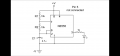
Pin 2 and 6 are supposed to detect voltage changes as the capacitor fills/drains, but how does the capacitor really change the voltage? If a capacitor drains, does the voltage increase or decrease and why?
The capacitor doesn't change the voltage.
The voltage on the capacitor changes as charge is added and removed.
When charge is removed, the capacitor voltage decreases.
When charge is added, the capacitor voltage increases.
This is given by the formula V = Q/C where Q is the capacitor charge is coulombs and C is the capacitance.
The total Q transferred into or out of the capacitor = I*t where I is current in amperes and t is time in seconds.
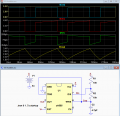
Below is the LTspice simulation of your circuit illustrating the charge and discharge of the capacitor:
The capacitor voltage (yellow trace) decreases (discharges) when the DIS input is low (red trace) and increases (charges) when the DIS input is open (high).
The current into and out of the capacitor through R2 is shown by the green trace (plus current is into and minus current is out of the capacitor).
If you are new to resistors and capacitors then a convenient way to look at the charge and discharge through a resistor is by the concept of a "Time Constant". The time constant of a regular RC circuit is:
TC=R*C
and that is the time it takes to charge to 63.2 percent of the power supply voltage.
If it is discharging, it is the time it takes to reach 36.8 percent of the starting voltage across the cap.
After 5 time constants the capacitor is though of as being almost fully charged or fully discharged.
An interesting consequence of this rule of the time constant is that after the first time constant charging up to 63.2 percent of the power supply voltage, the next time constant takes the voltage up another 63.2 percent of the remaining difference between the 63.2 percent and the supply voltage.
For discharging, the first time constant takes the voltage down to 36.8 percent of the starting voltage, and the second time constant takes it down another 36.8 percent, and the third another 36.8 percent, etc., until the voltage is nearly equal to zero then we dont care too much anymore.
For clarification of MrAl’s post above; in the time constant formula the resistance is the value in ohms and the capacitance in Farads. Or alternatively if the resistance is in meg-ohm then the capacitance is in µF.
It's also a little interesting that for the cap to discharge to exactly 1 percent of it's initial value it takes exactly ln(100) time constants (about 4.605 time constants).
ln(x) being the natural log function.
And to get to exactly 99 percent of its final value for the cap charging it also takes exactly
ln(100) time constants.

 Facebook
 Google
 GitHub
 Linkedin