Facebook
 Google
 GitHub
 Linkedin
I am helping a guy in the Midwest who restores vintage tractors to restore a 1969 Versatile (Canadian) D100 tractor. It has a Ford diesel engine and its tachometer was made by Smiths Instruments in England. The input to the tachometer comes from a reluctor style sensor that reads a 6 tooth rotor that spins at 1/2 the rate of the engine. That means that there are 3 pulses per rev, the same as a 6 cylinder, 4 stroke gas engine.
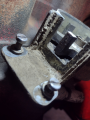
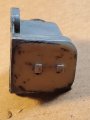
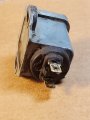
The system was not working when it was removed from the tractor. The tachometer and sensor were sent to me in California to see if I could fix it. Here is how the sensor looks:
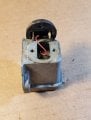
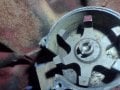
I opened the sensor by removing the connector screws to expose the internal wiring and I saw that one of the wires had broken, presumably doe to vibration over the years. I repaired the broken wire, put it back together and moved on to the tachometer itself.
I connected a gear driven reluctor style vehicle speed sensor from a 1994-98 Mustang to the tachometer, powered it up and spun the sensor gear with my fingers and saw that the tachometer was working. I connected my function generator to the tachometer using a 10uF cap to block the DC and am able to calibrate the tachometer on the bench.
Now I want to be able to test the Smiths sensor with the tachometer, so my task is to fabricate a rotor that can cause the sensor to trigger the tachometer.
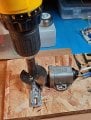
My first attempt was to put a carriage bolt through a hose bib handle and put it in my drill to create a small rotor:
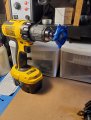
I tried it using a Output Shaft Speed reluctor sensor from a 1999-2004 Mustang and was able to get the tachometer needle to move. But when I switched to the Smiths sensor, while I could see a small sine wave on the scope, it didn't have the amplitude needed to trigger the tachometer. I am pretty sure that I need larger teeth on the rotor to be able to trigger the tachometer.
But that got me to start wondering about the construction of these reluctor sensors.
The Mustang OSS sensor has one bit of metal protruding from the face of the sensor, while the Smiths sensor has two bits of metal protruding from the face.
My theory was that the OSS sensor has a bar magnet in it and the Smiths sensor had a U-shaped magnet in it with the 2 metal bits being the ends of the U.
I know for a fact that there are magnets in the sensors and that the teeth in the tractor rotor are not magnetized. As an experiment, I held a compass next to the OSS face with the face to the east of the compass and the compass needle aligned with the metal bit on the face of the sensor.
I then ran the same experiment with each of the metal bits of the Smiths sensor with the following results:
OSS:
Smiths top: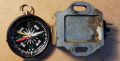
Smiths bottom: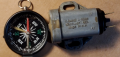
I was not shocked to see the compass needle point away from the top metal bit in the Smiths sensor, but I was shocked to see the compass move to 90 degrees away from the bottom metal bit. I rotated the whole experiment 90 degrees to make sure that the earth's magnetic field was not the culprit and it was not.
Can anyone explain to me how this sensor could be constructed to cause the 90 degree field near the bottom metal bit? I am baffled and have not been able to find much about the construction of sensors like this on the internet.
The system was not working when it was removed from the tractor. The tachometer and sensor were sent to me in California to see if I could fix it. Here is how the sensor looks:
I opened the sensor by removing the connector screws to expose the internal wiring and I saw that one of the wires had broken, presumably doe to vibration over the years. I repaired the broken wire, put it back together and moved on to the tachometer itself.
I connected a gear driven reluctor style vehicle speed sensor from a 1994-98 Mustang to the tachometer, powered it up and spun the sensor gear with my fingers and saw that the tachometer was working. I connected my function generator to the tachometer using a 10uF cap to block the DC and am able to calibrate the tachometer on the bench.
Now I want to be able to test the Smiths sensor with the tachometer, so my task is to fabricate a rotor that can cause the sensor to trigger the tachometer.
My first attempt was to put a carriage bolt through a hose bib handle and put it in my drill to create a small rotor:
I tried it using a Output Shaft Speed reluctor sensor from a 1999-2004 Mustang and was able to get the tachometer needle to move. But when I switched to the Smiths sensor, while I could see a small sine wave on the scope, it didn't have the amplitude needed to trigger the tachometer. I am pretty sure that I need larger teeth on the rotor to be able to trigger the tachometer.
But that got me to start wondering about the construction of these reluctor sensors.
The Mustang OSS sensor has one bit of metal protruding from the face of the sensor, while the Smiths sensor has two bits of metal protruding from the face.
My theory was that the OSS sensor has a bar magnet in it and the Smiths sensor had a U-shaped magnet in it with the 2 metal bits being the ends of the U.
I know for a fact that there are magnets in the sensors and that the teeth in the tractor rotor are not magnetized. As an experiment, I held a compass next to the OSS face with the face to the east of the compass and the compass needle aligned with the metal bit on the face of the sensor.
I then ran the same experiment with each of the metal bits of the Smiths sensor with the following results:
OSS:
Smiths top:
Smiths bottom:
I was not shocked to see the compass needle point away from the top metal bit in the Smiths sensor, but I was shocked to see the compass move to 90 degrees away from the bottom metal bit. I rotated the whole experiment 90 degrees to make sure that the earth's magnetic field was not the culprit and it was not.
Can anyone explain to me how this sensor could be constructed to cause the 90 degree field near the bottom metal bit? I am baffled and have not been able to find much about the construction of sensors like this on the internet.