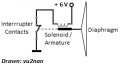
I've seen moped horns that operate on the principle of a magneto on a flywheel.
This is why it's worth reading the entire post.It may not be a DC horn, that's driven by a battery, but an AC one that's driven by a bike magneto.
Hi Daniel, looking at the set up of the horn it must be the square plate that makes the noise, but i would have thought it would need AC to work..Hi, sorry for the delay in replying, I have had family to stay. This s a video of how the horn was assembled.
https://photos.app.goo.gl/F9Qxj3EVmUNti2EX7
The TS has already reported that the diaphragm is pulled to the pole piece and held there until the power is removed.If it's generator powered then it must be getting a pulse from that generator. As the engine speeds up the pitch of the horn goes up. As the engine speed slows down the pitch of the horn goes down.
Quick test: Assemble it and tap the two wires to the battery. It should click and when you remove the wire you should see a serious spark. Don't be touching the bare wires when you do that or you'll curse my name. If that works then the horn is good according to how you're suggesting it works. OR you can take an ohm meter and check for continuity from terminal to terminal. Though I don't see any reason why, the horn wiring may have cracked and become an open circuit. An open circuit means there's no current flowing through the coil.
OK, so I don't know if the disc in the centre of the diaphragm is magnetic but I will check. The coil inside the horn does produce a magnetic field and does pull the diaphragm on to it until the power is released.If it's generator powered then it must be getting a pulse from that generator. As the engine speeds up the pitch of the horn goes up. As the engine speed slows down the pitch of the horn goes down.
Quick test: Assemble it and tap the two wires to the battery. It should click and when you remove the wire you should see a serious spark. Don't be touching the bare wires when you do that or you'll curse my name. If that works then the horn is good according to how you're suggesting it works. OR you can take an ohm meter and check for continuity from terminal to terminal. Though I don't see any reason why, the horn wiring may have cracked and become an open circuit. An open circuit means there's no current flowing through the coil.
One quick question: Is the diaphragm magnetic? I mean does metal stick to it? If so then when the AC sine wave goes one way the diaphragm will move similarly. When the AC sine wave switches and goes the other way so will the diaphragm. Basically - is there a magnet in the center of the diaphragm?
The disc will not be a magnet, but it will be a ferromagnetic material (at least partly iron). At this point I am convinced that the horn is expecting a pulsating DC or AC input. There is no provision for the switching required by an interruptor type horn.OK, so I don't know if the disc in the centre of the diaphragm is magnetic but I will check. The coil inside the horn does produce a magnetic field and does pull the diaphragm on to it until the power is released.
I will check the continuity between terminals.
What make and model is the motorcycle?No manual Dave, it was just figure out as I go - sorry.
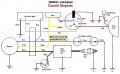
It makes sense: you are unlikely to really need the horn or lights without the engine running. It simplifies the electrical system by removing the battery and charging system.Here's a diagram from the Garelli service manuals, they all use the same method, AC for the horn and lights.
View attachment 308562
| Thread starter | Similar threads | Forum | Replies | Date |
|---|---|---|---|---|
|
|
Motorcycle turn signals and relay question | General Electronics Chat | 6 |
| Similar threads |
|---|
| Motorcycle turn signals and relay question |