This is an easier route to do what I asked about in my last post.
I don't need my own vibrating component if I use one I already have.
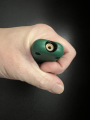
Now what I need is a BLE with battery that sends voltage through the RCA female jack as shown in the picture. In my hand is a part that does nothing but vibrate. It would have to be able to modulate, if I am using the correct word. I mean I need to be able to control how much voltage is sent in order to control the intensity of the vibrating motor in that part. Would that be a microcontroller that I need in order to send variable voltage to the vibrating motor? The microcontroller would control the voltage, and thus the intensity of the vibrating component in that green part.
That green peripheral doesn't have to send anything back to the central (iPhone). The peripheral does what the central tells it, which is either no voltage at all, or a variable strength of voltage.
Is there a way to do this without a microcontroller? If not what microcontroller do you recommend?
EDITED to correct that it's amplitude and not voltage that I determines the intensity of the vibrating component.
EDITED to say that the vibrating motor takes about 3 volts.
This is an easier route to do what I asked about in my last post.
I don't need my own vibrating component if I use one I already have.
Now what I need is a BLE with battery that sends voltage through the RCA female jack as shown in the picture. In my hand is a part that does nothing but vibrate. It would have to be able to modulate, if I am using the correct word. I mean I need to be able to control how much voltage is sent in order to control the intensity of the vibrating motor in that part. Would that be a microcontroller that I need in order to send variable voltage to the vibrating motor? The microcontroller would control the voltage, and thus the intensity of the vibrating component in that green part.
That green peripheral doesn't have to send anything back to the central (iPhone). The peripheral does what the central tells it, which is either no voltage at all, or a variable strength of voltage.
Is there a way to do this without a microcontroller? If not what microcontroller do you recommend?
EDITED to correct that it's amplitude and not voltage that I determines the intensity of the vibrating component.
EDITED to say that the vibrating motor takes about 3 volts.
This does almost nothing to simplify your problem. My post in your original thread details one possibility. @Reloadron ’s suggestion of the ESP8266 and Wi-Fi is also in that thread. Starting a new thread doesn’t change anything.
[MODERATION: This post was moved to the original thread since it is not a different topic. Please keep to one thread per topic for your questions. Thank you.]
There are ESP8266 libraries to make it fast as an AP (Access Point), a client of an AP (which would work with the iPhone hotspot), and as an ad hoc network. Depending on how you want to use this, the AP might be the best choice, but you can certainly use it with the iPhone.
There are ESP8266 libraries to make it fast as an AP (Access Point), a client of an AP (which would work with the iPhone hotspot), and as an ad hoc network. Depending on how you want to use this, the AP might be the best choice, but you can certainly use it with the iPhone.
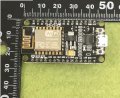
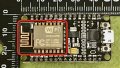
Ultimately, you only need the module that is inside the red box and a few small passive components. The rest of the board is there to provide serial communications for programming and the breakout of the pins. Generally, here size is an issue, you use the larger board for development—which is where a development board, which is what this is, gets its name.
Once you have the program(s) you need written, you‘ve got your prototype working, you use a raw module on your own PCB with the minimal number of components to make it work. You can program the module by temporarily connecting it to a serial-to-UART adapter, which is the small chip directly adjacent to the USB port on the opposite end of the board.
Ultimately, you only need the module that is inside the red box and a few small passive components. The rest of the board is there to provide serial communications for programming and the breakout of the pins. Generally, here size is an issue, you use the larger board for development—which is where a development board, which is what this is, gets its name.
Once you have the program(s) you need written, you‘ve got your prototype working, you use a raw module on your own PCB with the minimal number of components to make it work. You can program the module by temporarily connecting it to a serial-to-UART adapter, which is the small chip directly adjacent to the USB port on the opposite end of the board.
I played around with a HotSpot on my iPhone, but it wasn't practical for my needs. I looked at that component you suggested. It's not as easy to purchase as this component ESP8266, but Bluetooth would be more practical than Wifi for this project.

 Facebook
 Google
 GitHub
 Linkedin