VFD 240V IN 415V 3 phase out

Thread Starter

jonnydolt

Joined Oct 23, 2015
145
Recieved this from the manufacturer of the motor and QUOTE "

Mod Edit:
Please don't show the Email on the forum.
1:35 PM (1 minute ago)
to me


Mr.Jon Baldwin
Thank you very much for your inquiry through the China Chamber of Electrical and Mechanical Commerce. Is the motor you inquired about produced by our company in December 1991? (YES) It should be a dual voltage motor, with a delta connection when using 415V voltage and a star Y connection when using 240V voltage. Now our company's motor has been upgraded to a high-efficiency motor. I am sending you the sample information and hope to hear from you in a timely manner. My email address: <Snip> End QUOTE .... SOOOOO does this mean I need to change it to the Y (STAR) connection to run via the vfd?

Mod Edit:
Please don't show the Email on the forum.
 

Thread Starter

jonnydolt

Joined Oct 23, 2015
145
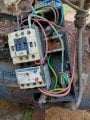
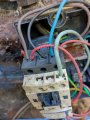
The previous owner replaced a faulty switch with contactors (se pic) it has Brown in 1L1 Red in 3L2 and Black in 5L3 .What I need to know is L1 ,U is L2 ,V and is L3 W , (U V W) on the VFD ? ; and also on the VFD I watched some vids and read a bit and it seems that on the input side R, S and T ,only 2 are needed and S and T are interchangeable ( does not matter what wire connects as long as R is one of them ) is this correct ? As/because in Australia we have 1 Active wire (Brown) and 1 Neutral wire (Blue) and of course 1 earth wire ......EDIT :- I remembered that my Nephew gave me an old 3 phase 2.2kw motor that was replaced during a maintenance program ,it still has wires and is labeled U,V.W ,....U is Brown (L1) ,V is Blue (L3) and W is Black (L2) so that half is solved now to solve the R,S and T :)contactor pic.jpgcontactor3.jpg
 
Last edited:

strantor

Joined Oct 3, 2010
6,875
Recieved this from the manufacturer of the motor and QUOTE "

Mod Edit:
Please don't show the Email on the forum.
1:35 PM (1 minute ago)
to me


Mr.Jon Baldwin
Thank you very much for your inquiry through the China Chamber of Electrical and Mechanical Commerce. Is the motor you inquired about produced by our company in December 1991? (YES) It should be a dual voltage motor, with a delta connection when using 415V voltage and a star Y connection when using 240V voltage. Now our company's motor has been upgraded to a high-efficiency motor. I am sending you the sample information and hope to hear from you in a timely manner. My email address: <Snip> End QUOTE .... SOOOOO does this mean I need to change it to the Y (STAR) connection to run via the vfd?
What they seem to be saying is the opposite of how motors work. Either they got mixed up about wye and delta or their explanation is so bad that they aren't at all trying to say what they seem to be saying.

Nothing on that data plate implies that it is a dual voltage motor.

A motor will have full mains voltage across each winding in delta and mains÷sqrt(3) volts across each winding
in wye/star. So if "motor A" is rated 415V in wye, when you put 415V across its terminals, it will have [415÷sqrt(3)]=240V across each winding. So that means you can change "motor A" from wye to delta and then you only need 240V to get the same power out. But if "motor B" is rated 415V in delta, then it means it expects 415V across each winding. If you put "motor B" in wye, then in order to get 415V across each winding, you would need 720V because 720V/sqrt(3) = 415V. You can run "motor A" on 240V or 415V. You can run "motor B" only on 415V (or on 720V if that exists anywhere).

The data plate on your motor indicates almost without question that it is "motor B." Yet this manufacturer seems to be saying that it is "motor A" and further that wye and delta work the opposite way as I have just described. They seem to suggest you take the motor out of delta and put it in wye, then run it on 240. This means you will putting 240V/sqrt(3)= 139V across each winding when they are meant for 415V. A motor run at 1/3 its design voltage is going to have zero balls and overheat quick, drawing gobs of current.

I realize that I'm just some rando on the internet and I personally would trust the manufacturer before I would some other rando on the internet so I'll not be offended if you don't take my word for it. You have the motor, you have the VFD, you are free to try it out if they have convinced you it will work. But I'll have already issued my preemptive "told-ya-so."
 

strantor

Joined Oct 3, 2010
6,875
The previous owner replaced a faulty switch with contactors (se pic) it has Brown in 1L1 Red in 3L2 and Black in 5L3 .What I need to know is L1 ,U is L2 ,V and is L3 W , (U V W) on the VFD ? ; and also on the VFD I watched some vids and read a bit and it seems that on the input side R, S and T ,only 2 are needed and S and T are interchangeable ( does not matter what wire connects as long as R is one of them ) is this correct ? ......EDIT :- I remembered that my Nephew gave me an old 3 phase 2.2kw motor that was replaced during a maintenance program ,it still has wires and is labeled U,V.W ,....U is Brown (L1) ,V is Blue (L3) and W is Black (L2) so that half is solved now to solve the R,S and T :)View attachment 295429
Sorry I don't follow your question at all. Can you re-phrase that?
 

Thread Starter

jonnydolt

Joined Oct 23, 2015
145
What they seem to be saying is the opposite of how motors work. Either they got mixed up about wye and delta or their explanation is so bad that they aren't at all trying to say what they seem to be saying.

Nothing on that data plate implies that it is a dual voltage motor.

A motor will have full mains voltage across each winding in delta and mains÷sqrt(3) volts across each winding
in wye/star. So if "motor A" is rated 415V in wye, when you put 415V across its terminals, it will have [415÷sqrt(3)]=240V across each winding. So that means you can change "motor A" from wye to delta and then you only need 240V to get the same power out. But if "motor B" is rated 415V in delta, then it means it expects 415V across each winding. If you put "motor B" in wye, then in order to get 415V across each winding, you would need 720V because 720V/sqrt(3) = 415V. You can run "motor A" on 240V or 415V. You can run "motor B" only on 415V (or on 720V if that exists anywhere).

The data plate on your motor indicates almost without question that it is "motor B." Yet this manufacturer seems to be saying that it is "motor A" and further that wye and delta work the opposite way as I have just described. They seem to suggest you take the motor out of delta and put it in wye, then run it on 240. This means you will putting 240V/sqrt(3)= 139V across each winding when they are meant for 415V. A motor run at 1/3 its design voltage is going to have zero balls and overheat quick, drawing gobs of current.

I realize that I'm just some rando on the internet and I personally would trust the manufacturer before I would some other rando on the internet so I'll not be offended if you don't take my word for it. You have the motor, you have the VFD, you are free to try it out if they have convinced you it will work. But I'll have already issued my preemptive "told-ya-so."
Thanks mate I responded to his email with mostly stolen words from you :) .....QUOTE :- "
Thank you for your reply ,did you get Y and Delta mixed up? as if the motor is rated 415V in delta, then it means it expects 415V across each winding. If you put the motor in Y connection , then in order to get 415V across each winding, you would need 720V because 720V/sqrt(3) = 415V
Many thanks for your time" end quote
 

Thread Starter

jonnydolt

Joined Oct 23, 2015
145
Got the motor off ,heavy bugger ,thought I would start by pulling the fan end off ,1 big circlip lots of slippery later it is a no go so left that to penetrate before plastic broke and start on the pully end, juiced it all up with penetrant and proceeded to remove the grub screw when the Allen key snapped off level with the top of the grub screw and down a good 10mm hole. I gave up for the day lol .Going to be loads of fun trying to remove that Allen key!!
 

Thread Starter

jonnydolt

Joined Oct 23, 2015
145
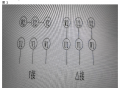
The manufacturer replied to my question of "were you mistaken" and his reply is as follows and QUOTE:- "
Mr.Jon Baldwin
I am very sorry, I accidentally made a mistake in my reply yesterday and got it
wrong. When using 415V voltage, a star Y connection is used, and when using
240V voltage, a delta connection is used.
Wire according to the specified connection method on the nameplate. The
connection method between the outgoing terminals of the motor winding is
shown in Figure 3 " END QUOTE 1685684356412.png1685684356412.png
 

strantor

Joined Oct 3, 2010
6,875
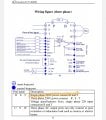
ON the VFD 240v input side there are 3 terminals for wire labeled R ,S ,and T which one is for active and which for neutral?
Screenshot_20230602-072017_Drive.jpg

The manufacturer replied to my question of "were you mistaken" and his reply is as follows and QUOTE:- "
Mr.Jon Baldwin
I am very sorry, I accidentally made a mistake in my reply yesterday and got it
wrong. When using 415V voltage, a star Y connection is used, and when using
240V voltage, a delta connection is used.
Wire according to the specified connection method on the nameplate. The
connection method between the outgoing terminals of the motor winding is
shown in Figure 3 " END QUOTE
I still say he's wrong about it being a dual voltage motor. I would be careful going forward, check amps, let the motor run a while unloaded, make sure it doesn't start overheating with no load. Then connect the compressor belt and watch it even closer for a while (amps and temp).
 

Attachments

strantor

Joined Oct 3, 2010
6,875
@jonnydolt
I have just now re-read the title of this thread (or maybe actually read it for the first time) and I wonder if we have been talking about the same thing all along or not.

VFD 240V IN 415V 3 phase out

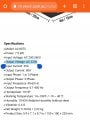
You do realize that your VFD will NOT step the voltage up to 415V, right? It takes in 240V single phase and outputs 240V 3 phase.

Screenshot_20230602-154709_Chrome.jpg

For the duration of my participation in this thread I have been talking about a way to power the motor with the 240V 3ph output of the VFD instead of 415V 3ph that it expects. I wonder if you've been reading it that way, or if you've been reading it some other way because you were expecting 415V would be available at the output of the VFD.

That is why I suggested a new motor. I don't think yours will operate reliably and/or at full speed, with only 240V as its input.
 
Last edited:

Thread Starter

jonnydolt

Joined Oct 23, 2015
145
@jonnydolt
I have just now re-read the title of this thread (or maybe actually read it for the first time) and I wonder if we have been talking about the same thing all along or not.

VFD 240V IN 415V 3 phase out

You do realize that your VFD will NOT step the voltage up to 415V, right? It takes in 240V single phase and outputs 240V 3 phase.

View attachment 295601

For the duration of my participation in this thread I have been talking about a way to power the motor with the 240V 3ph output of the VFD instead of 415V 3ph that it expects. I wonder if you've been reading it that way, or if you've been reading it some other way because you were expecting 415V would be available at the output of the VFD.

That is why I suggested a new motor. I don't think yours will operate reliably and/or at full speed, with only 240V as its input.
The manufacturers state .....
When using 415V voltage, a star Y connection is used, and when using
240V voltage, a delta connection is used ........... we shall see if it works, will now be a spare if it does , as last night I got feed up with the worry of blowing up the vfd or motor that I
purchased a 16HP petrol engine to run it
 

LowQCab

Joined Nov 6, 2012
5,101
This is a Compressor application.
You don't need or want a Variable-Frequency-Drive for a Compressor application.
You will find that your Electric-Bill will be substantially higher using a VFD.

You have 4 practical options......
1)

Purchase a new Single-Phase-Motor.
( it can be smaller than ~7.5-HP if You install a smaller Drive-Pulley )
( The Compressor will have somewhat reduced CFM-Capacity, but the same maximum-pressure )
( It will also make less Noise, and last much longer )

2)
For Commercial locations ......
Have your Electrical service provider provide 3-Phase-Electrical-Service to your building.
( Could be quite expensive, depending on your location,
but will probably pay for itself in a reduced Electrical-Bill in ~4 to ~6 years ).

3)
Get in touch with a Motor-Rewinding-Shop and get a recommendation on
an external Capacitor-Bank that will provide the correct Phase-Shift to allow operation on Single-Phase.

4)
A Motor-Rewinding-Shop may swap your ~7.5-HP 3-Phase-Motor for a
good used, or re-wound, ~5-HP-Single-Phase-Motor for a nominal fee.
( much less than a brand new ~5-HP-Motor )

Note .......
If this is a Residential location, your Electrical-Service, and Breaker/Distribution-Panel,
may not like dealing with the "Start-Up" Current needed for a ~7.5-HP-Motor, IT'S HUGE !!!
( This could cause all sorts of very aggravating problems )

Note ........
A Compressor-Motor CAN NOT be "ramped-up" with a VFD,
so the only function of your VFD will be to provide 3-Phase-Power, but NOT Variable-Speed.

Note .........
A VFD on a Compressor-Motor is just generally not a practical plan, for a variety of reasons,
and the VFD is guaranteed to increase your Electrical-Bill because
of the inherent, and unavoidable, inefficiencies of power-conversion.
.
.
.
 

strantor

Joined Oct 3, 2010
6,875
This is a Compressor application.
You don't need or want a Variable-Frequency-Drive for a Compressor application.
You will find that your Electric-Bill will be substantially higher using a VFD.

You have 4 practical options......
1)

Purchase a new Single-Phase-Motor.
( it can be smaller than ~7.5-HP if You install a smaller Drive-Pulley )
( The Compressor will have somewhat reduced CFM-Capacity, but the same maximum-pressure )
( It will also make less Noise, and last much longer )

2)
For Commercial locations ......
Have your Electrical service provider provide 3-Phase-Electrical-Service to your building.
( Could be quite expensive, depending on your location,
but will probably pay for itself in a reduced Electrical-Bill in ~4 to ~6 years ).

3)
Get in touch with a Motor-Rewinding-Shop and get a recommendation on
an external Capacitor-Bank that will provide the correct Phase-Shift to allow operation on Single-Phase.

4)
A Motor-Rewinding-Shop may swap your ~7.5-HP 3-Phase-Motor for a
good used, or re-wound, ~5-HP-Single-Phase-Motor for a nominal fee.
( much less than a brand new ~5-HP-Motor )

Note .......
If this is a Residential location, your Electrical-Service, and Breaker/Distribution-Panel,
may not like dealing with the "Start-Up" Current needed for a ~7.5-HP-Motor, IT'S HUGE !!!
( This could cause all sorts of very aggravating problems )

Note ........
A Compressor-Motor CAN NOT be "ramped-up" with a VFD,
so the only function of your VFD will be to provide 3-Phase-Power, but NOT Variable-Speed.

Note .........
A VFD on a Compressor-Motor is just generally not a practical plan, for a variety of reasons,
and the VFD is guaranteed to increase your Electrical-Bill because
of the inherent, and unavoidable, inefficiencies of power-conversion.
.
.
.
I disagree with almost all of this.
 

strantor

Joined Oct 3, 2010
6,875
This is a Compressor application.
You don't need or want a Variable-Frequency-Drive for a Compressor application.
Explain?
You will find that your Electric-Bill will be substantially higher using a VFD.
My Compressor is on a VFD and while it doesn't run enough to see a difference in my bill, I fail to see the logic in your statement. VFDs are often used to improve the electric bill. Throwing motors across the line causes an instant exaggerated current draw which the utility records and in the case of commercial customers, they bill as a "demand charge." The VFD ramps the motor to speed which greatly improves the situation. But please, do explain; what are you talking about? Power factor? If residential, this isn't a consideration.

Purchase a new Single-Phase-Motor.
( it can be smaller than ~7.5-HP if You install a smaller Drive-Pulley )
( The Compressor will have somewhat reduced CFM-Capacity, but the same maximum-pressure )
( It will also make less Noise, and last much longer )
I do agree with this

For Commercial locations ......
Have your Electrical service provider provide 3-Phase-Electrical-Service to your building.
( Could be quite expensive, depending on your location,
but will probably pay for itself in a reduced Electrical-Bill in ~4 to ~6 years ).
Care to explain how this will pay for itself? And what usage level you're assuming to make this statement?

Get in touch with a Motor-Rewinding-Shop and get a recommendation on
an external Capacitor-Bank that will provide the correct Phase-Shift to allow operation on Single-Phase.
Yes a static phase converter would work if OP had 415V single phase to match his 415V single phase motor. But he has single phase 240V.

A Motor-Rewinding-Shop may swap your ~7.5-HP 3-Phase-Motor for a
good used, or re-wound, ~5-HP-Single-Phase-Motor for a nominal fee.
Good point. And maybe the best option.

Note .......
If this is a Residential location, your Electrical-Service, and Breaker/Distribution-Panel,
may not like dealing with the "Start-Up" Current needed for a ~7.5-HP-Motor, IT'S HUGE !!!
( This could cause all sorts of very aggravating problems )
I have a 30HP rotary phase converter in my shop and yes, the start-up current is yuge. But the problem isn't in the breaker panel, it's in my neighbors' living rooms. They don't appreciate the flickering lights.
Note ........
A Compressor-Motor CAN NOT be "ramped-up" with a VFD,
so the only function of your VFD will be to provide 3-Phase-Power, but NOT Variable-Speed.
This is absolutely false. But if you want to get closer to truth, go ahead and expound. Are you referring to the minimum speed required for splash lubrication to work? If so, you should have just broached the topic rather than making such a bold false statement. Yes, piston Compressors, in addition to their upper limit speed rating, also have a lower limit speed rating. The lower limit may not always be published, but it does exist. When I set out to built a variable speed Compressor, I intentionally purchased a compressor head which did have a published lower speed limit, and I programmed my VFD to ramp from 0 to to minimum and then enter an analog pressure control mode, where it is not screaming into action and cutting off abruptly all the time, but rather running continuously at a greatly reduced (but higher than min limit) speed to meet demand. This is so I don't spill my coffee or shart myself every time the compressor needs one more PSI of pressure.

Note .........
A VFD on a Compressor-Motor is just generally not a practical plan, for a variety of reasons,
Strongly disagreed.

the VFD is guaranteed to increase your Electrical-Bill because
of the inherent, and unavoidable, inefficiencies of power-conversion.
Yes there is conversion loss and inefficiency to consider, but unless the thing you're running is very small, and you're running many of them, and you're running them 24/7, the loss is negligible and the benefits (chiefly among them, converting single to 3ph) almost always outweigh the costs.

Screenshot_20230603-080537_Google.jpg
 
Last edited:

strantor

Joined Oct 3, 2010
6,875
The manufacturers state .....
When using 415V voltage, a star Y connection is used, and when using
240V voltage, a delta connection is used ........... we shall see if it works, will now be a spare if it does , as last night I got feed up with the worry of blowing up the vfd or motor that I
purchased a 16HP petrol engine to run it
As if compressors weren't loud enough already LOL. The issue is not that serious. If you are careful, mechanically decouple the motor from the compressor, it is safe to try running the motor in delta from the VFD. It won't explode. What it might do, is run hot. Run it for a while with no load, make sure it isn't getting hot. If it seems fine, re-couple the compressor and again monitor it for heat. If it runs hot then you need a different motor.
 

LowQCab

Joined Nov 6, 2012
5,101
This is not a proffesional, commercial, installation.

Just because something along the lines of what is being discussed here
has been successfully accomplished, even routinely, by a proffesional,
does not indicate that this scheme will be a "no-brainer" for an inexperienced person.

There are a tremendous number of problems that could occur,
many of which could be dangerous, or at the very least, expensive.
.
.
.
 
Top