240V Hot Water Tank Switching Issue

Thread Starter

pmolsen

Joined Jan 2, 2019
8
I have a 240V switching problem. I have a Powerdiverter solar diverter installed Powerdiverter It is an intelligent device that switches spare solar power to a hot water service rather than sending it back to the grid and receiving next to nothing. If there is not sufficient spare power to fully power the HWS it chops the waveform to send whatever is available. If there is no spare then it sends nothing and the tank heats up overnight on cheaper off-peak power. The best of both worlds. The Powerdiverter supports up to a 3.6kW tank.

I have a large twin-element 315L tank with dual 3.6kW elements. The top element heats up the top of the tank for fast availability. When it is hot a SPDT thermostat switches the power to the bottom element. The tank is a long way from the kitchen and it took around a minute for the water to come through. Annoying and a waste of power.

I therefore installed a second smaller tank close to the kitchen. I then moved the top thermostat from the main tank to the bottom. When the main tank reaches temperature the thermostat switches over to what it thinks is its own second element, but in fact I ran those wires to the second tank. So in theory it should all work fine as only one tank can be on at a time. Unfortunately the Powerdiverter sees an overload situation at the moment of switching and shuts down.

So even though the two tanks can never be physically wired at the same time, something is upsetting the Powerdiverter. My first attempted solution was to install a Geya GRT8-A1 time delay relay switch so the second tank did not switch on for 5 seconds. Unfortunately the device did not like the chopped waveform when only partial power was being sent from the Powerdiverter (and even though it does zero-crossing switching). I burnt out two of them within minutes of powering them on.

My next solution was to install a small 240v - 12v transformer, and a small 555 timer based relay board to do the delay. The small relay in turn switches a contactor to turn on the second tank. That has worked perfectly for 2 years. It recently died. Not sure which component.

Rather than fixing that one I would prefer to solve the switch-over issue, because in theory the SPDT thermostat should switch without the Powerdiverter even noticing. It occurs to me that it may be possible to install a large capacitor or something to absorb whatever spike is upsetting the Powerdiverter. Can anyone suggest a solution please? Attached is a diagram of the current wiring.

Powerdiverter have since produced an updated model that allows two tanks to be powered, but I would prefer not to spend the money on a new system if I can solve the problem more easily.
 

Attachments

MisterBill2

Joined Jan 23, 2018
27,159
First, you will not get any "spike" from a resistance heater element. There is not enough inductance in the heater element to cause a problem.
I am guessing that there are other users for the main water heater than the kitchen sink, so that the large water heater must also be kept hot. A very simple scheme will be to switch power to the small water heater whenever it is satisfied, and then when the small water heater is satisfied as well, switch the power to the bottom element in the main tank, thru the lower tank thermostat.
The apparent "overload" sensed by the "powerdiverter" would appear to be an over-voltage glitch caused by the momentary full power load interruption during the switch-over time.
 

crutschow

Joined Mar 14, 2008
38,316
Although the resistance heater would have little inductance, that small inductance plus the line inductance may still be enough, at the high currents switched, to cause a spike sufficient to upset your controller.
An EMI filter (example) at the output(s) of the controller might solve the problem.

But if you already have a working solution, I would stick with that, and just replace/repair the failed timer.
 

MisterBill2

Joined Jan 23, 2018
27,159
It seems far more likely that it is a case of poor regulation in the inverter supplying the 240 volts. Consider that during the switch over, the load goes from3600 watts to zero watts. then to the 1200 watt load. That is quite a glitch.

You could put the two 3600 watt elements in series which will reduce the power draw quite a bit. AND your thermostat switches will last a lot longer. If that is the solution it will be cheap and easy. and very reliable.
 

Thread Starter

pmolsen

Joined Jan 2, 2019
8
First, you will not get any "spike" from a resistance heater element. There is not enough inductance in the heater element to cause a problem.
I am guessing that there are other users for the main water heater than the kitchen sink, so that the large water heater must also be kept hot. A very simple scheme will be to switch power to the small water heater whenever it is satisfied, and then when the small water heater is satisfied as well, switch the power to the bottom element in the main tank, thru the lower tank thermostat.
The apparent "overload" sensed by the "powerdiverter" would appear to be an over-voltage glitch caused by the momentary full power load interruption during the switch-over time.
Thanks for the reply. That "simple scheme" is what the problem is - switching from one tank to the other. It is tripping the Powerdiverter overload function as though both elements are operating simultaneously, which is not possible with a SPDT thermostat relay. The relay cannot be faulty because before I installed the second tank that relay was happily switching between the two elements in the same tank without upsetting the Powerdiverter. Which is why it is all the more confusing. If it could do that then why can't it switch a functionally identical setup?
 

Thread Starter

pmolsen

Joined Jan 2, 2019
8
... But if you already have a working solution, I would stick with that, and just replace/repair the failed timer.
It isn't a satisfactory working solution because it has broken down in less than 2 years. Plus it is using cheap parts not designed for that function.
 

Thread Starter

pmolsen

Joined Jan 2, 2019
8
...
You could put the two 3600 watt elements in series which will reduce the power draw quite a bit...
I cannot put the two elements in series because each one has to shut off its own thermostat independently when it reaches temperature. If the elements are in series then as soon as one tank is hot its thermostat will cut power to both tanks. But thanks for trying to help.
 

Tonyr1084

Joined Sep 24, 2015
9,744
Just jumping in here - get a 240VAC relay and when the upper element turns on - instead of turning the element on you turn the relay on. That relay connects power the second tank. You will have to bypass the upper thermostat in the main tank or set it higher than the lower element will heat the tank to.

One word of caution here - and you probably already have this covered, but it's still worth stating: Make sure you have a good working pressure relief valve installed in both tanks. An over heating tank can become a bomb if it has no where to release excess pressure. A steam boiler explosion can be devastating. As pressure builds the boiling point goes up and up and up until the tank fractures. Then all that super-heated water flashes over to steam expanding somewhere around 1600 to 1700 times the volume. But it sounds like you're smart enough to know all that. Still, it's worth repeating.
 

MisterBill2

Joined Jan 23, 2018
27,159
What I meant was the two elements in the big heater. That will reduce the total wattage to 1800 watts in the big tank unit, THAT MIGHT be enough reduction to make the change over work without tripping the diverter overload.
As for timer, there are industrial timers for any delay you choose, rated to function once a minute for two shifts six days a week for a few years. But they do cost more than a 555 timer IC. BUT they run on mains voltage and very seldom fail.
 

Thread Starter

pmolsen

Joined Jan 2, 2019
8
As for timer, there are industrial timers for any delay you choose, rated to function once a minute for two shifts six days a week for a few years. But they do cost more than a 555 timer IC. BUT they run on mains voltage and very seldom fail.
The problem is the supply when less than full power available from solar is a chopped waveform. It is supposedly zero-crossing but may not be. (If I had a decent scope I could check. Actually I have a little old Vellaman HPS5 "personal scope". Wouldn't like to go near 240v with it but if I run the supply through a standard iron core 240v - 12v transformer it should show me the waveform) It fried the two proper timers that I bought and would likely fry industrial ones.
 
Last edited:

Thread Starter

pmolsen

Joined Jan 2, 2019
8
Just jumping in here - get a 240VAC relay and when the upper element turns on - instead of turning the element on you turn the relay on. That relay connects power the second tank. You will have to bypass the upper thermostat in the main tank or set it higher than the lower element will heat the tank to.
Do you mean that the relay might provide a sufficient delay to cure the problem. Something like that was what I had in mind, but with a severely chopped AC supply waveform (say 10% power) the relay would likely chatter and also produce big back-EMF spikes. (Can you put a flyback diode across an AC relay?)
 

Tonyr1084

Joined Sep 24, 2015
9,744
Do you mean that the relay might provide a sufficient delay to cure the problem?
That I don't know. But assuming the original switching operation that was controlled by the controller was sufficient I would tend to think it would. But again - I don't know. Remember, your system worked for two years without a problem.
 

MisterBill2

Joined Jan 23, 2018
27,159
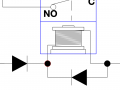
There is a trick to stopping a relay from chattering or eve humming. That is to have two adequately rated diodes in series opposing, with the relay coil connected across one of the diodes. It works quite well, and it also demonstrates clearly that a shunt diode increases a relay release time.
 

Tonyr1084

Joined Sep 24, 2015
9,744
I believe this is what @MisterBill2 is talking about.

Drawing has been removed.

I've never heard of this before. Seems like an interesting application. In THIS case I drew the cathodes face to face. I suppose anodes face to face might accomplish the same thing. IDK, ask Bill.
 
Last edited:

MisterBill2

Joined Jan 23, 2018
27,159
I believe this is what @MisterBill2 is talking about.

View attachment 350410
I've never heard of this before. Seems like an interesting application. In THIS case I drew the cathodes face to face. I suppose anodes face to face might accomplish the same thing. IDK, ask Bill.
NO!!! THAT is NOT what I was describing.
The one diode is shunting the coil, the other diode is in series with the power.
In the figure shown, the coil would only be connected across ONE of the diodes. The voltage is applied across the open ends of the two diodes. The result is the constant polarity of the magnetic flux created by the current only being in one direction.
This concept has been very difficult to explain to a lot of professional highly paid wire twisters. Some of them NEVER got it.
 

Tonyr1084

Joined Sep 24, 2015
9,744
NO!!! THAT is NOT what I was describing.
The one diode is shunting the coil, the other diode is in series with the power.
In the figure shown, the coil would only be connected across ONE of the diodes. The voltage is applied across the open ends of the two diodes. The result is the constant polarity of the magnetic flux created by the current only being in one direction.
This concept has been very difficult to explain to a lot of professional highly paid wire twisters. Some of them NEVER got it.
Will be modifying that drawing. For the moment I'm removing the drawing.
 

MisterBill2

Joined Jan 23, 2018
27,159
Many thanks to Tony R!!
The circuit shown in post #18 is exactly what I was describing. The diode in series with the supply allows only one polarity of half-wave AC pulses to the coil, the diode shunting the coil starts conducting as soon as the voltage starts to drop on that positive half cycle, and it continues to conduct as the magnetic field continues to collapse. so the current in the coil does not completely cease, and so the magnetic field does not reverse, and also does not drop to zero. Thus the buzz does not happen.
So the simple circuit does complicated stuff.
 

Thread Starter

pmolsen

Joined Jan 2, 2019
8
Many thanks to Tony R!!
The circuit shown in post #18 is exactly what I was describing. The diode in series with the supply allows only one polarity of half-wave AC pulses to the coil, the diode shunting the coil starts conducting as soon as the voltage starts to drop on that positive half cycle, and it continues to conduct as the magnetic field continues to collapse. so the current in the coil does not completely cease, and so the magnetic field does not reverse, and also does not drop to zero. Thus the buzz does not happen.
So the simple circuit does complicated stuff.
Bear in mind that in this application the Powerdiverter is chopping the waveform. It could be down to 10% or 5% or maybe even 1%. I would have to check the specs. Without some additional circuitry or capacitors it is not going to sustain the magnetic field long enough to hold in the relay.
 
Top