Verify gut feeling I can hook up 4 motors in parallel.

Thread Starter

Samantha Groves

Joined Nov 25, 2023
169
I am about to order a robotic car which moves with 4 TT motors https://www.otronic.nl/en/chassis-w...-motors-robot-base-diy?utm_source=chatgpt.com

When you want to go forward all motor must rotate clockwise and if you want to go back backward all motors have to go counter clockwise.So I was thinking to control the motion using a H bridge.And since all the motors move at the same time,can I put them in parallel?


1791505173917.png
 

MaxHeadRoom

Joined Jul 18, 2013
30,836
Those typically have one axle where the wheels are free to turn via surface friction ..
The other two are generally indipendantly controlled either by using standard IC's or a small PIC.
They are track following robots, although looking again, there appears there is not much in the way of control !
What are you attempting?
Just uncontrolled drive? If so what is the surface?
 

Thread Starter

Samantha Groves

Joined Nov 25, 2023
169
Those typically have one axle where the wheels are free to turn via surface friction ..
The other two are generally indipendantly controlled either by using standard IC's or a small PIC.
They are track following robots, although looking again, there appears there is not much in the way of control !
What are you attempting?
Just uncontrolled drive? If so what is the surface?
I dont know what I actually know is how the car robot is I have put a link to my first comment.
 

MaxHeadRoom

Joined Jul 18, 2013
30,836
Yeah, it says Robot Base, so I assume there is not that much in the way of electronics on board!?
Looking at the inverted view shows no electronics etc
20 euro's is pretty high though
 
Last edited:

Thread Starter

Samantha Groves

Joined Nov 25, 2023
169
To answer your question correctly, we would have to know the motor’s full load and stall currents. It may well be that the 2N3904 collector ratings are insufficient, and the magic smoke escapes.
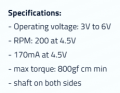
its 170mA at 3.6V and I will be using a sufficiently big battery to provide that 4x170mA current.Since the logic signal is 5V we have 3.6V maximum at the loads(motors).Ideally I would need a 5V supply source to minimise heat generated in the transistor.
 
Last edited:

Thread Starter

Samantha Groves

Joined Nov 25, 2023
169
Also im planning to also put a flyback diode rated at more than 1A reverse current just to be safe I just want to know if putting 4 inductive loads in parallel is OK.
 

Thread Starter

Samantha Groves

Joined Nov 25, 2023
169
To answer your question correctly, we would have to know the motor’s full load and stall currents. It may well be that the 2N3904 collector ratings are insufficient, and the magic smoke escapes.
If the maximum continuous operating current of the transistor is less than the stall current of the combined 4 motors can i put multiple transistors in parallel?Or do I simply add a resistor between the supply and the collector?
 

B-JoJo-S

Joined Jan 3, 2026
552
If all four motors rotate in the same direction at once, forward or reverse, how do you plan on steering? I would expect steering to involve four independently controlled motors. The left two rotate forward while the right two rotate reverse making the vehicle turn right. Reverse the process to turn left.

Expecting four independent motors in parallel to run with identical speed and power is unrealistic. And just to be clear, unless the motors have reversible axels (left or right of the gear box) having all four motors run in the same "clockwise" direction the cart will only try to turn left or right continuously when powered.

A clockwise motor (let's assume shaft facing north) will drive in one direction. An identical motor facing south will drive in the opposite direction. In order to achieve all four motors running in the same direction you'll need to wire two of them opposite the other two.
 

Thread Starter

Samantha Groves

Joined Nov 25, 2023
169
If all four motors rotate in the same direction at once, forward or reverse, how do you plan on steering? I would expect steering to involve four independently controlled motors. The left two rotate forward while the right two rotate reverse making the vehicle turn right. Reverse the process to turn left.

Expecting four independent motors in parallel to run with identical speed and power is unrealistic. And just to be clear, unless the motors have reversible axels (left or right of the gear box) having all four motors run in the same "clockwise" direction the cart will only try to turn left or right continuously when powered.

A clockwise motor (let's assume shaft facing north) will drive in one direction. An identical motor facing south will drive in the opposite direction. In order to achieve all four motors running in the same direction you'll need to wire two of them opposite the other two.
If all four motors rotate in the same direction at once, forward or reverse, how do you plan on steering?
I am not.I am only interested in going forward and backward(it is a simple project).
Expecting four independent motors in parallel to run with identical speed and power is unrealistic.
.They are identical tho since they are part of the same module(robot car).So the steering will be minimal.My project is about using reinforcement learning(machine learning) to self teach a robot car to be lightphile.I am gonna hook up a photoresistor at the helm of the robot ,this will get some readings , then according to a neural network it will decide what do (go forward or backward),then take another reading at that location.Pretty fun project.
 

MaxHeadRoom

Joined Jul 18, 2013
30,836
There are several cheaper versions of these such robot cars that are line-follwer versions, some with descrete logic, some with processor, also much cheaper.
They typically just use two motors for traction.
 

KeithWalker

Joined Jul 10, 2017
3,621
its 170mA at 3.6V and I will be using a sufficiently big battery to provide that 4x170mA current.Since the logic signal is 5V we have 3.6V maximum at the loads(motors).Ideally I would need a 5V supply source to minimise heat generated in the transistor.
Check the datasheet for 2N3904. It's maximum rated collector to emitter current is 200mA. With luck, your H-bridge circuit could possibly drive only one motor. If you use a higher supply voltage, you could drive the motors connected in series. They would also share the mechanical load much better than in parallel.
If you use two H-bridges, each driving two series connected motors, you would also have turning ability.
 

kiroma

Joined Apr 30, 2014
244
I am about to order a robotic car which moves with 4 TT motors https://www.otronic.nl/en/chassis-w...-motors-robot-base-diy?utm_source=chatgpt.com

When you want to go forward all motor must rotate clockwise and if you want to go back backward all motors have to go counter clockwise.So I was thinking to control the motion using a H bridge.And since all the motors move at the same time,can I put them in parallel?


View attachment 372063
For more symmetrical H bridge, I suggest you to use PNP top transistors. But if you want better operation, go with MOSFETs.
 

MisterBill2

Joined Jan 23, 2018
28,398
The temperature rise on the SMALL transistors may become an issue if the motors will be running for very long times. I did follow the link for those motors and I did not see ANY electrical information at all. Possibly I missed it somehow.
I would not ever deal with a vender that does not supply specification information about the motors they offer to sell.
 
Last edited:

MisterBill2

Joined Jan 23, 2018
28,398
What seems to be missing from the spec is the current and RPM at the "full load" torque delivered. But probably that is a variable not easily obtained. Many applications do not demand the maximum capability of the motors. Putting motors working together in series tends to help with load sharing.
 
Last edited:
You typically are not going to revolve those motors at exactly the same rate just by applying full voltage to each.
Yes! Obviously one motor will do most if not all the work.

If Forward and Reverse is all you want then a single motor driving an axel will do the same job without trying to introduce any steering into the system. Someone said it looks like overkill for the money. You'd be better off constructing your own system from scratch.

Try Lego's.
https://www.amazon.com/s?k=lego+mot...9&ref=nb_sb_ss_p13n-expert-pd-ops-ranker_3_11
 
Top