VBE Which way are we clamped.

Thread Starter

MikeJacobs

Joined Dec 7, 2019
232
I have tried to ask this before and never figured this part out.

Talking about a BJT, lets say in saturation I know my VBE is .7 volts.

I have never got anyone to help me to understand which way we are clamped

Is VE guaranteed to be .7 volts less the VB or is VB guaranteed to be .7 volts higher then VE.
Obviously VE has a much higher current as its getting current from IC

So here is the main question again
Is VE guaranteed to be .7 volts less the VB or is VB guaranteed to be .7 volts higher then VE.
 

SamR

Joined Mar 19, 2019
5,491
VE = VB - 0.7V

VBE = VB - VE
0.7V is ~right within a few mV ~6.5-7.3V or so and not the same from transistor to transistor due to manufacturing variances. 0.7 is the "accepted" value for Si. 0.3V for germanium.
 

ci139

Joined Jul 11, 2016
1,993
your VBE depends on many . . . (i hope the spice would manage the following ...)

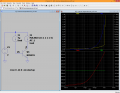
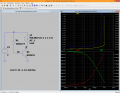
VB against IC . . . and there are more alike . . . a lot -- the reason behind is re getting a voltage drop from IC thus reducing the IB thus reducing the VBe ... if IB is constant (as in the case below) the VB will rise along the Vre

BjT-internal-dependencies_v01.png BjT-internal-dependencies_v02.png

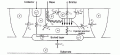
the more in depth internal structure (not a Si BJT , but it gives an apx. insight)

Untitled-2.gif
src.
 
Last edited:

Irving

Joined Jan 30, 2016
5,135
0.7v is the voltage necessary to overcome the natural depletion zone in the b-e PN junction and start the movement of charge across the junction. It varies with temperature, and the presence of current from collector to emitter will have some effect.. 0.7v is a 'typical' value for silicon.
 

Papabravo

Joined Feb 24, 2006
22,083
Regardless of the absolute voltage levels, there is always a voltage drop measuring Vb with respect to Ve. If the transistor is part of some high voltage circuit you could have Vb at -102 VDC and Ve at -102.7 VDC. The difference would still be -102 VDC - (-102.7 VDC) = 0.7 VDC. For circuit analysis it doesn't matter if voltage drops are considered positive or negative, it only matters that you treat voltage drops and voltage rises consistently.
 

WBahn

Joined Mar 31, 2012
32,878
I have tried to ask this before and never figured this part out.

Talking about a BJT, lets say in saturation I know my VBE is .7 volts.

I have never got anyone to help me to understand which way we are clamped

Is VE guaranteed to be .7 volts less the VB or is VB guaranteed to be .7 volts higher then VE.
Obviously VE has a much higher current as its getting current from IC

So here is the main question again
Is VE guaranteed to be .7 volts less the VB or is VB guaranteed to be .7 volts higher then VE.
It's a question without distinction.

The voltage difference between the base and the emitter of a silicon NPN transistor will be about 0.7 V in the active region. This is an approximate value and the exact value depends on a lot of things. In saturation, the Vbe is a bit higher than it would be in the linear region at similar collector currents (consider that you would have to lower Vbe in order to take it out of saturation) and it can be quite a bit higher if being driven hard.

A transistor, like any device, has no idea what absolute voltage its terminals are at. This is underscored by the fact that absolute voltage has no meaning since all voltages are voltage difference between two points. The only thing a device knows are the voltage differences between its various ports.

In a given circuit, sometimes you can determine the base voltage (relative to the circuit common) and in others you can determine the emitter voltage (relative to the circuit common). If you know that the transistor is in the active region, then knowing one of those two you can find the other. If it is in saturation you can do the same thing, but it isn't quite as sure a thing.
 

crutschow

Joined Mar 14, 2008
38,526
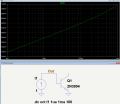
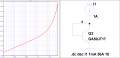
Here's a plot of Vbe vs base current with voltage on a log scale that shows the logarithmic relation between the two (except at higher currents where the base-emitter resistance comes into play).
Note that Vbe doesn't reach 0.7V until the current is near 1mA.


1595895729264.png
 

Thread Starter

MikeJacobs

Joined Dec 7, 2019
232
I think I am not asking the question correctly
What sets what for voltage
Which is why im saying the term clamp

Does VE set VB above by .7 volts

OR

Does VB set VE below by .7 volts

Which controls which
 

WBahn

Joined Mar 31, 2012
32,878
I think I am not asking the question correctly
What sets what for voltage
Which is why im saying the term clamp

Does VE set VB above by .7 volts

OR

Does VB set VE below by .7 volts

Which controls which
I answered your question. It is a question without distinction.

It is like asking whether the current through a resistor sets the voltage at the right side of the resistor relative to the voltage at the left side or is it the other way around. Or whether a 9 V battery sets the voltage of the positive terminal 9 V above the negative terminal or does it set the voltage of the negative terminal 9 V below the positive terminal. They are nonsensical questions. The current through a resistor correlates to a voltage drop across the resistor. The chemical reactions in a battery cause a voltage drop across the battery. The transistor in the active or saturation region has a voltage drop across the base-emitter junction.
 

Papabravo

Joined Feb 24, 2006
22,083
I think I am not asking the question correctly
What sets what for voltage
Which is why im saying the term clamp

Does VE set VB above by .7 volts

OR

Does VB set VE below by .7 volts

Which controls which
Clamping is the wrong concept and is causing you a problem. There is no fixed level at which either node is clamped. So just get the whole idea of clamping OUT of your head. The two thing work in concert. The only rule is the base can never be greater than 0.7 Volts above the emitter, and it can certainly be less than 0.7 V above the emitter. It does not matter what level the emitter is at and it still does not meet the definition of clamping. This also means it is possible for the emitter to be above the voltage on the base so no clamping there either.
 

LvW

Joined Jun 13, 2013
2,030
I think I am not asking the question correctly
What sets what for voltage
Which is why im saying the term clamp
Does VE set VB above by .7 volts
OR
Does VB set VE below by .7 volts
Which controls which
The voltage VBE is controlled by the designer - that means: by YOU !!
* When the emitter is grounded (bad design) VBE is set by the voltage divider at the base only.
* When there is an emitter resistor the voltage at the base (again set by YOU) opens the transistor and allows an emitter current which increases the emitter potential (feedback action). As a consequence, VBE is reduced until there is an equilibrium between a VBE value that is necessary to enable the emitter current IE=f(VBE) which allows the corresponding emitter voltage.
 
Top