Variable Wattage Box

Thread Starter

q12x

Joined Sep 25, 2015
2,227
Update.
I made the 100mV step and the 10mV step. Now Im making the 1mV step.
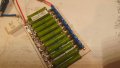
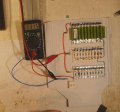
Those green ones are 1W 51R old nicheline russian military resistors. Not that great, they are too big compared with today 1W. I ordered 5W carbon ones at 51R but they will arrive after 1month if im lucky or even more than that. Depends on how hard the winds blow.
1728178424983.png
1728177639081.png Screenshot_9.jpg
and I catch it too late, now after I posted the img and after I made the movies about it, that 100...500mW should have be mA or mV over 1R. Because the wattage is raising up to 5W for the 'green' module.
 
Last edited:

boostbuck

Joined Oct 5, 2017
1,043
You are a genius. Clearly your design skills are at a level I cannot even comprehend. I never would have thought of this (whatever it is.)
Indeed. It's a mystery beyond the ken of mortal intellect.

I’m perplexed at all the effort (time equals money) to avoid what would be a fairly easy task with the right tool. You need a controller with a feedback loop.....
So true - I said this at the very beginning AND provided a sample implementation. A basic multiplier chip providing a VxI feedback to a linear regulator gives a single knob controlling watts to the load, and using a cheap Chinese meter on the output showing volts, amps, watts means it's trivial to measure.

So much simpler than the convoluted path followed above, unless in the fog of information the requirements have changed - I struggle to follow where this is going tbh.
 

boostbuck

Joined Oct 5, 2017
1,043
- You dont get it at all. It is very easy to criticize and blame and point the finger. I can do it too on someone work, even on your work if you have any. Oooh I can be a real bitch. Because is that easy. Everyone can be a critic.
You post an idea, and ask for criticism, and when you get it (a reasoned critique, I might say) you respond as above. Actually, it's apparent you don't want criticism, you want praise:

BobTPH said:
You are a genius. Clearly your design skills are at a level I cannot even comprehend. I never would have thought of this (whatever it is.)
hahaha ! and yes, thank you, very much appreciated. It was a bit hard core until here.
I rest my case.
 

Thread Starter

q12x

Joined Sep 25, 2015
2,227
- Well, this is a thing I wanted to make for a very long time. But I forget the circuit because it was very long time ago, and I was too young to remember anything. But I remained with the idea of it and what I can do about it. When I got the load resistor circuit, the good one, from @Reloadron, I immediately jump on it, and abandon my previous design in favor for this later one because something sparked and clicked with it. I want to believe I encounter it before, or some version of it, but I could see it from the first read in that link that it is exactly what I wanted. That's why I immediately jump on it. And again, many thanks mister @Reloadron !
- I do 'partially' understand what you said mister @boostbuck ... but you are not helping at this point. I am sure there are easier ways to do it, but this is the first time for me to do it and I'm doing it this way. Later, if this works as I imagine, I will try to upgrade it and probably apply that multiplier chip you mention. For me, that chip is VERY New, in the way of thinking with it in circuit, very new. I never worked with it, and by the look of it, it appears a bit too complicated to even setup it's basic circuit. Also I have no idea what to expect from it, how to collect the result and print it on a display. All this being said, I'm not YET comfortable working with such an expensive and hard to set up chip, that I can not understand its true function completely (only partially). After I am more familiar and I understand this side of electronics better than I do now, then, I will consider it, like you may suggest. You might be familiar with it, but not everyone else is like you. I hope you understand my point.
- Also, I had (and still have) a similar chip that was a fiasco when I tried to put it in practice, with all the help and it still didn't work as it should. Im referring to that L6506 Current Controller used specifically for L298N, some time ago. So, I had to delve into this side of electronics that was unfamiliar then and now. So you will forgive me if I'm taking it slow, to really understand it. And so far I do learn something. But this project is not about that L6506, is only a good example I can give.
I hope is more clear now.
 

Reloadron

Joined Jan 15, 2015
7,889
Update.
I made the 100mV step and the 10mV step. Now Im making the 1mV step.
Those green ones are 1W 51R old nicheline russian military resistors. Not that great, they are too big compared with today 1W. I ordered 5W carbon ones at 51R but they will arrive after 1month if im lucky or even more than that. Depends on how hard the winds blow.
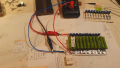
View attachment 333103
View attachment 333099 View attachment 333100
and I catch it too late, now after I posted the img and after I made the movies about it, that 100...500mW should have be mA or mV over 1R. Because the wattage is raising up to 5W for the 'green' module.


OK and moving right along. Here is what I suggest you do. Get yourself a nice clean sheet of paper and a pencil with a large eraser preferred. Make a list of exactly what you want. Look ahead to a final version, all the features that you want.

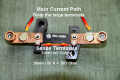
Next, consider all of the possible uncertainties in your measurement plane. Your data will only be as good as the sum of the cumulative errors. While I am sure the average DMM will resolve 1 mV that is not always the case with a micro-controller collecting data. Here is an example of what I am getting at. I want to measure current to a load bank. I decide to use a current shunt to measure my current, I expect currents as high as 45 Amps. I decide to use a 50 amp shunt.
50 Amp Shunt.png

With a full scale current of 50 amps my shunt will output 50 mV full scale so I have a 0.001 ohm shunt. Just like the picture. Keep in mind any voltage dropped across my shunt will not be seen across my actual load. So I now have 0 to 50 amps equals 0 to 50 mV or simply 1.0 mV per amp. Since I want data acquisition I need a micro-controller and since they are very common off the shelf I choose an Arduino Uno Rev 3. This chip is easy to code for and offers 6 A/D (Analog to Digital) inputs. However I soon discover I have a problem. My micro-controller has a 10 bit A/D converter.
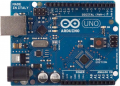
Arduino Uno:
Arduino UNO Rev 3 SMD.png

The A/D by default uses a 5.0 volt reference for the A/D. What this means is a 10 bit A/D gives me 1024 quantization levels or steps. My max analog in is 5 volts so I get 5/1024 = 0.00488 so my best resolution is 4.88 mV. Not that great since that would be 4.88 amps. I want to resolve 1.0 amp or even less.

I should point out I am doing this about 20 years ago so I don't have a better current sensor than my shunt. Today I would likely look to a current sensor like an ACS 712 or similar using hall effect technology.

I buy a ADS1115, ADS1115 16 Bit 16 Byte 4 Channel I2C IIC Analog-to-Digital ADC PGA Converter the reality is while toted as 16 bit there is 1 bit used for sign so it's a 15 bit or 2^15 so I now have 32,768 quantization levels.

Something just came up so more later as I have to run. Later...

Ron
 

Reloadron

Joined Jan 15, 2015
7,889
OK I seem to have some time. I hope you see where I am going with all of this. Collecting data you will need something to collect the data and like anything we collect we need somewhere to put the data as well as a means to get it. Now if you want quick and simple in the images I provider earlier I used a Dataq product similar to others out there. Their starter kits come with some decent software, and offer a wide input range depending on the models. Data acquisition has come a long way since 20 years ago. :) I pointed out only a few pitfalls to avoid, there are more. Back to the clean sheet of paper. :)
Ron
 

Thread Starter

q12x

Joined Sep 25, 2015
2,227
- Ok, I get your point @Reloadron. It seems you are very concentrated-focused on data acquisition either with your Dataq device, or with arduino.
- Well, I am not concentrated on that, not yet. That is way much high level than I need right now to concentrate on. BTW, I am a good programmer so I don't worry about the programming part, especially with arduino which is a breeze. I do have Arduino R3 as you show in your picture and I did a couple of nice projects with it, including ADC reading or as you put it 'data acquisition', so I know the feeling already. I can send you an old video where I'm reading a bunch of LDRs directly into my PC, while arduino is an intermediary instrument, a converter if you wish, and I made a program as well in C# that is listing all the LDR readings. I believe I used an ADC0808 chip //in//out, and it was partially broken(or scrapped) and I had to carefully read the good registers from it, avoiding the bad ones. Fun times.
- Dataq devices are way overpriced for my pocket and my extremely low budget so I can say from now, they are not on my table, especially with the little amount of stuff I'm testing here, but I took a mental note about their existence and somewhere in the future, if I will manage to make money, I will get one as a general purpose data aquisition device, not only specifically for this project here.
- Ok so for more clarity, what Im doing here is a very manual way of doing this thing. Automation is easy now, at my age. The important thing is the basics, which I am really after. And thats what Im doing here with this project. Well, Im also pushing this basic thing a bit higher into a device that is a bit more versatile to do a bunch of things with it, but it is still manual and basic, as complex as it is. If everything will work as I imagine, I will automate the shit out of it, no problem, if it will be really necesary, of course.
Get yourself a nice clean sheet of paper and a pencil with a large eraser preferred. Make a list of exactly what you want. Look ahead to a final version, all the features that you want.
- Aaaah ... yes... haha...well... good advice actually but .... I do know what I want, its very simple but it is hard for me to get to it. I still have to learn some basic stuff like this reading the shunt stuff and making a reliable variable current source, and probably a few more on the road. So far the best variable current source I could make is this bank of resistors of 100mA step (green ones) and the other ones of 10mA and 1mA steps. Im interchangebly say 1mA or 1mV step because it is a reading over the 1R that is making them the same thing.
- In the end, I managed to collect 5W from this bigger bank of 100mA steps. Real 5W not bullshit, with proper heating over the 51R1W resistors that are a very bad resistor construction because of the nicheline they rely on, in my opinion ofcourse and for this particular project Im conducting here, but its all that I had and Im lucky I had the 51Rs so... I'm rolling with what I have here, bad or good. Im waiting for 51R5W CF Carbon Film, in the hope they will perform better and I know for certain they will remain colder than these ones here. These 51R1W green ones, they dont play nice in series with the other modules, the 10 and 1 step. They shift dramatically, so I was expecting 1.111V and I got 1.045 or something like that. Very innacurate. While the other 2 modules linked toghether or not, they show me the expected values of 111mV when linked toghether. I blame the nicheline, the diferent composition, technology they are made of, for the 100 ones. Anyway... thats my current problem Im fighting now.
- In fact, I have a general knowledge that nicheline resistors are Bad, but I never knew why. I know it from little child actually, it remained with me along time. Aparently, conform to my experiment here, they shift their value, when heated, when conducting too much power, current through them. They heated to ~50*C, and I was lucky they got at this value, they could have gone way higher and I suspect, some spots more higher temp on the body of some of these resistors. Its not a consistent temp but a humped one, from my observations,over the body length.
Thanks so far.
 
Last edited:

Reloadron

Joined Jan 15, 2015
7,889
Ok, I get your point @Reloadron. It seems you are very concentrated-focused on data acquisition either with your Dataq device, or with arduino.
I merely used those as examples. I don't work for either. :) I don't even get a commission. Since retirement every now and then I help a good and long time friend training people to work in his gun shop. Electrical engineering was my life career and while I enjoyed it, my real love is a day on the outdoor rifle range.

how to collect the result and print it on a display.
That led me to believe you wanted a form of data acquisition.

Next as to cost. Cost can always be a point. My idea of inexpensive may not be the same as yours.

If you don't want to use a current shunt I mentioned other ways like using a hall effect sensor. The ACS712 modules: ACS712 Hall Effect Current Sensor Module 5A 20A 30A Range They come in as mentioned 5 amp, 20 Amp and 30 Amp flavors and what I consider inexpensive that can cover current.. I pair things with an Arduino simply because it works and is convenient. Additionally, unless a project is to be a permanent project fine and if the project is just a proof of concept project that's also fine, just break down the modules Tag and bag them for a rainy day. :)

I can suggest parts all day long. What is important how you not I setup and layout your project.

Ron
 

Thread Starter

q12x

Joined Sep 25, 2015
2,227
Update:
the 2 bottom modules are working very predictably, exactly (as I like to call them) as 'programmed'.
The black sheep is the top one that is dropping the V, quite substantially. But even so, it is a very functional circuit.
This is phase 1 of the project completed. Next, phase 2.
I made a movie about all this circuit you see here, including the construction of 1 module.
Screenshot_3.jpg
 

Reloadron

Joined Jan 15, 2015
7,889
While a little long it was a good video and I like how you used the jumpers. I like how you picked off the voltage right at your loads. The small difference between your power supply current reading and your meter is likely a result of the supply is looking at the total current it is supplying. There will be some lead resistance between source and load. Now you have a nice load bank of resistive load. :)

Ron
 

Thread Starter

q12x

Joined Sep 25, 2015
2,227
While a little long it was a good video and I like how you used the jumpers. I like how you picked off the voltage right at your loads. The small difference between your power supply current reading and your meter is likely a result of the supply is looking at the total current it is supplying. There will be some lead resistance between source and load. Now you have a nice load bank of resistive load.
Thank you. But this is not over since I didnt make it to look at it how pretty it is. I will have to put it to work, and stress some components, to determine -hopefully- their true power rating when drive to some limits. My limit was always 50*C over everything and if im 60 like in this case is still close enough to my limit but if is 80 or 100 is too much. At least in my books. I am aware a component is made to run at 120 or 150*C and run normally. It may be, but I call that unnecessary thermic stress. I mentioned in the movie a rule, that every component should run cold and I believe it and I try to stay with it as much as possible. THats the reason my 50*C limit is so low, very close to the ambient, and not too far apart.
What Im saying with all this is that my future tests with this new load bank will be conducted at 50*C mostly, as a safe and precaucious zone. I don't think I will push it to 120*C. But will see. My other goal is to reach a component datasheet maximum running specification without destroying the component and for a long use. Im aware is a crazy goal, but so far Im doing my best without too much insight about how to do it. All the insight I have are my experiments that -hopefully- are deeper and deeper into the problem. We will see how successful my starting idea is. Im curious as much as you.
- "is likely a result of the supply is looking at the total current it is supplying", yes, including the power cord with its aligator clips. I should had switched my other thicker cable with also thicker aligators. But at 5W... I really thought this will be enough....hmmm, I will use it on the next experiments then.
 
Last edited:

Reloadron

Joined Jan 15, 2015
7,889
When I was doing this on the side it was for an online forum where they evaluated the ATX Form Factor power supplies used in home computers. The idea being if the PSU had a 5 volt supply rated at 20 amps would it deliver rated current at rated voltage. In the case of the 5.0 volt rail under a 20 amp rated load the voltage should remain between 4.75 and 5.25 volts (+/- 5%). Did the unit function as advertised is all we were interested in. :) It was fun and on the actual unit they paid well for everything. :) Hell, that was over 20 years ago. I like how you look at the thermal rise.

Ron
 

Thread Starter

q12x

Joined Sep 25, 2015
2,227
- Well, I failed again. But, this last circuit make me see some details that I didnt see with the other one with LM358 opamp variable current source. The important detail that here with this cct was right in my face, was the voltage drop over the component in test. Like I mentioned, I said I will keep a constant 5V and only vary the current through all that Resistor Load Bank (RLB). Well, when Im including a component to test in this circuit, it will actually drop a certain voltage over it, and lower the voltage for the RLB circuit that I build from the supposedly fixed 5V to something less. And thus, the current over 1R is way off than when I initialize it with only a wire instead of a component. For example: if I originally initialize it as 250mV over 1R from the resistors jumpers, then, after I insert a transistor instead of the wire, the current drops to 4V over the entire RLB. It should have be 5V, but is less now, and that's because the voltage is now divided between the component in test and the RLB cct. The tr VCE is 912mV and is reaching 55.6*C in ~5min. The voltage over 1R is still 250mV and my PSU is also showing me a 250mA. But the programmed resistors are for 306mV(when initialized), to give me now that 250mV over 1R. I kind of seen this voltage dividing problem from before starting this cct but I said I will deal with it later, and it turned out to be a corner stone. Daaem.
- Although I failed at the momment, Im still glad I build this second cct that is folowing another logic than the other one with the opamp, and in my eyes is a bit more intuitive, even if its a bit more manual to set the value than a single convenient POT as before. Both ccts are good, but I believe they solve the varying current a bit different from each other. I don't think I've seen this voltage drop in the other cct with the LM358, or I don't remember it so evident as Im having it now, literally right in my face, with this cct here. Hmmm. Its both intriguing and depressing in the same time, 50-50 from both medicines.
Eeeeeeeeeeh....
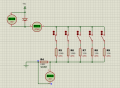
I used the exact same circuit I posted in #85, nothing new.
1728516289500.png
- But instead of the diode I used a BC548 with its Base directly (no resistor) connected to its Collector. Thats it. Similar setup was with LM358 opamp, the tr in test was also having it's base unprotected by any resistor and it was drived Hard exactly like I did here. So I duplicate the same driving, I would say. If Im wrong, then point it out. You can see the voltage drop in the circuit here with the diode, that 853mV over the diode. Very close to my tr case in reality.
- Any helpful and constructive suggestion, in the sense of how to remedy and correct the situation, will be greatly appreciated.
 
Last edited:

Reloadron

Joined Jan 15, 2015
7,889
You lost me a little in this. In your above schematic what is the diode supposed to be doing other than dropping about 0.835 volts? So we have 5.0 volts applied, diode forward voltage drop 0.835 volt so the voltage applied to the load becomes 5.0 - 0.835 = 4.165 volts across the load resistance of R5 and R6 3.985 ohms / 2 = 1.992 Ohms. so we get 4.165 volts / 1.992 ohms = 2.090 amps through the 0.001 Ohm shunt so we get 2.090 amps * 0.001 ohms = 0.0029 volt or 2.09 mV. That all works out fine. I will say while this all works out fine if you use an LM358 to create a variable current source

I said I will keep a constant 5V and only vary the current through all that Resistor Load Bank (RLB).
OK, we have a variable current source. As we change the current across a resistive load the voltage drop will change based on the load resistance. This will work till we reach the compliance voltage of the current source at which it's game over. We touched on current sources and compliance voltage several pages ago. so I don't quite get what you are saying in the above quote.

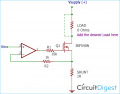
Normally in a current source design we let the operational amplifier drive a transistor or a MOSFET for higher current. The LM358 can't really source much current so we incorporate transistors based on how much current we want to source to a load. Similar to the below image:

LM358 Current Source.png

Ron
 

Thread Starter

q12x

Joined Sep 25, 2015
2,227
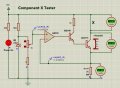
Yes, this is the cct I was referring and that I used awhile ago, before RLB.
Component X Tester.jpg
In this image we have that X component which in this case is a simple wire. But if we change it with a diode or another tr, we can test it for power. This cct worked fine for continuous power for the X component and the math was simple enough even I as an artist could solve it. But it gets very hairy, very quickly when you pulse it. Im explaining what I did when I tested this cct.
The same thing is for our RLB cct, for that diode, that is our X Component Under Test (CUT).
And my picture is the same with your picture as well, for the X_CUT position, in the Collector/Drain of the tr.
 

Reloadron

Joined Jan 15, 2015
7,889
I find the RLB references humorous because RLB is my initials. :)

Yes, if we look at schematics for a current source they pretty much all look about the same. I have a few things to get done today so catch you later.

Ron
 
Top