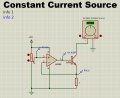
Variable Wattage Box

wayneh

Joined Sep 9, 2010
18,104
Does your load uniformly take more current as the voltage is increased, meaning current is a function of voltage?

If so, you can ultimately accomplish what you want: One dial, a range of power settings. Maybe two dials for coarse and fine adjustment. The machine will adjust voltage, measure current, and converge on the solution where the power is what you called for.

Otherwise you cannot really get there. There are too many degrees of freedom - combinations of voltage and current that can produce the desired power level. Finding one solution wouldn't preclude there being other solutions if voltage and current are independent variables.

But I still think you're making this harder than it needs to be. A very inexpensive DC power supply gives you control over both voltage and current. It's fast and easy to start at a low voltage, write down the current draw, turn the voltage know up 1V and repeat. Put the data in a spreadsheet and you have a nice model of power consumed by your device at all the voltages you want to try. Then you can dial in whatever power level you want by choosing the voltage that causes that power draw.
 
Last edited:

Thread Starter

q12x

Joined Sep 25, 2015
2,227
- I totally get that I can calculate on the spot the wattage of a load in test. But... its VERY nice to have a W box and some switches or dials to mindlessly change them to your quick needs.
 

Thread Starter

q12x

Joined Sep 25, 2015
2,227
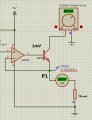
An opamp problem:
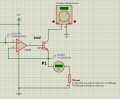
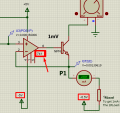
- At +input I have a 424uV!!! signal. I diminuate it as much as I could to be clear that it is not the interference problem.
You can see the value at the (left) blue probe.
- At -input I have a constant 2.3mV. Also see the coresponding (right) blue probe. And here is the problem. I can not lower it down more than this value. This is the minimum possible, for this cct and this kind of setup. My problem is that I want to make it read 1mV instead of 2.3mV. That 2.30mA is the same as the voltage because of that 1R resistor. They are interchangeable V and A at this point.
- I managed to change the -input to 1mV actually, by changing the 1RLoad into a 2.22RLoad. See my notes in the cct.
But I dont want to change this critical value that I depend of getting my accurate readings over it. Basically transforming V into A.
- My suggestion is to insert something on the -input line, from P1 to the actual -input. But what?
Or some other circuit that can deal with this limitation? I dont think my solution is the only solution. If it is, be clear to me, and tell it to my face that it is. Im not sure it is. I trust in your experience more than mine, especially with opamps, although now I start to get more comfortable around them.
1726270000863.png- Thank you -
 
Last edited:

wayneh

Joined Sep 9, 2010
18,104
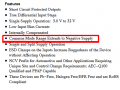
I suspect your problem would go away if you could supply power to your op-amp with a voltage below ground. -5V would be fine but even -1V would do it. The common-mode range of the LM358 does include ground but as the data sheet says "Allowing Direct Sensing Near Ground". [emphasis added] Your application relies on full sensing at ground and for that you need either a below-ground voltage on the power pin or a different op-amp with better performance near/at ground.
 

WBahn

Joined Mar 31, 2012
32,823
I made it in reality and it works just fine !
View attachment 331312
And where are you going to connect your load? I assume between the transistor emitter and the current sense resistor?

How is that going to do what you want? All your variable voltage source will do is change the voltage across the resistor transistor. It will have no effect on the voltage across the load (until it gets either too-high or too-low for the circuit to stay in control).

Edit: Fix typo.
 
Last edited:

Thread Starter

q12x

Joined Sep 25, 2015
2,227
I suspect your problem would go away if you could supply power to your op-amp with a voltage below ground. -5V would be fine but even -1V would do it. The common-mode range of the LM358 does include ground but as the data sheet says "Allowing Direct Sensing Near Ground". [emphasis added] Your application relies on full sensing at ground and for that you need either a below-ground voltage on the power pin or a different op-amp with better performance near/at ground.
smart idea but....
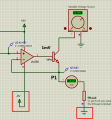
1726273632324.png 1726273742163.png
In first picture, nothing changes ! Remains the same.
In the second picture with the common -5V(or -1V) the ampermeter must be reversed and the voltage across 1RLoad is dependent by the -5V instead of the top variable supply as intended.
---
Edit#1
I changed the direction of that ammeter and still showing MAX value. So its not the current flow. And usually the bigger potential surges into the lowest one, if my top PSU is +7V and the bottom one is -1V, the +7V should surge into that -1V with no problems. This might be yet another bug of the simulator? hmmm. But either way, he is telling me clearly something is wrong. Also the blue probe is showing 1.19V which is indeed the max of my +input setting.
---
Edit#2
1726275895130.png
I changed the opamp with the classical uA741. The problem remains the same !
I power the opamp with +5 and -5V. If Im keeping a little bit below 0V, that -0.5V on the 1RLoad, it is working, showing some results, not the ones I want but some numbers on the ammeter. But if I go crazy, to -1V or more (-5V) it will MAX out. I believe that THIS it is related, most PROBABLY, with what you just said earlier "Allowing Direct Sensing Near Ground". Interesting.
 
Last edited:

Thread Starter

q12x

Joined Sep 25, 2015
2,227
as the data sheet says "Allowing Direct Sensing Near Ground". [emphasis added]
from onsemi : https://www.onsemi.com/download/data-sheet/pdf/lm358-d.pdf
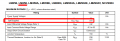
I knew that I know is working in negative range like the old uA741, but I double check it now:
Common mode...usually refers to ground rail (0V)...very rarely used in my vocabulary in this way.... interesting. But he is suggesting as negative rail as the common rail. Makes sense.
1726274234003.png
more clear here:
1726274095805.png
 
Last edited:

Thread Starter

q12x

Joined Sep 25, 2015
2,227
All your variable voltage source will do is change the voltage across the resistor. It will have no effect on the voltage across the load
You are so WRONG! The voltage across 1RLoad will maintain at the programmable +input of the opamp and it's -input will dictate the actual voltage over 1RLoad, thus changing the current through the Load and the upper transistor.
So the variable voltage source will have no chance to change the voltage across the resistor while the -input from the opamp is connected.
But please, try to think on a solution of my recent 1mV problem. Thanks.
 

WBahn

Joined Mar 31, 2012
32,823
You are so WRONG! The voltage across 1RLoad will maintain at the programmable +input of the opamp and it's -input will dictate the actual voltage over 1RLoad, thus changing the current through the Load and the upper transistor.
So the variable voltage source will have no chance to change the voltage across the resistor while the -input from the opamp is connected.
But please, try to think on a solution of my recent 1mV problem. Thanks.
I had a typo. It was supposed to say that all it will do is affect the voltage across the transistor.

Perhaps you have changed what you want this thing to do, but originally you said that you wanted a circuit that would set the power delivered to a load to be controlled by one 'knob', though later you said that it would be acceptable to have to knobs, one to control the voltage and the other to control the current. I'm assuming that you think that this circuit of yours, with the opamp to set the current and a variable voltage supply, somehow does that. It doesn't, regardless of where you put the load. Although, it actually does do this for one specific component, namely the transistor (though it's not a direct relationship, it's a pretty easy one to figure out).

If you have decided to abandon you notion of a variable wattage box in favor of just making a constant current source, I must have missed that.
 

Thread Starter

q12x

Joined Sep 25, 2015
2,227
I'm assuming that you think that this circuit of yours, with the opamp to set the current and a variable voltage supply,
You assume right. Although Im not sure about the variable voltage PSU. Because I will most probably vary only the current from the opamp circuit, while the voltage will remain static, or, if the case may be, I will have 2 or 3 different voltage supplies. But the idea is that they will be fixed, not variable. The variability of the voltage will set a max limit for the current drawn. And that can be done from the start from a fixed PSU.

If you have decided to abandon you notion of a variable wattage box in favor of just making a constant current source, I must have missed that.
Yes, at its core it is a constant current source. But the main purpose or destination, it will be a variable wattage box.
I know it is hard to visualize it now, but it will make sense in the end, after I will make it and when you will see it put in practice. Im not building it because it sounds nice, but to actually put it to some important work, at least for me. I promise you, you will get it in the end, at least its importance.
- See if you can throw any idea about my 1mV problem.
 

WBahn

Joined Mar 31, 2012
32,823
Where, exactly, in your circuit is the device that you are trying to control the power to located?

Let's say that you set the current to be 100 mA. How will this circuit allow you to change the power delivered to this load while maintaining the current through it 100 mA?
 

Thread Starter

q12x

Joined Sep 25, 2015
2,227
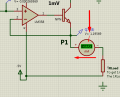
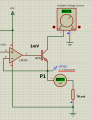
I solved the problem ! Without altering the 1RLoad value.
I'm showing the result with a perfect 1mV and 2mV reading. What a challenge ! Ha. So, it is possible !
1726348855789.png1726348915751.png
 
Last edited:

WBahn

Joined Mar 31, 2012
32,823
So WHAT is possible?

You still can't control the power to your load by separately controlling the current and the voltage.

Your circuit controls the voltage current, only. The variable voltage source being variable serves no purpose. Set it to anything above about half a volt and it will have no effect, until you get so high that you destroy the transistor.
 
Last edited:

AnalogKid

Joined Aug 1, 2013
12,126
Your circuit controls the voltage, only.
The current only - ?

And - going back to a post lost in the mists of history - this is a variable current box. Yes, you can vary the current through the load, measure the voltage across the load, and multiply them to get the power being dissipated. But that is not what comes to mind given the title - a box that, with the adjusting of only one knob, sets a power dissipation in the load that remains constant as the load varies. That is a true "variable wattage box".

ak
 

WBahn

Joined Mar 31, 2012
32,823
The current only - ?

And - going back to a post lost in the mists of history - this is a variable current box. Yes, you can vary the current through the load, measure the voltage across the load, and multiply them to get the power being dissipated. But that is not what comes to mind given the title - a box that, with the adjusting of only one knob, sets a power dissipation in the load that remains constant as the load varies. That is a true "variable wattage box".

ak
Yep, wasn't paying attention to what I was typing and thinking of what I was going to say next. I'll correct that.

As for what the circuit is intended to do, I did specifically ask if this was still supposed to control power to the load and the TS confirmed that it was still supposed to somehow be a constant power circuit, while admitting it's a constant current circuit.
 

AnalogKid

Joined Aug 1, 2013
12,126
As for what the circuit is intended to do, I did specifically ask if this was still supposed to control power to the load and the TS confirmed that it was still supposed to somehow be a constant power circuit, while admitting it's a constant current circuit.
The analog multiplier is your friend.

ak
 

WBahn

Joined Mar 31, 2012
32,823
The analog multiplier is your friend.

ak
Yes, and that was mentioned almost immediately in the thread, including a link to a design for a constant-power source, and it was immediately rejected by the TS, who continues to think that he can independently control both the voltage and the current at his load.

Until he gets over that fallacy, he isn't likely to make any actual progress.
 
Top