Van de Graaf tower how does it work ?

BobTPH

Joined Jun 5, 2013
11,537
A defibrillator delivers about 300 joules to the heart in an attempt to save a life. A 17 pF capacitor charged to 200KV has about 1/3 of a joule. Draw your own conclusions about whether it might kill you.
 

Thread Starter

Xenon02

Joined Feb 24, 2021
504
A defibrillator delivers about 300 joules to the heart in an attempt to save a life. A 17 pF capacitor charged to 200KV has about 1/3 of a joule. Draw your own conclusions about whether it might kill you.
I understand it won't kill a person.
Just a high peak of voltage and current and it drops really fast to 0.
 

Ya’akov

Joined Jan 27, 2019
10,244
@Xenon02 you are correct that a current spike that, sustained, could injure of kill a person, won't do that if it is sufficiently short. But that seem to provide any insight into the answer to your question.

Interpreting the apparent meaning of your question to read as "how can a VDG produce such high voltages which seem to require accompanying very high currents not injure of kill a person who allows that current to flow through their body?"

You said:

But usually 40kV in some electric boxes says it is leathal for us. So why 50kV is not dangerous. Let's say our body has 1k resistance so the current will be 50 Ampers with 50kV. Why electric box that are outsidewith 40kV can harm me but 50kV from generator doesn't

And why the voltage dropped from 200kV to 50kV while he is standing on a wooden chair ? It is an isolator so the current isn't flowing.
And why the voltage drops to zero while he touches the ground. The tower has 200kV potential, ground 0V potential so when I touch the tower I should have 200kV voltage and not 0 ....
Which indicates to me you didn't understand the nature of the VDG which bears almost no resemblance to the generator that is powering that electrical box.

Then you said:

Correct me if I'm wrong let's say the Van de Graaf generator provided 50 kV and I'm 1 k Ohm resistor that means the current that runes through me is 50 Ampers but the time that current is running though me is so much low that it is not dangerous even though it is 50 ampers ?
And you were wrong, so people tried to correct you. Aside from the absurdly low proposed resistance for a human being to ground, even it you had that right your proposed scenario is wrong. Whatever the proper number for the instantaneous current is, you are completely ignoring the nature of the VDG, the apparent subject of your original question.

Then you said:

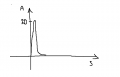
By the way the reduction from 200kV to 50 kV looks like that ?

1656971161623.png
To which which got the answer "No". And the question "haven't you understood what everyone has been telling you?"
The "no" was to your speculation that the current reduction was somehow a capacitive effect when if fact it can be explained as purely resistive.

Once the VDG is shorted out, any potential accumulated as charge on the dome is very rapidly dissipated because while the voltage is very high the total charge is not, and the belt that charges the dome can produce so little current it results in effectively 0 volts.

What can happen is that a person can replace the dome and be charged to a high voltage, again over time. The current doing this is vanishingly small but the cumulative result is a high voltage. Similarly to the dome, the person can't accumulate very much energy so even when they short themselves to ground, they will experience a very brief high energy impulse.

So, "how does it work?". The VDG is a static electricity generator. It depends entirely on the accumulation of charge top produce the high voltages. Contrast this to the electrical box you compared it to which is a alternating current generator which is capable of continuous delivery of voltages that result in high currents.

In the case of the VDG, the steady state output of the generator when attached to a load is very small while for the dynamo (AC generator) it varies with design but will always be far greater than any static electric generator, be it a VDG a Wimhurst machine, a Pelletron, or any other electrostatic generator.

None of this is to say that you couldn't make a VDG or other electrostatic generation device that would kill people. It would just depend on a longer impulse, though it would still suffer the same fate as smaller ones when grounded with a discharged accumulator.

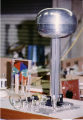
When I worked at the Boston Museum of Science I had the pleasure of maintaining the original Van Der Graff Generator which is the largest air insulated VDG in the world. In fact, it "cheats" a little but using a high voltage power supply to charge the belt To overcome the fact that practically speaking the belt was a pretty crappy insulator.

1657046585141.png
Photo by Z22 - Own work, CC BY-SA 4.0, https://commons.wikimedia.org/w/index.php?curid=34017074
The generator was in the ToE (Theater of Electricity) and there were hourly programs demonstrating it, and explaining features of its operation. I have no doubt it could have killed someone who got in the way.

As an aside, I designed and built a purely hand cranked VDG as an exhibit and it was able to produce ~250mm sparks in dry are with no external input other than the rotating of the crank, and it didn't require much work. While I was adjusting it while standing on a ~600mm square of acrylic/plexiglass/perspex to insulate myself from ground, it charged me up to the point that I discharged across the plastic from my big toe. I can tell you that hurt, but no damage.

1657047123296.png
The colorful device in the back is an electrostatic motor that works by charging regions on the plastic disk with the acrylic decals that repel each other and discharge.
 

BobTPH

Joined Jun 5, 2013
11,537
Well, you did ask why it didn’t kill him. People have talked about too little current, but that is not the case, there is plenty of voltage and current. it is too little energy, which depends on voltage current and time. In this case it is time that saves him.
 

Thread Starter

Xenon02

Joined Feb 24, 2021
504
Welcome Ya'akov

Thank you for your answer. I would like to talk about 1 of my statements.

Xenon02 said:
Correct me if I'm wrong let's say the Van de Graaf generator provided 50 kV and I'm 1 k Ohm resistor that means the current that runes through me is 50 Ampers but the time that current is running though me is so much low that it is not dangerous even though it is 50 ampers ?
And you were wrong, so people tried to correct you. Aside from the absurdly low proposed resistance for a human being to ground, even it you had that right your proposed scenario is wrong. Whatever the proper number for the instantaneous current is, you are completely ignoring the nature of the VDG, the apparent subject of your original question.
Why is it incorrect ?
What I tried to say here that the voltage is high and currentis also high but the time this current is high is so short that the energy is also small.

Which this comment says the same

Well, you did ask why it didn’t kill him. People have talked about too little current, but that is not the case, there is plenty of voltage and current. it is too little energy, which depends on voltage current and time. In this case it is time that saves him.
So I thought high voltage,high current,but the time that this current is high is very short which means that 20 ampers or 50 or 100 ampers can "lasts" not very long.

Something like this :

1657054451789.png

I think this is my fault because my english is pretty poor. I didn't mean here that the voltage is constant here nor the current.


And I don't understand this statement

Xenon02 said:
But usually 40kV in some electric boxes says it is leathal for us. So why 50kV is not dangerous. Let's say our body has 1k resistance so the current will be 50 Ampers with 50kV. Why electric box that are outsidewith 40kV can harm me but 50kV from generator doesn't

And why the voltage dropped from 200kV to 50kV while he is standing on a wooden chair ? It is an isolator so the current isn't flowing.
And why the voltage drops to zero while he touches the ground. The tower has 200kV potential, ground 0V potential so when I touch the tower I should have 200kV voltage and not 0 ....
Which indicates to me you didn't understand the nature of the VDG which bears almost no resemblance to the generator that is powering that electrical box.
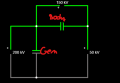
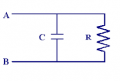
I've tried to make an equvelent circuit but when I'm standing in the isolation (wooden chair) the circuit is not "closed" it is open so I was supprised that the voltage dropped from 200kV to 50kV.

So I tried to make a circuit :

1657054812855.png

But I understand that is is wrong. Could you show me an simple equivilant circuit why the voltage drops from 200kV to 50kV in open circuit ? Or is it from a law that I don't know ?


Moreover, as I understand when I touch the generator while standing on the ground it is not able to produce high voltage, because it is shortened

Once the VDG is shorted out, any potential accumulated as charge on the dome is very rapidly dissipated because while the voltage is very high the total charge is not, and the belt that charges the dome can produce so little current it results in effectively 0 volts.
That's how I interpret. Like it is unable to accumulate a lot of charge because it is shortened and it is dissipated all the time it is starting it;s charging. Like I charge something and while charging it is also disscharging.
 

MrChips

Joined Oct 2, 2009
34,832
Capacitance.

Your body has capacitance, much greater capacitance than that of the Van der Graaf dome.
As soon as you touch the globe the total charge is redistributed across the net capacitance. Hence the voltage drops.
 

Ya’akov

Joined Jan 27, 2019
10,244
Welcome Ya'akov

Thank you for your answer. I would like to talk about 1 of my statements.


Why is it incorrect ?
What I tried to say here that the voltage is high and currentis also high but the time this current is high is so short that the energy is also small.

Which this comment says the same


So I thought high voltage,high current,but the time that this current is high is very short which means that 20 ampers or 50 or 100 ampers can "lasts" not very long.

Something like this :

View attachment 270820

I think this is my fault because my english is pretty poor. I didn't mean here that the voltage is constant here nor the current.


And I don't understand this statement


I've tried to make an equvelent circuit but when I'm standing in the isolation (wooden chair) the circuit is not "closed" it is open so I was supprised that the voltage dropped from 200kV to 50kV.

So I tried to make a circuit :

View attachment 270821

But I understand that is is wrong. Could you show me an simple equivilant circuit why the voltage drops from 200kV to 50kV in open circuit ? Or is it from a law that I don't know ?


Moreover, as I understand when I touch the generator while standing on the ground it is not able to produce high voltage, because it is shortened


That's how I interpret. Like it is unable to accumulate a lot of charge because it is shortened and it is dissipated all the time it is starting it;s charging. Like I charge something and while charging it is also disscharging.
I was trying to clear up two things that were being conflated. The initial voltage drop versus the continuing operation. As @MrChips points out, your body gets charged up because the connection to ground is high resistance and the voltage isn’t high enough to make it past the insulator (chair). But after that, there will be a constant bleeding off of charge in every case it can find a path where the voltage is sufficient.

In fact, preventing this is one of the challenges of making a VDG. Pointy bits anywhere, including attracted dirt particles will cause the dome to discharge limiting the highest possible voltage. This highest voltage still requires time to accumulate and the current will be very low as this happens. Eventually the voltage may reach the point of discharging through the air, or some other thing that was previously an insulator, and then, yet again, the current will be very briefly high.

The energy that can be delivered is a product of the total charge on the VDG dome, or latterly, the person‘s body.. The leakage which is a resistive feature determines the voltage limit, and the voltage and discharge path resistance the current limit

An electrostatic generator on the small scale of the VDG in question can’t ever provide enough energy to harm a person for that reason. It will never sustain sufficient current. I know you understand this point, but you asked something different initially and then silently switched to this one point (not a cogent explanation of the phenomenon you asked about), without acknowledging your previous error.

That is what was irksome to some members trying to answer your question, it mysteriously changed midstream.
 

Thread Starter

Xenon02

Joined Feb 24, 2021
504
Capacitance.

Your body has capacitance, much greater capacitance than that of the Van der Graaf dome.
As soon as you touch the globe the total charge is redistributed across the net capacitance. Hence the voltage drops.
So May I ask my last question ?

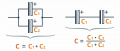
How does look the equivalent circuit ? I was trying to make an circuit that could represent this situation of distrubuiting total charge.

An electrostatic generator on the small scale of the VDG in question can’t ever provide enough energy to harm a person for that reason. It will never sustain sufficient current. I know you understand this point, but you asked something different initially and then silently switched to this one point (not a cogent explanation of the phenomenon you asked about), without acknowledging your previous error.

That is what was irksome to some members trying to answer your question, it mysteriously changed midstream
Then I would like to appologize not only to you but to everyone.
I thought that somebody would understand what I was trying to say but I see everybody though I was talking about 50kV :D Which was confusing comparing to my statements where we touch the ground and the dome.
I'm sorry for switching topics. So I believe what I said about high voltage and high current was right but not for this this part where we stand on wooden chair, of course high peak of voltage and current is when we touch directly dome while standing on the ground.
 

Ya’akov

Joined Jan 27, 2019
10,244
So May I ask my last question ?

How does look the equivalent circuit ? I was trying to make an circuit that could represent this situation of distrubuiting total charge.
In your schematic, You have a static arrangement of the generator’s capacitance and the body’s capacitance. The trouble is, there will only be one voltage to be measured for each configuration.

You have the dome, which has enough charge to be to reach 200kV. That would be the first configuration, wthout the body.
Next you have the second configuration, the done and body in series, the 200kV potential, based only on the capacitance of the dome will be reduced to 50kV because the additional capacitance of the body requires more charge to achieve 200kV and what is accumulated in the dome is not enough

Then I would like to appologize not only to you but to everyone.
I thought that somebody would understand what I was trying to say but I see everybody though I was talking about 50kV :D Which was confusing comparing to my statements where we touch the ground and the dome.
I'm sorry for switching topics. So I believe what I said about high voltage and high current was right but not for this this part where we stand on wooden chair, of course high peak of voltage and current is when we touch directly dome while standing on the ground.
Apologies are not necessary. I was explaining the confusion as I saw it. People were still trying to answer what appeared to be your question and what you were saying wasn’t that answer but the outcome of the content of the answer.

Lanugage barriers can be difficult, and even if people (supposedly) are both fluid the language being used confusion of that sort occurs all the time. If I could make one suggestion it would be to repeat back your understanding of what the person you are talking to said, rather than your conclusions from it, before going further into those conclusion.. That allows them to see you understood what they were saying (assuming you did) and to listen to the feast as additional logical extension.

I hope I didn’t make you think I was blaming your for the confusion, that was not my intention.[/QUOTE]

[EDIT: fixed broken quote tag]
 

Thread Starter

Xenon02

Joined Feb 24, 2021
504
You have the dome, which has enough charge to be to reach 200kV. That would be the first configuration, wthout the body.
Next you have the second configuration, the done and body in series, the 200kV potential, based only on the capacitance of the dome will be reduced to 50kV because the additional capacitance of the body requires more charge to achieve 200kV and what is accumulated in the dome is not enough
Is it like we have 2 capacitance in series ? If yes then isn't it like that capacitence in series reduces the total capacitence ?
1657116208727.png
 
Top