USS Fitzgerald

Thread Starter

nsaspook

Joined Aug 27, 2009
16,325
https://news.usni.org/2018/03/08/singapore-safety-report-uss-john-s-mccain-aug-21-2017-collision
The safety investigation determined that the USS John S McCain made a sudden turn to Port (left) into the path of Alnic MC because of a series of missteps that took place after propulsion controls were transferred.

When the Bridge team of Alnic MC saw the USS John S McCain turning, it presumed that the USS John S McCain would be able to safely pass ahead. The collision happened within three minutes of the USS John S McCain turning to Port, and the actions taken by Alnic MC were insufficient to avoid the collision.
 

jpanhalt

Joined Jan 18, 2008
11,087
The safety investigation determined that the USS John S McCain made a sudden turn to Port (left) into the path of Alnic MC because of a series of missteps that took place after propulsion controls were transferred.
I saw that and wondered why there was no further elaboration. One thought, whoever was in command was facing aft and ordered a "left" turn for avoidance. A sailor hearing "left" turned Port. ;)
 

spinnaker

Joined Oct 29, 2009
7,830
I saw that and wondered why there was no further elaboration. One thought, whoever was in command was facing aft and ordered a "left" turn for avoidance. A sailor hearing "left" turned Port. ;)

It is the whole reason you use port and starboard on the boat. There is no left and no right. Just port and starboard. Though a dyslexic captain and/or helmsman can still mix them up. ;)
 

Thread Starter

nsaspook

Joined Aug 27, 2009
16,325
I saw that and wondered why there was no further elaboration. One thought, whoever was in command was facing aft and ordered a "left" turn for avoidance. A sailor hearing "left" turned Port. ;)
The real reason for the fatal turn was the throttle (for dual shaft control) wasn't ganged when the helm was shifted back and forth. So when ordered to slow after regaining control, the lee helmsman only slowed the port (left) throttle causing the aft screw to turn the ship into the other.
 

WBahn

Joined Mar 31, 2012
32,844
The real reason for the fatal turn was the throttle (for dual shaft control) wasn't ganged when the helm was shifted back and forth. So when ordered to slow after regaining control, the lee helmsman only slowed the port (left) throttle causing the aft screw to turn the ship into the other.
So what procedures should have been in place to quickly detect that the ship wasn't responding to the given orders the way it was supposed to?
 

Thread Starter

nsaspook

Joined Aug 27, 2009
16,325
So what procedures should have been in place to quickly detect that the ship wasn't responding to the given orders the way it was supposed to?
They did the right thing by first giving steering control to AFT (a separate control station away from the bridge with a emergency override) steering after thinking (incorrectly) control wan't responding correctly to commands on the bridge. This confirmed that the actual rudder systems were working correctly. There are several stations for helm control with the possibility of separate throttle controls at another station for the normally ganged port and starboard propulsion units. Having a two man throttle/steering split is normal operation. In close quarters or in special operations one person sometimes handles both duties because it's faster but more prone to screw-ups because generally that's when you start to use engine control with steering to maneuver quickly. The combined throttle/steering control mode on ONE station was effect (close quarter with other ships in the narrow sea lane) when the CO noticed the helm was having problems keeping course in the shipping lane using engine control in manual unganged mode to offset drift and steering at the same time.

The CO then ordered split duties for throttle given to the lee helm while the helm remained in steering control. This is the point where things go to hell when they didn't see that total control was shifted instead.
What happened was steering was actually moved from the helm operating station to another station so the helm reported loss of steering correctly while going 20 knots in a narrow sea lane with a steering and throttle bias to keep on course. Someone should have noticed it was just a control shift not a failure in the system.

AFT steering control assumed command after a emergency was sounded but split throttle control was still on the bridge. AFT steering did a steering command test causing a turn to Port before returning control to the bridge. The CO ordered a reduction in speed that increased the rate of turn to port as the ship slowed because the screws were set to asymmetrical speeds (66 Port, 90 Starboard SRPM) to offset drift. This changed the shaft speeds to a 44/87 SRPM split after the first speed reduction increasing the Port turn rate. (double pucker time)

There are no new procedures that are needed, only properly trained personnel that can understand the root problem (steering and propulsion systems operations) instead of assuming a failure and losing control troubleshooting a nonexistent failure. A big bright light bulb on each station for who had steering and propulsion might be helpful.
 

WBahn

Joined Mar 31, 2012
32,844
There are no new procedures that are needed, only properly trained personnel that can understand the root problem (steering and propulsion systems operations) instead of assuming a failure and losing control troubleshooting a nonexistent failure. A big bright light bulb on each station for who had steering and propulsion might be helpful.
The first thing I thought of before reaching the end of your first paragraph was that perhaps there should be a very distinct and unmistakable indication of what station has control of what at each such station with each one emphasizing the things that THAT station currently has control over. Seems pretty obvious. I wonder how much incremental history played a role.

The problem of being distracted by troubleshooting small things and causing bigger problems is hardly unknown. For example, that's exactly what caused the crash of Eastern Flight 401 back in 1972. The result of that was exactly what appears is needed here -- a look at training. That crash led to an awareness of the problem that was confirmed after other crashes in the 1970's, such as United Flight 173 in which the plane ran out of fuel because the crew was distracted diagnosing a landing gear problem. The result was a HUGE change in how aircrews are trained to deal with situations called CRM (Crew Resource Management).
 

Thread Starter

nsaspook

Joined Aug 27, 2009
16,325
The first thing I thought of before reaching the end of your first paragraph was that perhaps there should be a very distinct and unmistakable indication of what station has control of what at each such station with each one emphasizing the things that THAT station currently has control over. Seems pretty obvious. I wonder how much incremental history played a role.

The problem of being distracted by troubleshooting small things and causing bigger problems is hardly unknown. For example, that's exactly what caused the crash of Eastern Flight 401 back in 1972. The result of that was exactly what appears is needed here -- a look at training. That crash led to an awareness of the problem that was confirmed after other crashes in the 1970's, such as United Flight 173 in which the plane ran out of fuel because the crew was distracted diagnosing a landing gear problem. The result was a HUGE change in how aircrews are trained to deal with situations called CRM (Crew Resource Management).
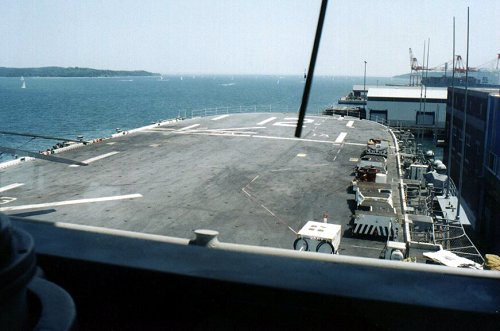
This is a picture of the last ship I was on (IWO JIMA class of helicopter assault ships ). She was build in the 60's.

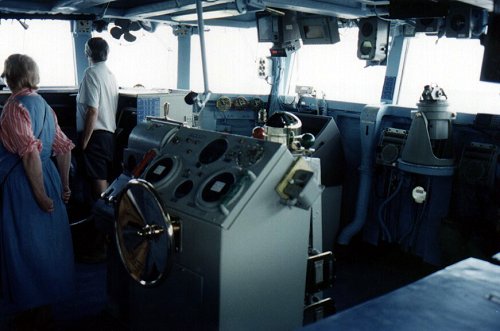
Bridge view

The captain's chair is where the lady is.

Standard old school steering and throttle on one station that could be manned by two people or one.
In an emergency control could be shifted to the AFT station or they could Override the bridge.

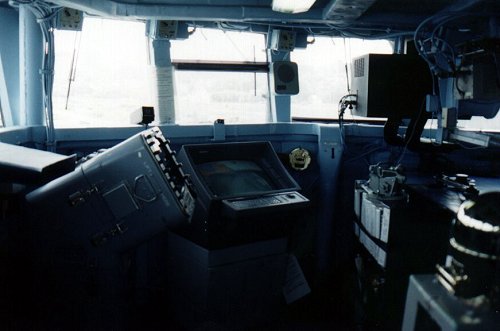
Starboard side bridge view radar and weapons stations.


McCain Old style helm.


McCain had recently upgraded to the “Integrated Bridge Navigation System” Helm like this. Most of the controls and indicators are on the computers screens loaded with busy small print and icons designed for office use.
The computer assisted navigation seems to make understanding who has positive control and the exact configuration unclear at a glance in a emergency when control in switched rapidly from control stations or changing modes.

When the Lee Helm lowers the speed of the port shaft to 44 rpm/100% pitch, no-one is aware that the starboard shaft is still at 87 rpm/100% pitch. With the rudders amidships, no-one is steering but the rate is increasing. They don't panic but they are unaware of what's causing the problem.

It would have been nice to have a bridge mounted OIC Override button that gave full control to the single Helm station with all systems set to a known default old school configuration so they could work out a proper solution then.

I don't think that a lack of training was totally at fault because the system seems just too complicated during an emergency. Most of the senior people in charge used the older systems and in a emergency that familiar older training tends to control your actions so they didn't help regain total control until it was too late.


FROM THE US NAVY DOCUMENTS and other reviews of what happened.
Watchstanders on USS John S. McCain did not have the training or knowledge on the modes of operation of the Integrated Bridge and Navigation System, particularly relating to the ship’s steering controls. They unknowingly transferred control of steering away from the Helmsman while shifting modes of operation. The designed responses of the IBNS when shifting modes also creates known vulnerabilities that have not been clearly communicated to the operators on ships with these systems.

Because steering control was in Back-up Manual at the HELM station, the offer of control existed at all the other control stations (Lee Helm, Helm forward station, Bridge Command and Control station and Aft Steering Unit and maybe the HELM as well). System design is such that any of these stations could have taken control of steering via drop down menu selection and the Lee Helm’s acceptance of the request, if this had occurred would have transferred steering control.

The Comprehensive Review considered that the Integrated Bridge Navigation System provided controls and information which were “inconsistent with best practices in industry for safety critical control panels”. For instance the touch screen for throttle control is considered unusable. Eight of the first 12 ships receiving the installation immediately reported intermittently losing throttle control when changing speed quickly. It also states “unnecessary complexity in equipment or inadequate training for operators creates a latent hazard that may not be revealed during training or assessment of proficiency in conducting normal operations”.

The review went on to say that there is a tendency of designers to add automation without considering the effect to operators who are trained and proficient in operating legacy equipment. Similarly, attempts to add flexibility with alternate modes of control demand operator attention to track modes of operation and stay aware of differences in system behavior. Surface force IBNS operators interviewed noted the on densely packed display areas the frequency of faults is distracting, leading to normalization over time.
 

Thread Starter

nsaspook

Joined Aug 27, 2009
16,325
https://www.stripes.com/former-uss-...eads-guilty-in-plea-deal-will-retire-1.529163
WASHINGTON — The commander of the USS John S. McCain when it collided with a commercial tanker last year in the Straits of Singapore pleaded guilty Friday to dereliction of duty and acknowledged his role in the deaths of 10 sailors.
https://www.stripes.com/uss-john-s-mccain-chief-pleads-guilty-in-court-martial-loses-rank-1.528952
WASHINGTON — A chief charged with training and use of a navigational system on the USS John S. McCain at the time it collided with a commercial tanker in the Straits of Singapore, pleaded guilty Thursday to dereliction of duty and acknowledged his role in the deaths of 10 sailors last year.
 

Thread Starter

nsaspook

Joined Aug 27, 2009
16,325
https://www.defensenews.com/naval/2...ds-widespread-shortfalls-in-basic-seamanship/
WASHINGTON — A three-month internal review conducted by senior U.S. surface fleet leaders found some or significant concerns with the ship handling skills of nearly 85 percent of its junior officers, and that many struggled to react decisively to extricate their ship from danger when there was an immediate risk of collision, according to an internal message obtained by Defense News.

Led by the Surface Warfare Officer School, officer of the deck competency checks were conducted on a random selection of OOD-qualified first-tour division officers (the newest officers in the fleet) in underway bridge navigation simulators fleet-wide between January and March. Of the 164 officers who were evaluated, only 27 passed with “no concerns.” Another 108 completed with “some concerns,” and 29 had “significant concerns,” according to the message, which was released by the Navy’s top surface warfare officer Vice Adm. Richard Brown.

Brown, who leads Naval Surface Force Pacific, termed the results “sobering.”
 

WBahn

Joined Mar 31, 2012
32,844
Do you think the US Navy will adopt the aviation motto of "12 hours, bottle to throttle"?
Hard to say. The "Eight hours, bottle to throttle," is more than just a motto, it is explicitly mandated by the FARs (FAR 91.17). There are other requirements as well, such as a max BAC of 0.04%.The 12 hour rule is a common requirement of commercial air carriers and commonly followed by general aviation pilots as well. I don't know what the military requirements are. What are the actual maritime requirements? Unless one of them is based on a specific time requirement, I would not expect to see widespread adoption of such a motto.
 

JoeJester

Joined Apr 26, 2005
4,390
33 CFR 95 covers some maritime rules:

Sec. 95.020 Standard for under the influence of alcohol or a dangerous drug.An individual is under the influence of alcohol or a dangerous drug when:
(a) The individual is operating a recreational vessel and has a Blood Alcohol Concentration (BAC) level of .08 percent or more, by weight, in their blood;
(b) The individual is operating a vessel other than a recreational vessel and has an alcohol concentration of .04 percent by weight or more in their blood; or,
(c) The individual is operating any vessel and the effect of the intoxicant(s) consumed by the individual on the person's manner, disposition, speech, muscular movement, general appearance or behavior is apparent by observation.

However, we would have to look at the USN policy ....

OPNAV INSTRUCTION 5350.4D
From: Chief of Naval Operations
Subj: NAVY ALCOHOL AND DRUG ABUSE PREVENTION AND CONTROL

6. Policy

d. Alcohol consumption is a personal decision by individual members. Those who choose not to consume alcoholic beverages shall be supported in their decision and encouraged to remain alcohol free. Those members who choose to consume alcoholic beverages must do so lawfully and responsibly. Responsible use is the application of self-imposed limitations of time, place, and quantity when consuming alcoholic beverages. Alcohol consumption is never an acceptable excuse for misconduct or poor judgment. Any misconduct or irrational behavior where alcohol use is involved must be addressed immediately and effectively. Most individuals will respond to immediate and effective intervention. Alcohol ,abuse left unaddressed has potential to place both the member and the Navy in danger. Therefore, while it remains an individual's choice as to whether or not to drink alcoholic beverages, members who choose to drink shall do so in an appropriate place, at an appropriate time, and in an appropriate quantity. Alcohol shall not be consumed to the extent that it:

(1) Impairs rational and full exercise of a member's mental and physical faculties while in a duty status or in the performance of military duties;
(2) Reduces member's dependability and reliability;
(3) Reflects discredit upon the member personally or upon Navy; or
(4) Results in behavior that is in violation of this instruction and/or reference (b).

e. Violation of policies set forth in this instruction subjects military members to the full range of administrative and disciplinary actions available. These include informal counseling, comments ,in fitness reports and evaluations, punitive measures, and ADSEP as required by reference (b).

f. Navy does not condone consumption of alcoholic beverages during normal working hours. Commanders, commanding officers, , and OICs may authorize consumption of alcoholic beverages during normal working hours for official functions, ceremonies, and other infrequent command-sponsored events.

I can say the CG had similar rules in their Alcohol policy.

As OIC, I only had alcohol aboard the unit during the Commissioning and my Change of Command/Retirement ceremonies. There was an after party at the VFW though and there was no Cinderella liberty for the crew.

on edit ...

STCW regulations, which regulate the professional mariner had a change in 2012 ..


For the first time under STCW, mandatory limits for alcohol consumption are also being introduced (a limit of not greater than 0.05% blood alcohol level (BAC) or 0.25 mg/l alcohol in the breath), although individual flag states may choose to apply stricter limits.

For example, seafarers must now always have at least 10 hours rest in any 24 hour period. To help further reduce the possibility of fatigue, much of the flexibility that previously applied under STCW has now been removed.

from: http://www.professionalmariner.com/...rest-hour-alcohol-rules-go-into-effect-Jan-1/

I don't see the seafaring community in the USN abiding by rules listed for a union.
 
Last edited:

BR-549

Joined Sep 22, 2013
4,931
In 1969 I lived in a dilapidated ranch bunk house, just outside Edwards AFB in the Mojave desert.

Had my drivers license but still underage. Had a VW Bug. It was my hippie era. I could make real good money......in the evenings......at the officers club.......trying to keep the 3 bars stocked.

It was quite a work out and often needed help. On special occasions......as many as 10 bars could be going.....in that small club.

I have never seen such drinking since.....and I was in the Navy shortly after that.
 
Top