Facebook
 Google
 GitHub
 Linkedin
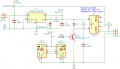
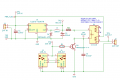
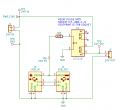
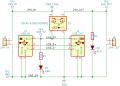
Hi all, let me preface this to say I'm not an EE (I don't even play one on TV), but as an ME test engineer I've been learning a smattering of electronics over the last few years. I have a USB data acquisition (DAQ) device that is powered by 24V and is used to supply analog output voltages to control 8 stations with electric motors which spin automotive engines through various test cycles, anywhere from idle up to 6000 RPM or more. These stations run 24/7. If the USB signal to the device is interrupted (without losing the 24 volt power), the device will "stick" or "hang" at the last known analog output voltage command. This can be a major problem if the engine is expected to run briefly at 6000 rpm and ends up staying there for possibly hours overnight (this happens only on very rare occasions, but will still ruin a test if it does). So as a safety feature I tried to design a circuit that will use the USB input signal to power an SSR via a transistor to enable/disable the 24V power input. This way if the USB signal is lost the DAQ device will shut down, thereby shutting down all of the engines. The circuit mostly works okay, with the power being applied when I plug in the USB and shutting down when I remove it, but for some reason after running awhile the USB signal will just drop out randomly, shutting down all of our tests. This can happen after a day or two or possibly a week or two; it's pretty random. This phenomenon seems to be caused by the circuit itself, because if I remove the circuit the disconnects don't happen. I've included a schematic below. Let me know if you require additional information. I'd appreciate any advice you can give to help me mitigate this problem.