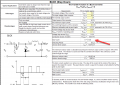
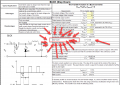
It says right on the sheet 50% dutyI cannot find any formulas in the buck.xls.
I will assume that you use 50% duty cycle and want 30V to become 15V.
There is 0.4V loss in Q1. There is loss in D1. There should be resistance in L1 and that will eat up power and voltage.
When were you going to tell us that? Why say the MOSFET has RDSon and not say I am using 0 ohm parts?I’m doing this in a simulation with ideal parts
What sheet. I looked for any "50%" or any "50" or "0.5" and can't find it in the forum or in the excel fine.It says right on the sheet 50% duty
Which simulation program? Where is the file?I’m doing this in a simulation with ideal parts
Don't be too harsh. He just needs to review the basics and do the calculations.When were you going to tell us that? Why say the MOSFET has RDSon and not say I am using 0 ohm parts?
What sheet. I looked for any "50%" or any "50" or "0.5" and can't find it in the forum or in the excel fine.
Which simulation program? Where is the file?
I hate to jump on you, but you are wasting our time and not getting an answer.
Are you for real man? It clearly says .54 in many locations. Including in my original postWhen were you going to tell us that? Why say the MOSFET has RDSon and not say I am using 0 ohm parts?
What sheet. I looked for any "50%" or any "50" or "0.5" and can't find it in the forum or in the excel fine.
Which simulation program? Where is the file?
I hate to jump on you, but you are wasting our time and not getting an answer.

ThanksDon't be too harsh. He just needs to review the basics and do the calculations.
I'm a big believer in showing your work algebraically and when people don't do that, it's a clear indication they have skipped important lessons.
As for myself, I can't tell what he knows and what he doesn't because he doesn't really show his approach.
Often times I think people are reluctant to reveal their weaknesses such as these and then try to reason it out in other ways but that doesn't work.
I see learning like climbing a steep rock face. Sometimes you take a path which leads nowhere and you have to go all the way back down.
The trouble is it takes a lot of energy and determination to find a new path especially when people are working against you.
It says right on the sheet 50% duty
I was looking for .5 (and variants of that) not .54, or .534.Are you for real man? It clearly says .54 in many locations. Including in my original post
so you berate me and complain that I'm not providing the information but when i show it listed in more then one location your response to me is .... "goodluck"I was looking for .5 (and variants of that) not .54, or .534.
Good luck.


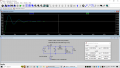
Thank you very much for taking an interest in my learning this. It was kind of you to put that effort in. I think the issue i have found was an unexpected voltage drop caused by a RDS and therefore a VDS of the FET i was not expecting. I thought they were ideal but apparently not.Here is a simulation of your circuit with the suggested values and it checks out. This is why showing your work is critical for an effective analysis. A few things to note:
1) The document you provided is limited with the information it contains. Power converters are much more complicated so you must realize the document as well as my simulation is an over-simplification. It is also quite possible the values and the method itself is wrong so look to many sources for your information. The rest of my comments follow on this idea.
2) The actual MOSFET they used isn't given. All we know is it has an ON resistance of 100mΩ which results in a 0.4V drop across it at full load. Since we don't know anything else, I am modelling the device with a Voltage Controlled Switch where I set the threshold to an arbitrary 10V (the drive signal is 12V so the switch fully conducts with an effective series resistance of 100mΩ).
3) Similar to the FET, the diode used wasn't disclosed either. All we know is it has a forward voltage of 800mV.
4) All real circuits have series resistance. When using SPICE, I've found it's better to add some to every component to offset the ideal nature of the simulator. More is generally better because modest amounts (less than 10mΩ) will barely have an effect on a high voltage, low impedance source.
And finally, I highly recommend you return to the basics on this stuff and I mean the basics. Look up the formal definitions of voltage, current and the other units used to understand what the transfer function is saying. The bottom line is all of this stuff is algebra so you better get used to thinking and writing algebraically.
View attachment 320737
Not sure what you mean by ideal because nothing is. I wanted to show how you should take the data given and work within those bounds to solve the problem.Thank you very much for taking an interest in my learning this. It was kind of you to put that effort in. I think the issue i have found was an unexpected voltage drop caused by a RDS and therefore a VDS of the FET i was not expecting. I thought they were ideal but apparently not.
Regardless..... learning is taking place. I will try and pay it forward someday.
Agreed thank youNot sure what you mean by ideal because nothing is. I wanted to show how you should take the data given and work within those bounds to solve the problem.
As a pragmatist, I would say my circuit worked because I only included what was provided with minimal additions. I also think I've made it fairly easy for you to look at my work to tell what's going on. If I don't present my thought process in a clear, organized manner, how is anyone supposed to understand what I mean? Some people use words, I prefer simulations, diagrams and algebra.