Using multi-vibrator circuit to pulse small electromagnetic coils

Thread Starter

NickB

Joined Feb 1, 2016
95
Yes, not as bad as it looks & yes there are 6 inverters in 1 chip.
They make "breadboards that make it pretty easy to wire with 30 awg wire.


@Alec_t 's idea is worth a try, don't you think?
Hi Ron_v, I'd considered it but worried about getting the strength of the coils the same - they are neat but still home made units. I'm going to give it a try as it will save time. If it doesn't work I'll give the schema a try that you so kindly put together.

Just wondered if you could tell me what battery configuration you envisaged? As I'm a novice it's not obvious to me. Also the connection Vdd - where does that go to?

Thanks
Nick
 

ronv

Joined Nov 12, 2008
3,770
Hi Ron_v, I'd considered it but worried about getting the strength of the coils the same - they are neat but still home made units. I'm going to give it a try as it will save time. If it doesn't work I'll give the schema a try that you so kindly put together.

Just wondered if you could tell me what battery configuration you envisaged? As I'm a novice it's not obvious to me. Also the connection Vdd - where does that go to?

Thanks
Nick
Hi Nick,
I think the 90 degree coils should work since there won't be any dead spot.
But just in case. Vdd is the voltage that goes to the IC to power it.
I left the batteries the same, but tapped off in the center of the 4 of them for the coils. I think that will still give you enough power and the voltage should stay high enough to run the circuits. (I hope):)
 

ebeowulf17

Joined Aug 12, 2014
3,307
If it were me I'd try repositioning the coils so that they're 90* apart rather than180* apart and wire them in series. I think that would eliminate any dead spot and so enable just a single pulse to twitch/spin your gizmo.
I don't understand how this eliminates a dead spot. If the field isn't moving or reversing polarity, there will be a position in which the magnet can rest at equilibrium with the combined 90* offset magnetic fields. If the magnet is already resting in that position when a pair of 90* offset coils are activated, it won't move. The changed angle makes the equilibrium position less intuitive and visibly obvious to predict, but I don't see how it eliminates any such equilibrium position. Am I missing something?
 

Thread Starter

NickB

Joined Feb 1, 2016
95
Thanks Shortbus but they don't need to be very strong. The ones I've built are plenty strong enough for moving neodymium magnets even at 1.5v.

Nick
 

hp1729

Joined Nov 23, 2015
2,304
Hello there, this is my first post so please go easy on me.

I want to create a circuit that will pulse two very small electromagnetic coils and have been experimenting with this multi-vibrator circuit on my breadboard using the same components but with 6v.

http://www.technologystudent.com/elec1/dual1.htm

My circuit is powered by 4 x AAA cells and is switched via a Mosfet connected to an RF receiver. The EM coils are very small air coils (6mm cores) with 50 winds of 28 gauge wire and appear to draw approx. 3.5 amps when connected direct to the batteries.

Don’t laugh, but perhaps naively, I thought I could just swap out the 680R resistors and LEDs and replace them with the coils and snubber diodes. However, there doesn’t appear to be sufficient current to drive the coils at all.

My question is - should I try to get more current to flow through the circuit by using higher spec transistors, or should I just use the multi-vibrator circuit to pulse two small relays connected to the coils and power instead?

Space is an issue so I want to use as few components as possible.

I’m a complete novice, but a quick learner. Any advice or help greatly appreciated.

Thanks

Nick
Not air core coils. Iron core.
 

Alec_t

Joined Sep 17, 2013
15,121
If the field isn't moving or reversing polarity, there will be a position in which the magnet can rest at equilibrium with the combined 90* offset magnetic fields.
Providing the coils with small iron cores should overcome that. The equilibrium position with the coils de-energised will then differ from the equilibrium position when they are energised.
 

ebeowulf17

Joined Aug 12, 2014
3,307
Providing the coils with small iron cores should overcome that. The equilibrium position with the coils de-energised will then differ from the equilibrium position when they are energised.
When they're de-energized, won't the needle rest in any position equally well (no magnetic field, so no influence?) Or do the cores end up creating a field of opposite polarity when de-energized? Honestly, I'm not trying to be difficult here. Just trying to understand this better and maybe learn something new. I'm reasonably comfortable with a lot of magnetic concepts, but still have a LOT to learn! A lot of what goes on with inductors is still fascinating and mysterious to me.
 

Alec_t

Joined Sep 17, 2013
15,121
When they're de-energized, won't the needle rest in any position equally well
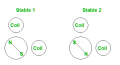
For air cores yes, but for iron cores I don't think so. If the coils are 90* apart I reckon there will be two stable positions for the rotating magnet when the coils are de-energised, since its poles will tend to pull towards the two iron cores. If the coils are then energised such that both cores produce, say, a N pole adjacent the magnet, the magnet should rotate, since the N pole of the magnet will be repelled while the S pole will be attracted.
Stable positions.PNG
 
Last edited:

Thread Starter

NickB

Joined Feb 1, 2016
95
For air cores yes, but for iron cores I don't think so. If the coils are 90* apart I reckon there will be two stable positions for the rotating magnet when the coils are de-energised, since its poles will tend to pull towards the two iron cores. If the coils are then energised such that both cores produce, say, a N pole adjacent the magnet, the magnet should rotate, since the N pole of the magnet will be repelled while the S pole will be attracted.
View attachment 100139
Hi Alec_t, thanks for your help on this, really appreciated. I've never made ferrous coils before, only large and small air coils in the past so should be interesting. I'll probably look to get some iron powder but need a tiny container 6mm in diameter - got any tips or seen anything which could be utilised?

Thanks
Nick
 

shortbus

Joined Sep 30, 2009
10,050
I'll probably look to get some iron powder
Not iron powder but solid iron. I'd make a small bundle of soft steel wire, whats known as "mechanics wire" or used to be called "bailing wire". Even a nail or bolt would work.

Unless you are switching your coil polarities back and forth, your magnet is only going to swing until opposite polarities line up. I'd do this a little differently myself. Instead of a circular magnet, a square or rectangular magnet mounted to the edge of a circle/wheel. This would make the wheel off balance to start with. Then the coils would be mounted 180 degrees apart on the center line of the axle. First energize one coil the wheel would turn that direction. Then energize the other magnet and the wheel would turn that direction. Kind of like how it's done in an analog ammeter.
 

Alec_t

Joined Sep 17, 2013
15,121
I wouldn't bother with iron powder unless you have a convenient source. Soft iron has traditionally been used for cores and would be ideal, but anything ferromagnetic might do (providing magnetic remanence is not too strong). I'd try a short nail/screw/bolt as a core. That could also provide a means for mounting the coil. The mounting would need to be adjustable in any case, since there's no guarantee that the 90* arrangement would perform better than a 180* one. It occurs to me that further, more stable positions exist in the de-energised state: with a magnet pole in its closest position to a coil core.
 

Thread Starter

NickB

Joined Feb 1, 2016
95
Not iron powder but solid iron. I'd make a small bundle of soft steel wire, whats known as "mechanics wire" or used to be called "bailing wire". Even a nail or bolt would work.

Unless you are switching your coil polarities back and forth, your magnet is only going to swing until opposite polarities line up. I'd do this a little differently myself. Instead of a circular magnet, a square or rectangular magnet mounted to the edge of a circle/wheel. This would make the wheel off balance to start with. Then the coils would be mounted 180 degrees apart on the center line of the axle. First energize one coil the wheel would turn that direction. Then energize the other magnet and the wheel would turn that direction. Kind of like how it's done in an analog ammeter.
Hi Shortbus, that's kind of what I was wanting to do with my original post but I can't find a circuit that will energize one coil then energize a second coil while turning the first coil off with just one signal from my RF receiver. That would be my preferred route. I'd even looked at using two channels from the receiver to activate the coils on separate circuits but that seems an un-elegant way of doing it. Also, as I'm wiring toe switches to the remote key fob, I'd have to use two which would be tricky.

I've been playing around with the two coils this afternoon and as you rightly point out, with coils at 90* and energised together the dead spot just ends up at 35*. I then tried a couple of steel screws through the coils - same thing. I want to avoid using ferrous cores TBH as they are fiddly to make and soft iron is near impossible to get in the UK. Mild steel will just become magnetised over time as it doesn't drop the field like iron so I think I'd have the same problem with dead spots.

I'd prefer to stick with energising the coils separately if possible. I like your idea of possibly using the tiny magnet as a counter weight on a brass flywheel, that way the pointer will end up at a truly random position which is what I want ideally.

Thanks
Nick
 

Thread Starter

NickB

Joined Feb 1, 2016
95
A half bridge driver, and a couple of mosfets would do it.
Sounds interesting - would you be kind enough to elaborate a bit? As I mentioned earlier I'm a complete novice with circuits so have no idea what a 'half bridge driver' is or how I'd configure it with the two mosfets. Any help to get this thing across the finish line would be greatly appreciated.

Thanks
Nick
 

Alec_t

Joined Sep 17, 2013
15,121
Are you set on having the magnet/pointer end up in a random position? If not, it could be biased by a spring, gravity, or magnetically, to a known position which is not a dead spot, so that a single coil to be used reliably.
 

Thread Starter

NickB

Joined Feb 1, 2016
95
Hi Alec_t. I have two options and am weighing up the pros and cons of each in terms of what it adds to the effect I'm creating. The first option is to have the pointer end up at a random position. Second is to have it end up at one of two positions on the dial. To better explain why, please see the link below.

http://www.mysteriousplanchette.com/Manu_Portal/isaacpease.html

The dial on the right is what I'm recreating. It's an effect based on an old spirit dial. You'll notice it has 'Yes' and 'No' at approx 45* and -45*. Having the pointer stop at either of those two places is fine for option two and could be achieved using tiny neo magnets (less powerful than the coil), placed underneath at the edges of the dial plate. In this instance I’d probably ditch the diametrically opposed magnet in favour of a brass flywheel with a small regular magnet placed in an offset position.

Option one lends itself to more storytelling as the pointer could spell anything out and would probably still use the diametrically opposed magnet. Either option is acceptable to me though.

If the circuit for either option uses a H Bridge driver and mosfets to reverse polarity in the coil (I'm learning), I could get away with using one coil possibly. The circuit is currently activated by a Mosfet (STP36NF061) used as the switch connected to the RF receiver, but I’m struggling to see how I’d configure a ‘A half bridge driver, and a couple of mosfets’as suggested by Shortbus. I would have thought you’d need two switches, one to power the coil on in the first instance and then one to reverse the polarity or am I missing something?

As always any help or suggestions greatly appreciated.

Nick
 

Thread Starter

NickB

Joined Feb 1, 2016
95
Are you set on having the magnet/pointer end up in a random position? If not, it could be biased by a spring, gravity, or magnetically, to a known position which is not a dead spot, so that a single coil to be used reliably.
Hi Alec_t. I have two options and am weighing up the pros and cons of each in terms of what it adds to the effect I'm creating. The first option is to have the pointer end up at a random position. Second is to have it end up at one of two positions on the dial. To better explain why, please see the link below.

http://www.mysteriousplanchette.com/Manu_Portal/isaacpease.html

The dial on the right is what I'm recreating. It's an effect based on an old spirit dial. You'll notice it has 'Yes' and 'No' at approx 45* and -45*. Having the pointer stop at either of those two places is fine for option two and could be achieved using tiny neo magnets (less powerful than the coil), placed underneath at the edges of the dial plate. In this instance I’d probably ditch the diametrically opposed magnet in favour of a brass flywheel with a small regular magnet placed in an offset position.

Option one lends itself to more storytelling as the pointer could spell anything out and would probably still use the diametrically opposed magnet. Either option is acceptable to me though.

If the circuit for either option uses a H Bridge driver and mosfets to reverse polarity in the coil (I'm learning), I could get away with using one coil possibly. The circuit is currently activated by a Mosfet (STP36NF061) used as the switch connected to the RF receiver, but I’m struggling to see how I’d configure a ‘A half bridge driver, and a couple of mosfets’as suggested by Shortbus. I would have thought you’d need two switches, one to power the coil on in the first instance and then one to reverse the polarity or am I missing something?

As always any help or suggestions greatly appreciated.

Nick
 

Alec_t

Joined Sep 17, 2013
15,121
Hmmm. I can see from the link that the random option would be more versatile. For that option I'm now wondering if perhaps you might need 3 coils to guarantee the movement you want?
 
Top