Using capacitors in feedback loops

Thread Starter

Ross19892018

Joined Dec 26, 2018
32
Hi,

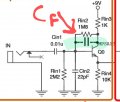
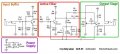
I've been looking into the applications for capacitors as I found some interesting "Orange drop" capacitors in a guitar pedal I took apart and fancied seeing what else I could find. I have been reading about using feedback or Miller capacitors in CE amps to control the frequency response by selectively feeding back higher frequencies, shaping the overall gain curve and potentially improving its stability. Could this possibly help give a brighter more full tone in an audio application? I have a simple diagram for a buffer at the input of a guitar pedal and thought it could be advantageous to stick one in there between the base and collector. Any thoughts?
Screenshot_20250126_214453_Chrome~2.jpgcry-baby-wah-gcb-95-schematic-parts-small.jpg
 
Last edited:

MrChips

Joined Oct 2, 2009
34,628
Just the opposite. Inserting a capacitor between the base and collector applies increasing negative feedback as the frequency gets higher. In other words, it would make guitars sound less bright.
 

LvW

Joined Jun 13, 2013
1,996
Just the opposite. Inserting a capacitor between the base and collector applies increasing negative feedback as the frequency gets higher. In other words, it would make guitars sound less bright.
Yes - I agree to the above explanation.
This method is very often used for improving the stability of opamps in case of resistive feedback.
Such a "Miller capacitance" does nothing else than to reduce the first corner frequency thereby reducing the amplified frequency range. This explains why many opamps have an open-loop gain (lowpass behaviour) with a 3dB corner frequency as low as (10...100) Hz only.
 

Thread Starter

Ross19892018

Joined Dec 26, 2018
32
Just the opposite. Inserting a capacitor between the base and collector applies increasing negative feedback as the frequency gets higher. In other words, it would make guitars sound less bright.
Ok I see what your saying. So these types of capacitors are for keeping a signal within a controlled frequency range/stabalisation or for noise reduction possibly, if its dampening higher frequencies, but in this audio example it would be pointless and counterproductive
 

DickCappels

Joined Aug 21, 2008
10,661
Orange drop capacitors are pretty good for audio in general because, possibly among other attributes, they tend to not be microphonic and they have low leakage current.
 

MisterBill2

Joined Jan 23, 2018
27,180
Consider that the MPSA13 is a very high gain darlington transistor, my faint recollection is that it is not particularly low noise. The biasing arrangement with the two resistors is used to keep it toward the middle of it's linear range. And now, since the MPSA18 is listed as a LOW NOISE transistor, I am wondering if "MPSA13" is a misprint, since it has a small signal HFE of typically 5000. And still, the base to collector resistor is to keep it in the middle of the most linear portion of the curve.
 
Top