Using an IR Transmitter as a beacon for a robot

Thread Starter

John A Bonilla

Joined Mar 11, 2017
92
Hello Everyone,

I am currently working on a project where I am trying to get a robot to move toward a designated location, however I am on a budget. I was looking into IR beacons and saw this as a great solution to my problem however there isn't much information that I could find to use them with an arduino. I continued my research and now I am trying to find out if it would be possible to attach an IR receiver to my robot, and the have it move towards an IR transmitter across a room. I'm not sure how to go about it, however this would very much appreciate any help that you can give me! If you have any questions, please feel free to ask.

-John Bonilla
 

be80be

Joined Jul 5, 2008
2,395
IR receiver Are for remotes there not much good for fixed signals. They block noise and fixed signal looks like noise.
They work great for remotes that send codes.

You could send out codes but that's not really help.

I would use a photodiode or phototransistor works best with like 4 to 6 of them you then hone in on the one that picks up the most ir light.

https://www.google.com/search?q=ir+...0j35i39j0l3.6171j0j7&sourceid=chrome&ie=UTF-8
 

Sensacell

Joined Jun 19, 2012
3,783
Not going to be easy.

You will need to modulate the IR beam, to differentiate it from ambient light.
Simple IR TV remote receivers have AGC (automatic gain control) that will make determining signal level impossible, it will either detect, or not.
These are simple and cheap, but without a way to see the relative signal level, your robot won't have much to go on.

You would need to roll-your-own modulated light receiver, with adjustable gain, and a signal level output.
Then your robot could spin, look for light signals and determine the direction the signal was strongest.
Your detector should have a narrow bandpass filter, so it can reject all the other interfering modulated light that comes from LED lamps, CFL's monitors, etc.

It will need a large range of sensitivity, the signal will range over 1,000,000 : 1- from close to far.
It might also lock onto reflections from reflective surfaces too.
 

DickCappels

Joined Aug 21, 2008
10,661
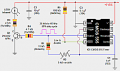
Remote control IR receivers are a good solution but as be80be indicated the are intentionally blind to most temporal frequencies but respond very well to light modulated within their bandpass. The example receiver below would ignore room lights and most noise but it could readily see an infrared LED that is pulsed at 38 kHz with a 50% duty cycle.

Circuit example:

upload_2018-3-28_12-11-38.png

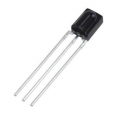
IR Receiver Modules,Carrier Frequency 38kHz
Manufacturer: VISHAY
for Remote Control Systems
Transmission Distance 45m.

upload_2018-3-28_12-3-22.png
Datasheet: https://www.es.co.th/detail.asp?Prod=013503152
 

Thread Starter

John A Bonilla

Joined Mar 11, 2017
92
IR receiver Are for remotes there not much good for fixed signals. They block noise and fixed signal looks like noise. They work great for remotes that send codes. You could send out codes but that's not really help. I would use a photodiode or phototransistor works best with like 4 to 6 of them you then hone in on the one that picks up the most ir light.https://www.google.com/search?q=ir+...0j35i39j0l3.6171j0j7&sourceid=chrome&ie=UTF-8
Not going to be easy.

You will need to modulate the IR beam, to differentiate it from ambient light.
Simple IR TV remote receivers have AGC (automatic gain control) that will make determining signal level impossible, it will either detect, or not.
These are simple and cheap, but without a way to see the relative signal level, your robot won't have much to go on.

You would need to roll-your-own modulated light receiver, with adjustable gain, and a signal level output.
Then your robot could spin, look for light signals and determine the direction the signal was strongest.
Your detector should have a narrow bandpass filter, so it can reject all the other interfering modulated light that comes from LED lamps, CFL's monitors, etc.

It will need a large range of sensitivity, the signal will range over 1,000,000 : 1- from close to far.
It might also lock onto reflections from reflective surfaces too.
Remote control IR receivers are a good solution but as be80be indicated the are intentionally blind to most temporal frequencies but respond very well to light modulated within their bandpass. The example receiver below would ignore room lights and most noise but it could readily see an infrared LED that is pulsed at 38 kHz with a 50% duty cycle.
Thank you for all your replies! I am trying to make sense of everything because I am still learning about all of this. This video is where I got the idea of using IR beacons:


However, if any of you have better ideas to do something similar to that it would be greatly appreciated. I will continue to look into the IR phototransistor, and how try to build it however apart of my project emits a significant amount of light so I don't know if it will be an issue.
 

be80be

Joined Jul 5, 2008
2,395
The video is probably fake tho. You can pick up ir light but it's not easy because lights give off some I have 4 monitors they play hell on some
IR receivers.

I still think the best is 4 iR phototransistors 2 works ok but you get homing 1 and you spend lot's of time looking for the beacon.

With 4 or 5 you can hone in on it and also tell more about what your seeing.
 

RichardO

Joined May 4, 2013
2,270
Maybe you could do an optical (or ultrasonic) version of the VOR aircraft navigation system.

Here is a quick description of how it works:

A rotating directional signal is broadcast from the VOR, while a second (omnidirectional) signal is broadcast only when the rotating signal passes north. The VOR receiver in your aircraft measures the time—or phase—difference in these two signals and comes up with the bearing—or radial—from the station.
 

jpanhalt

Joined Jan 18, 2008
11,087
Many years ago, there was a nice project on the DPRG site that used homing with two detector on a modulated IR signal. Unfortunately, I did not find the archive copy easily;

Here is the original link and the new DPRG site:
Link to Original DPRG Project: http://www.dprg.org/projects/1998-08a/
New DPRG site: https://www.dprg.org/category/news/

I am also attaching the original code that was for a 12F509 (i.e., simple, no interrupts). That actually is what got me started with MCU's.
 

Attachments

John P

Joined Oct 14, 2008
2,059
Use a flashing IR LED as the beacon, where it would pulse at 38KHz or 40 KHz, whatever the receiver wants. Then mount the receiver on the robot inside a rotating cylinder with a slot in it. Aternatively, put the receiver vertically on the axis of rotation, and have a rotating mirror at 45 degrees reflecting light onto the sensor. The idea would be that at a certain narrow range of angles (of the slot in the cylinder, or the rotation of the mirror), the sensor would see the beacon, and otherwise it wouldn't. The robot would then set its direction of travel so that the angle at which the beacon was seen was exactly on the centerline. And that's the direction it would travel in, toward the beacon.
 

be80be

Joined Jul 5, 2008
2,395
I'm not the best video maker But I think you can get the idea this is probably the best way if you want find a beacon.

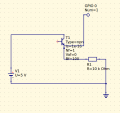
You cover the IR phototransistor with heat shrink tubing.

Put a 10 k from emitter to ground hook the adc like adc pin 0 to the emitter ground to the resistor.
and then run a test the adc will go up as it finds the beacon.

It dead simple not the best but it works I use 5 that you scan the one that picks up stronger i track.

The npn is the IR phototransistor
Screenshot from 2018-04-01 18-06-50.png
 

Sensacell

Joined Jun 19, 2012
3,783
I'm not the best video maker But I think you can get the idea this is probably the best way if you want find a beacon.

You cover the IR phototransistor with heat shrink tubing.

Put a 10 k from emitter to ground hook the adc like adc pin 0 to the emitter ground to the resistor.
and then run a test the adc will go up as it finds the beacon.

It dead simple not the best but it works I use 5 that you scan the one that picks up stronger i track.

The npn is the IR phototransistor
View attachment 149538

Sure, it can detect a laser or narrow beam IR LED, but the concept of a beacon implies that it emits in a broad angle that can be found from almost anywhere in the room.

Unless your beacon emits a ton of optical power, a simple photo transistor and resistor cannot reliably detect this signal if the source is more than a few 10's of centimeters away, the signal is just way too weak. Indirect sunlight for example would totally swamp the signal.

Modulating the light and employing a narrow band filter to recover the signal is the way to go.
It's tempting to try the standard TV remote receivers, but there are traps for the unwary here.

I am also suspicious of the video in post #5, maybe they tweaked everything just right, but move anything, and it's a fail.

The AGC and other data recovery circuits in IR receiver modules make them crappy for this application, the modules are trying desperately to feed you a clean signal under the worst of conditions, the IR source needs to emit "just the right amount" of IR such that it's close to the threshold where detection fails.

If you have ever played around with this idea, you quickly see that the window of "just enough" IR power is impractically narrow, too little and you detect nothing, a little more and it sees light reflecting off of everything - it's useless for locating anything.

To really make this work, you need to measure the signal power, while it ranges over many orders of magnitude.
 

be80be

Joined Jul 5, 2008
2,395
Ok you think so LOL with with a plain IR led I can locate it from over 4 foot away.

What I posted is easy for someone to make and code on a arduino and it way easier then using a
IR receiver which it just a IR phototransistor with a decoder that outputs data that is not based on Light intensity.

I just happen to have pointer laying around which I said you could use most anything red led led pointers

Kind of blows that out of the water.
few 10's of centimeters
That was 4 foot, And you can go way more with not much added you pwm the IR led to get it output as high as it can go without blowing the led.

I don't mean to sound smart But I made the same thing years ago when I made a little bot that followed lines I then used the same 5 Ir phototransistors to find a red led in the room.
Once you find the light you hone in which it way easier if you use more then one because you can tell if the right or left one is picking up more IR light and move back too the center.
 
Last edited:

Sensacell

Joined Jun 19, 2012
3,783
Good demonstration.

This seems usable for controlled environments, where you have control over the ambient lighting conditions.
Sunlight is the deal breaker.
 
Top