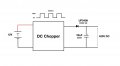
No matter what, you will need a rectifier to prevent current from flowing back in to the source during the non-420 volt part of the wave. This does not depend on your choice of filter or not, unless you want to experiment with the effect of a square wave source. This conclusion is based on my assuming that your chopper has a low impedance during the entire cycle, both low and high voltages.
You will indeed need some filtering to remove the ripple, although it may not be a lot, unless somehow you are able to synchronize your inverter and your drive signals. Some variable speed drives actually do that, but at the mains frequency.
And my understanding is that you intend to drive each phase of the motor directly with that IRF840 mosfet, and that you already have some circuit to handle the voltage developed when the mosfet switches off quickly. You will need to deal with that voltage in some manner.
No matter what, you will need a rectifier to prevent current from flowing back in to the source during the non-420 volt part of the wave. This does not depend on your choice of filter or not, unless you want to experiment with the effect of a square wave source. This conclusion is based on my assuming that your chopper has a low impedance during the entire cycle, both low and high voltages.
You will indeed need some filtering to remove the ripple, although it may not be a lot, unless somehow you are able to synchronize your inverter and your drive signals. Some variable speed drives actually do that, but at the mains frequency.
And my understanding is that you intend to drive each phase of the motor directly with that IRF840 mosfet, and that you already have some circuit to handle the voltage developed when the mosfet switches off quickly. You will need to deal with that voltage in some manner.
On the driver circuit board there will be a Schottky diode (SCS320AHGC9) for each motor winding to protect from back emf spikes.
They are incorporated in to the circuit as per the diagram. I hope that is sufficient.
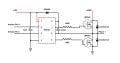
I attach the circuit for one of the windings and the board has all three on it. The diode, not yet shown on the circuit, I intend to put in line between pin 6 of the driver and the Source/Drain point between the two FETs.
I attach the circuit for one of the windings and the board has all three on it. The diode, not yet shown on the circuit, I intend to put in line between pin 6 of the driver and the Source/Drain point between the two FETs.
That should protect the driver. I suggest looking at any application notes that you can find relating to driving motors. And the diode between pin 6 and the junction of those two FET devices may interfere with the gate drive voltage to the upper FET. I would suggest diodes, pointing up, across each of the IRF840 FETs. That would send any spikes back to the power supply. And yes, I am aware that many FET power devices have an internal diode, but external protection is a better choice.
I attach the circuit for one of the windings and the board has all three on it. The diode, not yet shown on the circuit, I intend to put in line between pin 6 of the driver and the Source/Drain point between the two FETs.
I don't think the IR2104 will like having a diode in the path between pin 6 and the MOSFETs junction. The IRF840's already have built-in drain-to-source diodes; if you wish to add another diode in parallel with that, no harm will be done provided the diode is made for fast switching and has adequate current handling capability.
I think this is what Misterbill2 was saying. Is it that the diode in-line drops a bit of voltage between Pin 6 and the junction of the two FETs ? I have revised the circuit, so is this what is recommended?
I think this is what Misterbill2 was saying. Is it that the diode in-line drops a bit of voltage between Pin 6 and the junction of the two FETs ? I have revised the circuit, so is this what is recommended?
Yes, that is what I was intending to recommend. And as for the diode between pin6 and the "phase 1" junction, it would prevent the application of positive bias between gate and source of the upper IRF840, and that would prevent switching the upper transistor into full conduction. At least it would if the diode were pointing towards the junction. It is also important to provide an actual connection between the source of the lower Mosfet and pin 4, because that is the path of the switch-on bias for the lower transistor. Trusting the "ground" connection may not be adequate.
Yes, that is what I was intending to recommend. And as for the diode between pin6 and the "phase 1" junction, it would prevent the application of positive bias between gate and source of the upper IRF840, and that would prevent switching the upper transistor into full conduction. At least it would if the diode were pointing towards the junction. It is also important to provide an actual connection between the source of the lower Mosfet and pin 4, because that is the path of the switch-on bias for the lower transistor. Trusting the "ground" connection may not be adequate.
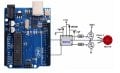
Thank you. Yes the circuit has a board strip between the lower FET Source and Pin 4 and then out to the negative side of the battery via the Arduino 5V supply and the feed to the DC chopper.
This may be an appropriate time to say how valuable the guidance from this site has been ever since I joined last year. Throughout that time, with my various projects, the enthusiastic and wide ranging expertise of members has been fantastic and invaluable. I’m sure I will have more refinements and queries to come but in the meantime - thank you to all.
This may be an appropriate time to say how valuable the guidance from this site has been ever since I joined last year. Throughout that time, with my various projects, the enthusiastic and wide ranging expertise of members has been fantastic and invaluable. I’m sure I will have more refinements and queries to come but in the meantime - thank you to all.
You are quite welcome. I feel obligated to share with others those insights gained in 40 years of engineering. Passing on insights is a benefit to others and an obligation to civilization in general.

 Facebook
 Google
 GitHub
 Linkedin