Using a rotary encoder switch to control rotation of a gear/wheel

Thread Starter

KenParcel

Joined Jan 29, 2017
5
Hello,
This is my first time attempting to build any complex device at all so please bear with my lack of understanding of the many seemingly (to most of you) basic concepts of electronics and mechanics.

I am trying to build a circular disk shaped device that will rotate via control knob. From what Ive gathered it will likely be an absolute encoder without detents or limits to rotation. The disk itself will be roughly 4 inches in diameter with a thickness of less than 2 inches. Weight of the disk will under 3 lbs, and the gears/mechanics of the disk must be able to withstand up to 20-30 lbs of weight on the exposed face which will need to rotate in increments of a minimum of 12 degrees at a time both clockwise and counterclockwise. Aside from the encoder switch I have absolutely no idea what kind of gear I will need and whether I need any further circuitry for the rotary switch output to work properly with the gear as I intend. Any input is really appreciated, even if its to bonk me over the head for obvious oversights. If anyone can post a link to any part they think I may need, would be super appreciated as well.
 

LesJones

Joined Jan 8, 2017
4,511
Do you really mean "increments of a minimum of 12 degrees at a time" ? So if the increment WAS 12 degrees then you would have 30 positions. If you had increments of 24 degrees then you would have 15 positions. Note 24 degrees is NOT less than 12 degrees. I suspect you mean that the maximum increment is 12 degrees. Is the axis of the motor horizontal (The motor would be lifting 20 - 30 pounds on an arm 2 inches long.) or is the axis vertical so that only the acceleration, deceleration and friction would need to be considered.

Les.
 

mcgyvr

Joined Oct 15, 2009
5,394
So a rotating disk..
Please describe the intended operation and motion more...
Does it "index" (aka.. go a specific # of degrees then stop and wait for the next "turn" signal?)
Does it rotate continuously?
Desired speed of rotation?
Do you only need a set speed and forward/reverse operation via a switch?
etc... more details = better answers..

I'll assume since this is an electronics forum that the mechanical aspect is taken care of or that you don't need help with that but just the electronic portion correct?
 

Sensacell

Joined Jun 19, 2012
3,777
I think you will find quite a bit of mechanical wisdom floating around here.

I assume the idea is "turn encoder, wheel follows" -as if they were connected? right?
what sort of ratio between the encoder and the wheel are you looking for?

My first idea would be to use a quadrature incremental encoder and a stepper motor / driver.
use a bit of logic to derive "step" and "direction" signals that can directly feed the motor driver.
 

Thread Starter

KenParcel

Joined Jan 29, 2017
5
Les, axis would be standing vertical. I actually do mean minimum 12 degrees. If I were to dial the knob from say position 11 to 18, it musn't stop at any positions between.

Mcgyvr it will have to move much like the human head does when one turns to look in a different direction, and can have similar rotation speed (Im pretty sure average head swivels clock in under 60 rpm?) It will indeed "index" by going 12 or more degrees at a time without interruption until it reaches the desired position. It does not need more than 1 speed and I feel the required speed will not be a problem. When you say mechanical, you do mean the gears yes? In which case no I havent made it quite that far. I do only need clockwise and counterclockwise motion but the feel of the entire project sort of requires a rotary type controller. During use the rotating movement and changes in clockwise and counter clockwise directions will be very frequent so the gear and switch would need a tolerance for high frequency of different commands in a short time. Application will be the base of a sort of display case. I apologize but I just realized this wasn't posted in the projects section as I intended.
 

Thread Starter

KenParcel

Joined Jan 29, 2017
5
Sensacell, yes precisely. I dial the knob, the wheels does the same and turns the same amount of degrees. Not sure what you mean by ratio between encoder and wheel? Thanks for the tips, will begin looking into those right away!
 

mcgyvr

Joined Oct 15, 2009
5,394
Mcgyvr it will have to move much like the human head does when one turns to look in a different direction, and can have similar rotation speed (Im pretty sure average head swivels clock in under 60 rpm?) It will indeed "index" by going 12 or more degrees at a time without interruption until it reaches the desired position. It does not need more than 1 speed and I feel the required speed will not be a problem. When you say mechanical, you do mean the gears yes? In which case no I havent made it quite that far. I do only need clockwise and counterclockwise motion but the feel of the entire project sort of requires a rotary type controller. During use the rotating movement and changes in clockwise and counter clockwise directions will be very frequent so the gear and switch would need a tolerance for high frequency of different commands in a short time. Application will be the base of a sort of display case. I apologize but I just realized this wasn't posted in the projects section as I intended.
Mechanical mechanisms alone can be used to give you a "NO" human head motion with a motor/single direction to create a back and forth..
From what you've provided already there is no need for any electronics/encoders,etc..
 

LesJones

Joined Jan 8, 2017
4,511
As 12 degrees is the minimum and you have not given a maximum then choosing 180 degrees would give the simplest solution as it would only need to stop in two positions. (say 0 degrees and 180 degrees.) I am assuming the ratio you want is 1:1 so the wheel rotates one revolution for one revolution of the knob. Is an aboslute encoder essential or could it go through an initialization each time it was switched on ? The knob would have to be set to zero degrees and a button pressed to tell the wheel to go to zero degrees. there would be an extra optical one line encoder so it could find the zero position. After that the wheel would just step the same number of steps as the knob. (and in the same direction) Another possible solution (Electrical but not electronic.) would be a selsyn system.

Les.
 

MaxHeadRoom

Joined Jul 18, 2013
30,590
A stepper motor has automatic detents and requires no feedback, in fact one stepper motor can drive another as a in the original Synchro servo.
No power needed, For any kind of load the steps could be amplified.
The degrees or number of steps could be observed visually or by operator indicator position.
Max.
 
Last edited:

Thread Starter

KenParcel

Joined Jan 29, 2017
5
Mcgyvr, can that kind of mechanism or similar be easily controlled with some kind of rotary switch?

Les, it would need to rotate to at least 270 degrees if not a full rotation and yes ratio would be 1:1. Im interested in the absolute encoder only because I see that as the best solution for a rotary switch. If there is a simpler way to control a rotational mechanism with a rotary switch in the way Ive described I cant seem to find it yet. I really like the selsyn system you suggested, both because it is intended for smaller applications and because the way the transmitter and receiver maintain same position. Im worried that this solution may be over priced for me and possibly oversized/overweight? Im not finding alot of widespread info or suppliers online for the synchro configured motors.

Maxheadroom, stepper motors seem to be the right direction for what Im looking for, they are also used in synchro setups is that correct? If I configure two of them to work synchronously would one motor essentially be the dial switch I am trying to find as well?
 

Thread Starter

KenParcel

Joined Jan 29, 2017
5
Actually is it possible for a freely rotating switch to only send forward/reverse signals depending on clockwise/counterclockwise turning?
 

MaxHeadRoom

Joined Jul 18, 2013
30,590
Maxheadroom, stepper motors seem to be the right direction for what Im looking for, they are also used in synchro setups is that correct? If I configure two of them to work synchronously would one motor essentially be the dial switch I am trying to find as well?
Yes they will work this way, two identical models, if loading is an issue then gearing is needed, both ends, TX & RX.
Max.
 

GopherT

Joined Nov 23, 2012
8,009
Actually is it possible for a freely rotating switch to only send forward/reverse signals depending on clockwise/counterclockwise turning?

Yes, just use a little DC motor as your rotating knob. That and a diode will get you either a positive voltage or negative voltage (depending in direction turned). The voltage can be amplified and correlate to a motor direction. Slow turning means less voltage, faster turning means higher voltage. Both could correlate to speed if connected through an amplifier.

Or, Max's stepper motor also works.
 

LesJones

Joined Jan 8, 2017
4,511
I don't think there would be any need to limit the full travel to 270 degrees. I dont think there needs to be any limit. (So you could rotate the knob 1000 revolutions ad the wheel would follow. I am still trying to understand MINIMUM of 12 degrees between steps. You did not respond to my comment that taken to its extreme 180 degrees between steps would be accepable. If this was the case then the wheel would only need to stop in two positions so all you would need is two contacts in the two position that you want the wheel to stop. I am still convinced thet you mean a MAXIMUM of 12 degrees between steps. Or in other words you need the wheel to stop in at least 30 positions. (NOT that it must stop in LESS than 30 positions.)

Les.
 

mcgyvr

Joined Oct 15, 2009
5,394
I think Ken needs to define his needs more.. In fact define it fully..
Do not use the word "minimum" without stating a "maximum" too or whatever..
I'm still confused as to what the actual intended motion path is.. How its controlled.. What the rotary switch is for,etc...
Kind of like pulling teeth here..

And yes Ken its entirely possible to control that mechanism I showed with a rotary switch.. If I knew what you wanted the rotary switch to actually do...
We need something like.
I need X to do Y and when I press G this happens,etc.. please fully define your needs..
If you don't now then then figure it out and post back..
 

LesJones

Joined Jan 8, 2017
4,511
Hi mcgyvr,
My understanding is that he wants the wheel needs to follow the knob as if it was linked mechanically for example each would have a chain wheel with the same number of teeth linked by a chain. (A toothed belt and pullies would behave in the same way.) The thing that I find confusing is that he says it can't move is steps of less than 12 degrees. (So there could be no more than 30 steps for a complete rotation of 360 degrees) I think he really means it the other way round that there should be more than 30 steps for one rotation. My initial thought was to use a gray code encoder on both the knob and the wheel and use some logic to make the drive motor match the position of the encoders. (Using a microcontroller would be the simplest way. many years ago I made an antenna position control system this way using a home made 8 bit encoder. (Giving 256 positions.) The logic was done using a mixture of TTL and cmos ICs. The position information came from a pre punched paper tape. (This was for tracking radio amateur satellites.)

Les.
 

MaxHeadRoom

Joined Jul 18, 2013
30,590
The stepper/synchro method is known as Electronic Gearing.
The same when a secondary servo is 'geared' or slaved off of the encoder of the primary servo.
Max.
 

Bernard

Joined Aug 7, 2008
5,784
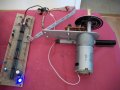
Here is an example of positioning with a Gray code wheel from post " Converting bobblehead owl to a random motion head ".
100_0064.JPG
 
Top