Using a battery as a regulator

Thread Starter

coinmaster

Joined Dec 24, 2015
502
Could you explain the reason?
I don't understand batteries that well.
I can't tell what the difference is between the battery being charged and the battery being used in this scenario.
 

MrChips

Joined Oct 2, 2009
34,814
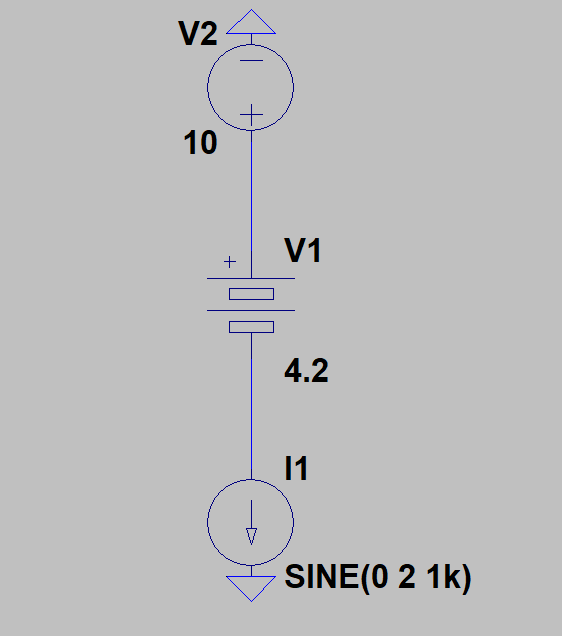
Look at the equivalent circuit you posted in post #3.
In theory, there is no difference between a battery symbol V1 and a voltage source V2.
The combined equivalent is one (10 - 4.2 = 5.8 VDC) voltage source.
 

BobTPH

Joined Jun 5, 2013
11,515
What you are trying to do is create a bipolar supply the wrong way, one in which the second supply must both source and sink current. I can think of no reason why, even if this were practical, it would be better than the standard configuraton that has been used for 60 years.

Can you please explain why a normal bipolar supply would not work?

Bob
 

Thread Starter

coinmaster

Joined Dec 24, 2015
502
What you are trying to do is create a bipolar supply the wrong way, one in which the second supply must both source and sink current. I can think of no reason why, even if this were practical, it would be better than the standard configuraton that has been used for 60 years.

Can you please explain why a normal bipolar supply would not work?

Bob
More heat, more components. I'm trying to cheap out.
 

BobTPH

Joined Jun 5, 2013
11,515
Sorry, but using a bipolar + and - 5V supply would be more efficient than your circuit. Your circuit has the battery fighting against the 10V supply, and dissipating power in the battery. This is not less heat and more efficient.

I think you are overthinking a long solved problem.

Edited to add: And if you really want more efficiency, a class D amp will approximately double it, and a full bridge will allow you to use a single 5V supply instead of your 10V supply plus a battery.

Bob
 

KeithWalker

Joined Jul 10, 2017
3,607
Because the circuit won't work without the battery. It has no voltage reference.
Let's not get off topic here. I know what I'm doing with the circuit. I just want to know if the battery plan can work.
I doubt whether the battery will last very long if you abuse it like that. Why not use a high powered zener diode instead?
 

mvas

Joined Jun 19, 2017
539
LiPos can take crazy amounts of current.
I'm open to other battery types as well.
I just don't know how this configuration affects the charge state of the battery.
LiPo's can take "crazy amount of current" but only for short periods, not continuously.
Watts = amps x ohms
You will be flowing amps continuously.
LiPo's do not like heat.
Compute the Watts, so that you will know vs guessing

I think, the battery will slowly DISCHARGE.
It takes more amps-hour to recharge vs discharge
Therefore, I think, on each full AC cycle ...
every charging 1/2 cycle will come up a little short vs each discharge 1/2 cycle.
This will repeat, over and over and over ... slowly discharging the battery.
 
Last edited:

dendad

Joined Feb 20, 2016
4,637
A capcitor in place of the battery would work just the same, but with a lot less excitement as the battery explodes.
Assuming the battery idea would work, but I cannot anyway see why you would want to use a battery, it would eventually either over charge or get fully discharge and start charging in reverse. Either idea can lead to a lot of fun.
 

gyro222

Joined May 1, 2018
7
Well, let me draw a more accurate example of what I want to do.

This is the effective equivalent to the circuit as concerns the issue.
A current source will send in a some amps of AC voltage into the battery which will then go into a voltage source.
The battery's job is simply to create a voltage drop while sinking the current, the voltage across the battery will stay pretty constant.
You cannot feed a battery with straight AC power and there’s a good chance that you will cause a fire and or damage any dc circuit your trying to run if that’s the case, there is a plethora of regulators on the market that really are cheap, you’re circuit simply won’t do what you expect from it im Sorry to say
 

gyro222

Joined May 1, 2018
7
A battery is still an impedance. I don't see a problem. In either case the current is still flowing in one direction.
I just want to know if the current swings are going to overcharge the battery.
You really need to do some homework, without diodes or proper regulation a battery does not convert a supply to dc, if you’re working with anything less than a few volts you simply shouldn’t be as it’s pretty obvious that you don’t know what’s doing and if it’s very low voltage and you try this do it in an open area and stand back
 

LowQCab

Joined Nov 6, 2012
5,101
You guys have the patience of a saint.
From quickly scanning over this thread, it looks like we have a silly person trying to re-invent the wheel,
since he's being secretive about what he is trying to accomplish and making nonsensical statements
like he's trying to replace $3.oo worth of components with a $30.oo Li-Po Battery to "save money".
I'm betting that he won't take any of the advice here and is going to create
a very expensive chemical fire, that he can't put out, when that Li-Po battery overheats and pops.

Li-Po batteries are down right DANGEROUS if you don't treat them with care,
and keep them within their rated limits.

Dude...... excellent Class-D amps, complete with matching switching power supply, and all in a nice looking box,
are available dirt cheap online, in any wattage rating you could ever need, from 250mw to 4000 watts.
They work really well, and are extremely efficient,
( however, your speakers are hideously INefficient, probably less than 1% efficient ).
You will never even get close to their performance with any home brewed design.
 
Top