Using a battery as a regulator

Thread Starter

coinmaster

Joined Dec 24, 2015
502
I want to use a low ESR battery such as a LIPO battery to set the voltage of and regulate a line in a circuit. I know this isn't optimal.
If the battery is fully charged but I'm sending a couple of amps of nearly continuous AC current into it, will it over charge the battery?
 

KeithWalker

Joined Jul 10, 2017
3,607
I want to use a low ESR battery such as a LIPO battery to set the voltage of and regulate a line in a circuit. I know this isn't optimal.
If the battery is fully charged but I'm sending a couple of amps of nearly continuous AC current into it, will it over charge the battery?
The normal fully charged voltage for a LIPO battery is 4.2 volts. If you keep charging it when it is fully charged, the voltage will go higher than that, but as it goes up, the life of the battery will go down. It will not work as a voltage regulator.
Note: If you discharge a LIPO battery to a voltage less than 1.7 volts, it will turn into a paper weight.
 

Thread Starter

coinmaster

Joined Dec 24, 2015
502
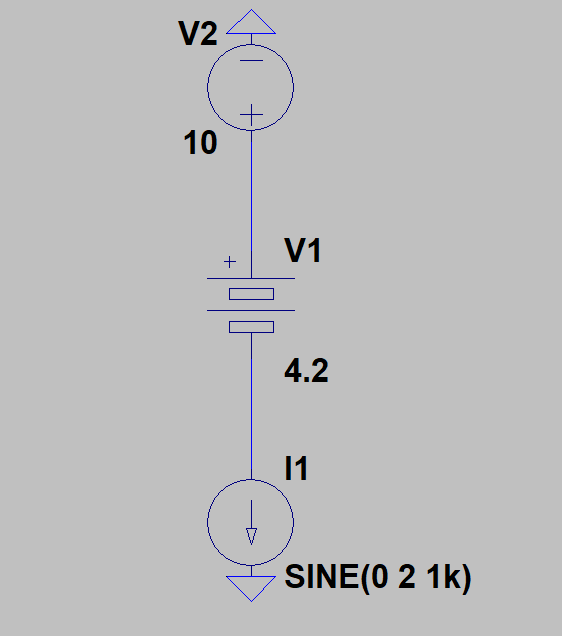
Well, let me draw a more accurate example of what I want to do.

This is the effective equivalent to the circuit as concerns the issue.
A current source will send in a some amps of AC voltage into the battery which will then go into a voltage source.
The battery's job is simply to create a voltage drop while sinking the current, the voltage across the battery will stay pretty constant.
 

Thread Starter

coinmaster

Joined Dec 24, 2015
502
A battery is still an impedance. I don't see a problem. In either case the current is still flowing in one direction.
I just want to know if the current swings are going to overcharge the battery.
 

Alec_t

Joined Sep 17, 2013
15,119
I just want to know if the current swings are going to overcharge the battery.
Yes, if the battery is already fully charged. What damage even a brief overcharge causes is uncertain, but the damage is likely to be cumulative. Risky with a lithium battery.
 

Thread Starter

coinmaster

Joined Dec 24, 2015
502
Literally a current source fed with an audio signal.
I want the battery to drop the voltage from the positive supply and sink the current.
I want the battery to effectively act as a DC source follower replacement.
I'll probably bypass the battery with a large cap but there will still be some ac trickle current going into the battery.
 

crutschow

Joined Mar 14, 2008
38,508
Okay, a battery can work as a poor regulator, but overcharging is bad for most batteries and a no-no for lithium batteries.
Can you explain more about what you are actually trying to do?
 

Thread Starter

coinmaster

Joined Dec 24, 2015
502
Sorry.

I'm making a current-out power amplifier.
I want to configure it so the signal currents cancel each other in the power supply so I'm making it a class A bridge.
But I don't want to build another class A stage for the other side of the bridge if I can avoid it.
The battery is an elegant solution assuming it doesn't blow up.
 

Thread Starter

coinmaster

Joined Dec 24, 2015
502
LiPos can take crazy amounts of current.
I'm open to other battery types as well.
I just don't know how this configuration affects the charge state of the battery.
 

BobTPH

Joined Jun 5, 2013
11,515
This problem has been solved ever since the dawn of solid state amplifiers and probably before that.

There are three solutions. You can use a bipolar supply and direct coupling from the half bridge. You can use a single supply and a coupling capacitor between the half bridge and the load. Or, as you noted, you can use a full bridge. The latter is the most popular with modern day class D amps.

Please explain why none of these works for you.

Bob
 

Thread Starter

coinmaster

Joined Dec 24, 2015
502
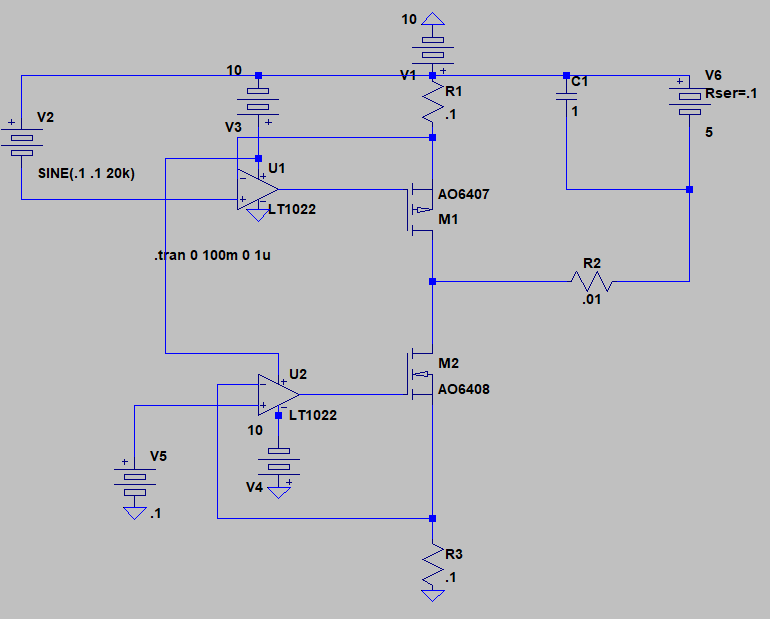
Since you have a high value cap (C1) in the post #13 circuit, why do you want the battery (V6)?
Because the circuit won't work without the battery. It has no voltage reference.
All power amplifiers are designed to drive current.
How much voltage, current, power, max frequency do you need?
Let's not get off topic here. I know what I'm doing with the circuit. I just want to know if the battery plan can work.
 
Top