Facebook
 Google
 GitHub
 Linkedin
I am looking for a way to make a 1-10v signal do dual duty as a dimming signal and relay control signal.
I know there are multiple ways to make this work and I'm willing to try something else if this is a big lift.
I have a DC push button touch switch that does on/off with dimming.
I also have a MeanWell LED driver (HLG-120H-48B) that runs on 110 VAC and has dimming functionality that can be controlled using PWM, 0-10 VDC, or 0-100 kOhm resistance.
I’m currently using a toggle switch (on the 48VDC output - i know, not ideal) and a separate 100k pot to control the dimming on the driver. I would like to use the single touch switch to switch the 110VAC power and do the dimming.
The touch switch functions on/off with a tap and hold to dim/brighten.
If I hook up a 10v power supply to the switch, the dimming function varies the measured DC output voltage from ~ 1-10 V.
I would like to switch the 110VAC neutral of the LED driver using a relay controlled by the touch switch and use the 1-10 VDC to as the dimming control signal.
The issue I’m struggling with is that when the switch turns on in the dimmest state, the voltage is too low to trip most relays.
I currently have a solid state relay that requires 3-32 VDC control.
Is there a way to use the 1-10V out from the touch switch to control the LED dimmer function and use the on/off function of the same output to control a relay?
This image is what I envision, but I don’t have the magic box.
I appreciate any insight or suggestions you can provide. The LED driver and LED strip are the only components that must remain as part of the final system.
I know there are multiple ways to make this work and I'm willing to try something else if this is a big lift.
I have a DC push button touch switch that does on/off with dimming.
I also have a MeanWell LED driver (HLG-120H-48B) that runs on 110 VAC and has dimming functionality that can be controlled using PWM, 0-10 VDC, or 0-100 kOhm resistance.
I’m currently using a toggle switch (on the 48VDC output - i know, not ideal) and a separate 100k pot to control the dimming on the driver. I would like to use the single touch switch to switch the 110VAC power and do the dimming.
The touch switch functions on/off with a tap and hold to dim/brighten.
If I hook up a 10v power supply to the switch, the dimming function varies the measured DC output voltage from ~ 1-10 V.
I would like to switch the 110VAC neutral of the LED driver using a relay controlled by the touch switch and use the 1-10 VDC to as the dimming control signal.
The issue I’m struggling with is that when the switch turns on in the dimmest state, the voltage is too low to trip most relays.
I currently have a solid state relay that requires 3-32 VDC control.
Is there a way to use the 1-10V out from the touch switch to control the LED dimmer function and use the on/off function of the same output to control a relay?
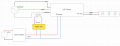
This image is what I envision, but I don’t have the magic box.
I appreciate any insight or suggestions you can provide. The LED driver and LED strip are the only components that must remain as part of the final system.