Facebook
 Google
 GitHub
 Linkedin
I am trying to repair a second generation Smiths tachometer from a 71 Volvo P1800. It consists of a blocking oscillator in a one-shot configuration driving an ammeter. The owner complains that it goes wonky when it is hot.
Here's the circuit:
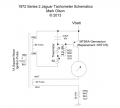
At room temperature, the circuit puts out a nice, clean square wave as it should, but when I heat the circuit up with a hair dryer, it starts to oscillate after the end of the one-shot pulse. When I hit the components with freeze spray, none of the components appear to be temperature sensitive other than the transistor and cap. They are too close together to cool independently.
I have replaced both the transistor and cap with new ones, but the problem persists. I have reflowed all of the solder joints, cleaned the pot, cleaned the connection between the pot and the PCB and cleaned the connection between the PCB and the meter frame to ensure a good ground.
The photos show the calibration signal (top) and the collector signal (bottom). The first shows the tachometer working correctly at room temperature:
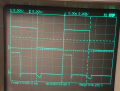
The second shows the tachometer reading very high after heating it up with the hair dryer:
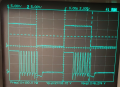
I am very bad with oscillators, so I have no clue as to what is causing these oscillations and how to fix this poor guy's tachometer. Any guidance would be greatly appreciated.
Mark
Here's the circuit:
At room temperature, the circuit puts out a nice, clean square wave as it should, but when I heat the circuit up with a hair dryer, it starts to oscillate after the end of the one-shot pulse. When I hit the components with freeze spray, none of the components appear to be temperature sensitive other than the transistor and cap. They are too close together to cool independently.
I have replaced both the transistor and cap with new ones, but the problem persists. I have reflowed all of the solder joints, cleaned the pot, cleaned the connection between the pot and the PCB and cleaned the connection between the PCB and the meter frame to ensure a good ground.
The photos show the calibration signal (top) and the collector signal (bottom). The first shows the tachometer working correctly at room temperature:
The second shows the tachometer reading very high after heating it up with the hair dryer:
I am very bad with oscillators, so I have no clue as to what is causing these oscillations and how to fix this poor guy's tachometer. Any guidance would be greatly appreciated.
Mark