understanding LM386 circuit

Thread Starter

Simon Larsen

Joined Feb 22, 2015
31
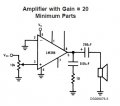
I am reading the datasheet for the LM386 (http://www.ti.com/lit/ds/symlink/lm386.pdf) and looking into the diagram (attached to this post).

My question is about the stuff connected to pin 5 (which is the signal output). I don't understand why it should be necessary to connect the Cap and resistor in series to ground (prior to the AC decoupling cap + speaker).

As I understand it the capacitor and resistor in series form a high-pass filter!?... but it is never used - since nothing is connected between the components!? ... I wonder if it (magically :D) act as a low pass filter passing signals with freq < 300kHz [1/(2*pi*10*0.05u)]..

anyone got a clue on this?
 

Attachments

MrChips

Joined Oct 2, 2009
34,807
A capacitor in series with a signal serves as a high pass filter.
A capacitor that shunts the signal removes high frequencies. This is a low pass filter. The purpose of the RC filter on the output of the amplifier is to suppress HF oscillations, not to filter the audio signal.
 

OBW0549

Joined Mar 2, 2015
3,566
The 0.05uF capacitor and 10 ohm resistor form what is called a snubber circuit, and are needed to keep the LM386 from oscillating at RF frequencies. They have negligible effect at audio frequencies, but up above a few hundred KHz they present a heavy resistive load on the amplifier's output, reducing loop gain and thereby discouraging oscillation.
 

Thread Starter

Simon Larsen

Joined Feb 22, 2015
31
aha! thanks. so is a snubber circuit and a Zobel network the same (just a matter of words) or do I need to read up on both?
 

OBW0549

Joined Mar 2, 2015
3,566
aha! thanks. so is a snubber circuit and a Zobel network the same (just a matter of words) or do I need to read up on both?
No, they're not the same. A Zobel network, whether in the context of telecommunications or of hi-fidelity audio, is used for impedance control. Wikipedia has a good article on Zobel networks.

In the present case, though, that RC network on the output of the LM386 is there simply to keep the amplifier from oscillating.
 

#12

Joined Nov 30, 2010
18,224
Do the math. When is Xc equal to 10 ohms?
At 318 KHz.
Is that audio range?
No.
Is it RF range?
Yes.
Couldn't possibly be operating under Zobel theory.
 

Thread Starter

Simon Larsen

Joined Feb 22, 2015
31
Do the math. When is Xc equal to 10 ohms?
At 318 KHz.
Is that audio range?
No.
Is it RF range?
Yes.
Couldn't possibly be operating under Zobel theory.
Hmm, I don't quite follow you.

1) why would I set Xc = 10 ohms?
2) why would I even consider calculating the frequencies that the filter passes when I don't use that in the rest of the circuit (nothing is connected to that network)?
 

#12

Joined Nov 30, 2010
18,224
1) Because 10 ohms is in series with the capacitor. When the two impedances are equal, you have the frequency where the capacitor becomes significant.

2) You asked why it was there. It is not connected to, "nothing" and it is not, "never used". The RC filter is connected to the output of the amplifier and the ground connection, and it works constantly.
 

#12

Joined Nov 30, 2010
18,224
I expect you're going to look up, "Zobel" but here it is in short form:

A cone type speaker has a coil and its impedance increases as frequency goes up. The Zobel circuit decreases impedance as frequency goes up. With both loads connected, the Zobel circuit keeps the amplifier from trying to work into dozens or hundreds of ohms in the 10 KHz to 20 KHz range.

There are easier ways to do this, like placing a capacitor across the primary of the output transformer in a vacuum tube amplifier or frequency compensating in the negative feedback loop of an operational amplifier type of circuit by limiting its frequency bandwidth or crippling its slew rate. Still, some people want their amplifier to work clear up to 50 KHz and the Zobel circuit keeps the load in the correct operating range.
 

Thread Starter

Simon Larsen

Joined Feb 22, 2015
31
aha. sounds pretty smart - the zobel network. I wonder if a design based on a zobel network is pretty much fixed to a certain speaker type (since the R and C values depends on the L and R for the speaker). But I guess I am beyond the scope of this thread (and also my poor knowledge of electronics - lol).

Thanks for all the input... I should get an oscilloscope :)
 

Thread Starter

Simon Larsen

Joined Feb 22, 2015
31
1) Because 10 ohms is in series with the capacitor. When the two impedances are equal, you have the frequency where the capacitor becomes significant.
aha.

2) You asked why it was there. It is not connected to, "nothing" and it is not, "never used". The RC filter is connected to the output of the amplifier and the ground connection, and it works constantly.
thanks. I did not mean to offend you. Its not that I doubt your information. My knowledge is just so limited so its hard to ask the "right" questions. But I think I have sufficient knowledge to continue on the web.
 
Top