Understanding grounding scenarios

-live wire-

Joined Dec 22, 2017
959
Why is a BJT being used for switching when a mosfet would be far more efficient? And shouldn't there be a pulldown resistor to prevent static/EMI issues? Anyways, on the topic of grounding, here is why mains continuity and poor isolation can be so bad.
 

Gibson486

Joined Jul 20, 2012
360
You need to understand the concept of ground current and ground loops. In most cased, when you use optocouplers, it is to isolate the grounds. If you do not isolate them, you could inject noise into a sensitive circuit when there is also a high current circuit near it, or you could create a ground loop (when you have multiple ground paths).

Of course, you can also use an optocoupler as a cheap way to do logic level shifts (like between 12V and 3.3V).
 

Gibson486

Joined Jul 20, 2012
360
Why is a BJT being used for switching when a mosfet would be far more efficient? And shouldn't there be a pulldown resistor to prevent static/EMI issues? Anyways, on the topic of grounding, here is why mains continuity and poor isolation can be so bad.
At 40mA, you will not see the efficiency benefits. Also, if EMI was as easy as a pull down resistor....lots of us would be out of jobs.
 

MaxHeadRoom

Joined Jul 18, 2013
30,674
o_O "as well as the AC neutral" ? Are you sure that's how PC power supplies are wired?
In a desktop PC the power supply common is connected to the case which in turn is connected to the service earth conductor, the neutral is also connected to this same earth ground at the service entrance.
Hence NO galvanic isolation exists!! Period.
Max.

Galvanic isolation is a principle of isolating functional sections of electrical systems to prevent current flow; NO direct conduction path is permitted. Energy or information can still be exchanged between the sections by other means, such as or electromagnetic waves, or by optical, acoustic or mechanical means.

https://www.schneider-electric.ca/en/faqs/FA157465/
 
Last edited:

nsaspook

Joined Aug 27, 2009
16,330
In a desktop PC the power supply common is connected to the case which in turn is connected to the service earth conductor, the neutral is also connected to this same earth ground at the service entrance.
Hence NO galvanic isolation exists!! Period.
Max.

Galvanic isolation is a principle of isolating functional sections of electrical systems to prevent current flow; NO direct conduction path is permitted. Energy or information can still be exchanged between the sections by other means, such as or electromagnetic waves, or by optical, acoustic or mechanical means.

https://www.schneider-electric.ca/en/faqs/FA157465/
In the case of needing different ground potential references you are correct but that's not needed in the PC supply common and the AC motor neutral case to eliminate a ground current loop because there should be no neutral/ground connection at the PC, at the SSR or at the motor. Technically capacitive isolation is also galvanic isolation (no direct wiring) but simply being 'galvanic' provides little or no safety and/or isolation from transient AC effects relative to earth ground with X Y series capacitors.
 
Last edited:

MaxHeadRoom

Joined Jul 18, 2013
30,674
The bottom line is that the example I gave that many have used thinking they are getting Galvanic isolation does not give them it.
A simple resistance check from one side of the opto common input to the common output shows a few ohms, which does not qualify for Galvanic isolation, IMO.
A typical PC MoBo has mounting screws bonding the DC ground plane to a earth grounded chassis.
Max.
 

nsaspook

Joined Aug 27, 2009
16,330
https://www.acromag.com/sites/default/files/The Importance of Isolation_1.pdf
A COMMON MISCONCEPTION

Usually, when schematically representing an isolated I/O circuit, perhaps a transmitter or signal isolator, a customer will be confused by our showing a connection to earth ground on each side of an isolation barrier. The appearance of this earth ground symbol in both circuits causes them to think that the isolation barrier is somehow being violated because of a common connection to earth ground on each side of the barrier (after all, earth ground is a conductor). But what they fail to recognize is that even though a path between earth ground points is present, no circuit can be completed between the circuits because a return conduction path has been broken by an isolation barrier (i.e. there is no bidirectional circuit path). In fact, the presence of the isolation barrier allows each side to connect to the same or different earth ground potentials (within the limits of the isolation rating) without causing problems. Thus, it helps to always think of a conduction path in terms of a circuit loop, not a one-way street--the isolation barrier actually breaks this loop and prevents the flow of current between the earth grounds within the circuit itself.
 

MaxHeadRoom

Joined Jul 18, 2013
30,674
QUOTE: Thus, it helps to always think of a conduction path in terms of a circuit loop, not a one-way street--the isolation barrier actually breaks this loop and prevents the flow of current between the earth grounds within the circuit itself.
I believe that the ABOVE statement is all wrong in the general accepted definition of Galvanic isolation, IOW they are saying although the two systems are connected just because a a completed circuit is not present then Galvanic isolation occurs!
The main thing here is not only are they Galvanically connected, it is possible for a circuit to exist in a fault or unintended condition, for example.

Galvanic isolation is a principle of isolating functional sections of electrical systems to prevent current flow; NO direct conduction path is permitted.
Max.
 

nsaspook

Joined Aug 27, 2009
16,330
At the risk of being pedantic the opportune word in the isolation definition is 'direct conduction path' with a device that provides Galvanic isolation like a transformer IMO.


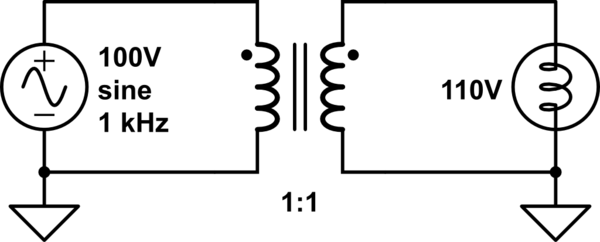
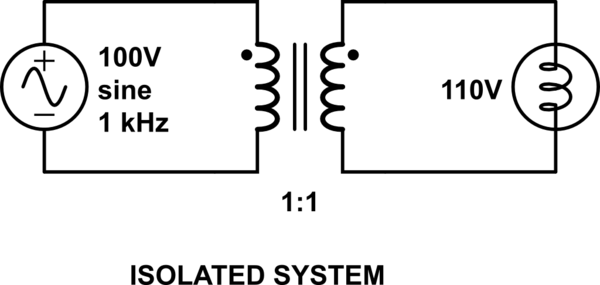
If we assume the symbols are earth ground points, the lamp circuit is still isolated from the energy source via the transformer because we don't have a direct conduction path from the source energy/signal to lamp just like the below diagram with a floating supply and lamp circuit.


A USB/RS-232/1394A connection between systems with direct power and/or signal/cable logic ground connections would defeat isolation between systems.
 
Last edited:

MaxHeadRoom

Joined Jul 18, 2013
30,674
That to me defeats the whole idea of declaring a circuit Galvanically Isolated.
IOW according to that there is no distinction between the two and could/would cause confusion if both are declared G.I. in this fashion.
Certainly not the definition I have been used to using in my career , as only the lower drawing would qualify.
Max.
 

ArakelTheDragon

Joined Nov 18, 2016
1,366
That is not always the purpose of opto-isolation, many times it is to transition from one system voltage level to another.
A prime example is where a PC port is used as an output to turn on a AC activated device such as a AC motor, Many use an opto or SSR thinking they are getting galvanic isolation whereas the PC supply common and the AC motor neutral are both connected to earth ground.
IOW there are many situations where it can be used without galvanic isolation occurring.
IN the systems I have designed, I try to keep all power common points to a star point Ground (Earth).
Max.
First do not use that symbol for ground in electronics! Despite that it is used and its interchangeable with the normal ground symbol, it actually means schasis. This can cause problems in some cases.

The ground concept is hard. I think you should buy a book and start reading.
 

MaxHeadRoom

Joined Jul 18, 2013
30,674
The ground concept is hard. I think you should buy a book and start reading.
If you have been around here for long you would probably notice my avid support for using correct symbols and the aversion to the continuous misuse of the Earth Ground symbol for Chassis, which was first defined around the '50's.;)
Max.
 

ArakelTheDragon

Joined Nov 18, 2016
1,366
If you have been around here for long you would probably notice my avid support for using correct symbols and the aversion to the continuous misuse of the Earth Ground symbol for Chassis, which was first defined around the '50's.;)
Max.
Not that I am against you, I hate it when someone changes the terms or symbols, or when they start making new ones:

I also think the upper circuit should qualify, because if you have a switch only on the plus, the circuit is still off. If you provide isolation on only the plus part, the current will still not be able to pass through the opto coupler in the same manner as if there was not one available.

All transformers are normally grounded.
 

-live wire-

Joined Dec 22, 2017
959
At 40mA, you will not see the efficiency benefits. Also, if EMI was as easy as a pull down resistor....lots of us would be out of jobs.
I thought it was way more power and current than that. And a pulldown resistor may not solve all your problems, but it is a good and very simple.
What is Meant by 'All transformers are normally grounded'?
Max.
Maybe he means the metal core is connected to earth ground.
 

ebp

Joined Feb 8, 2018
2,332
"... Chassis, which was first defined around the '50's"

Back in the bad old days when chassis common could be connected directly to AC mains "hot." Great fun for musicians whose electric guitar strings found their way to AC line neutral while the metal case of their microphone was at AC mains hot. Perhaps that was part of Donovan's inspiration
Electrical banana
Is gonna be a sudden craze
Electrical banana
Is bound to be the very next phase.
~~~
"The whole world's in a state of chassis."
- O'Casey, Juno and the Paycock
~~~

The reality is that there is inconsistency in use of "ground" symbols and it is just foolish not to put a guide on a schematic where the matter is critical. I've done several designs with three or four separate "grounds", not including any earth ground. Two of the "grounds" would, in the final system, be connected to something on or in dirt or water, but with a potential of up to many tens of volts relative to an actual Earth ground. Each of the subcircuits so-connected were galvanically isolated from each other and the rest of the circuit until they weren't anymore because the system had been installed. A two-channel system would have four wires stuck in the ground ground - no two at the same potential.
 

MaxHeadRoom

Joined Jul 18, 2013
30,674
The reality is that there is inconsistency in use of "ground" symbols and it is just foolish not to put a guide on a schematic where the matter is critical. I've done several designs with three or four separate "grounds", not including any earth ground. .
The sad part is if the correct symbols were used, there would/should be no confusion.
Max.
 

nsaspook

Joined Aug 27, 2009
16,330
My question then is, who's the final authority that defines and approves said symbols?
There is no official symbol world czar that you must follow nor are there universal standards for many things on schematics. There are standards (ANSI/IEEE, IEC, DIN, ...) and conventions that are hopefully noted somewhere.
https://www.allaboutcircuits.com/textbook/reference/chpt-9/wires-and-connections/

http://www.eaton.com.co/ecm/idcplg?...aveAs=0&Rendition=Primary&dDocName=MZ081001EN
 

ArakelTheDragon

Joined Nov 18, 2016
1,366
Once upon a time there were standards, but who knows for what reason in the past decades, someone decided standards are not needed anymore and things were left on auto pilot, without someone trying to organize them. I think some manager decided that engineers do not do anything and that's why now managers do it.
 
Top