Understanding electricity

MrChips

Joined Oct 2, 2009
34,887
Thank you, I think I understand most of it now.

One of the points of my confusion was believing that the electron lost energy moving from the inner ring to an outer ring, but it seams that it behaves the opposite way and produces a photon when moving inwards (using the Bohr model), so leaving the atom it actually have more energy. In other words, the energy level required in the outer ring is greater than the inner ring? and loose electrons have more energy than electrons in the outer ring?
Energy levels are greater in the outer shells. It takes energy to move electronics from an inner shell to an outer shell. Electrons in the outer shell, when given sufficient energy, can escape from the atom and become free electrons. These are the charge carries of electricity in conductors.
 

MrChips

Joined Oct 2, 2009
34,887
I think all this talk about electron orbits and energy levels is confusing since it has little to do with the transfer of energy by an electric current. As nsaspook noted it's the applied voltage (tension) the determines the energy that is transferred by the current.
The TS asked and it doesn't hurt to provide some simple answers for clarification.
 

nsaspook

Joined Aug 27, 2009
16,346
Energy levels are greater in the outer shells. It takes energy to move electronics from an inner shell to an outer shell. Electrons in the outer shell, when given sufficient energy, can escape from the atom and become free electrons. These are the charge carries of electricity in conductors.
The thing to note for the OP is that sufficient energy in good conductors does not come from a supplied electric field. At 25°c the free electrons in copper will move randomly at a Fermi velocity of ~1570 km/s but with no applied electric field their net motion in the wire will be zero.
 

Thread Starter

wildflower

Joined Oct 4, 2015
12
In high school I learned it as circular orbits. In college, that was replaced by "shells" or areas of probability.

Note in this http://www.ptable.com periodic table the numbers 2, 8, 18, 1 for Cu (Copper); These are related to the electron shells.
The current model with fields might be more correct and explain a lot of things on the QM level, but I still like Bohr's version because it is very easy to relate the energy-levels to orbits, but that maybe just because it's also what I was taught in school back in the 70'.

btw. Thats a really nice interactive table.
 

nsaspook

Joined Aug 27, 2009
16,346
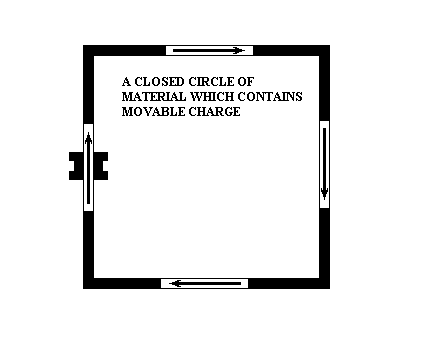
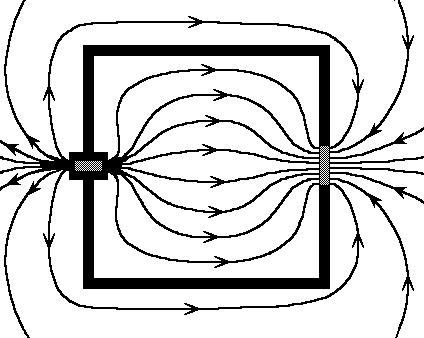
Nobody would care about electrons, charges and electricity if we couldn't use it for work. This work requires energy and electricity is a very effective way to transport EM energy. Once we get past the usually irreverent physical issues of charge carriers and current as "energy buckets" we then ask how exactly is energy moved in circuits. In a wire the electrons (like the links in a chain) are a medium and act as transfer agents for the EM energy that surrounds the wire from source to load. The current loop forms a sort of waveguide that lets energy propagate along a pair of wires from a battery to lamp.

THE CONDUCTIVE PATH: CURRENT


THE ENERGY FLOW (POYNTING FIELD)


A SIMPLE CIRCUIT
with arrows for current in the wire, notice that power flow doesn't change direction because the current flow loops back.


Diagrams from: http://amasci.com/elect/poynt/poynt.html
 

WBahn

Joined Mar 31, 2012
32,933
A battery is basically two isolated containers containing positive charge in one end and negative in the other. The negatively charged electrons will be drawn towards the positive side and not forced from the negative side.
This has a few problems with it. First, it describes a battery as if it were a capacitor. While sometimes you can effectively treat it as something like this, this description is far, far from the case.

Consider the following:

http://forum.allaboutcircuits.com/blog/a-battery-isnt-a-capacitor.588/

Then the statement that electrons are drawn from the positive side but not forced from the negative side contradicts your earlier claim that like charges repel and opposite charges attract. If a battery has positive charge on one end and negative on the other, then it stands to reason that a negatively charge particle is both attracted to the positive end AND repelled by the negative end.

Volt(V)
How many electrons are available (potential)
No. Voltage is a measure of the energy (joules) that will be imparted to each coulomb of charge that goes from a higher potential to a lower potential.

Amp(A)
Amount of electrons flowing through a connection over time
1 coulomb = (6.242e18 electrons) pr. second = 1 Amp * 1 sec.
No, but close.

An amp is a flow of CHARGE over time, not electrons.

A flow of 6.242E18 electrons per second is a current of -1 ampere because 6.242E18 electrons has a charge of -1 coulomb.

Watt(W)
How many electrons are needed to complete work with respect to time. 1 Watt = joule per second
No. It is the amount of energy per unit time. The number of electrons is NOT a measure of energy. 1 coulomb of charge traveling through 1000 volts in 1 second converts 1000 w of electrical power to something else (or vice-versa depending on which way the charge is flowing). But 100 coulombs of charge traveling through 1 volt in 1 second only is only converting 100 watts of electrical power. It is an interaction of voltage, current, and time.

AmpHour(Ah) = volume/consumption
How many electrons move in an hour. (Amps x hours)
1 Ah = 1 Amp flowing for one hour
It has nothing to due with volume or consumption. Fundamentally, it is a unit of charge equal to 3600 coulombs. Nothing more and nothing less.

WattHour(Wh) = Power consumption. Watt * Hours = Watt Hours
It is energy, not power. It is fundamentally equal to 3600 joules. Nothing more and nothing less.

Joule(J) = 1 joule is The amount of electricity required to light a 1 watt LED for 1 s
1 Wh represents 3600 joules (3600sec. = 1hour)
This is okay, although that isn't a very good definition of a joule. A joule is the amount of energy required to perform one newton-meter of work, which is a force of one newton acting through one meter (or any product of force and distance that integrates to that result).

Resistor = resist current flow

Capacitor = resist change in voltage, can store electrical energy temporarily in an electric field.

Coil = resist change in current, can store electrical energy temporarily in an magnetic field.

Diode = only lets current flow in one direction

Transistor = basically an input-controlled diode
These are all reasonable lay descriptions, though the transistor one is not very useful except in a real superficial way.
 

Thread Starter

wildflower

Joined Oct 4, 2015
12
I feel like I've opened a can of worms here.
I have done a lot of projects in my time, my method so far always included a fair amount of trial and error (sometimes with surprising outcomes), and whenever I tried to use a more logic approach, I just couldn't make it work, but now I'm starting to understand why :)

The hardest thing for me about understanding electricity, is having to unlearn all the things I thought I knew.

I plan to be chewing through 'The Art of Electronics' over the summer.
 

WBahn

Joined Mar 31, 2012
32,933
I feel like I've opened a can of worms here.
I have done a lot of projects in my time, my method so far always included a fair amount of trial and error (sometimes with surprising outcomes), and whenever I tried to use a more logic approach, I just couldn't make it work, but now I'm starting to understand why :)

The hardest thing for me about understanding electricity, is having to unlearn all the things I thought I knew.

I plan to be chewing through 'The Art of Electronics' over the summer.
You might also pick up an introductory electricity and magnetism physics text (usually the second part of a general introductory physics text) and learn the underlying fundamentals of where all this stuff comes from. I think that would make understanding the things you asked about here a lot easier and better.
 

nsaspook

Joined Aug 27, 2009
16,346
I feel like I've opened a can of worms here.
I have done a lot of projects in my time, my method so far always included a fair amount of trial and error (sometimes with surprising outcomes), and whenever I tried to use a more logic approach, I just couldn't make it work, but now I'm starting to understand why :)

The hardest thing for me about understanding electricity, is having to unlearn all the things I thought I knew.

I plan to be chewing through 'The Art of Electronics' over the summer.
You actually opened a large can of enlightenment but just can't see the bottom yet because of the worms on the top. :)
A simple field-based understanding of electricity is a basic requirement. There's no need to grasp the physics based math rigor to understand the fundamentals.

I would suggest reading this book (free summary) in addtiion to any circuit-theory based electronics text : http://onlinelibrary.wiley.com/doi/10.1002/0471433934.fmatter/summary
1.1 INTRODUCTION This book is written to bring together two topics: circuit theory and field theory. Electromagnetic field theory is an important part of basic physics. In school it is usually taught as a separate course. Because physics is a very mathematical subject, the connection to everyday problems is not emphasized. Circuit theory, by its very nature, is very practical. It provides a methodology that connects with the many problems that students will encounter in practice. It is natural for most technical people to reinforce circuit concepts and push basic physics into the background.
 

Thread Starter

wildflower

Joined Oct 4, 2015
12
You might also pick up an introductory electricity and magnetism physics text (usually the second part of a general introductory physics text) and learn the underlying fundamentals of where all this stuff comes from. I think that would make understanding the things you asked about here a lot easier and better.
Is there a particular one that you, or perhaps someone else here, would recommend?
 

WBahn

Joined Mar 31, 2012
32,933
Is there a particular one that you, or perhaps someone else here, would recommend?
That depends, in part, on where your math background is. In general texts fall into calculus and non-calculus based. If you have at least one semester of calculus, then I would strongly recommend a calculus-based text since not only will you get a much better understanding and see how things tie together, but it is also easier in a lot of ways because everything is more coherent and requires less "acceptance on faith". But if you don't have the calculus background, then it would be very confusing.

Also, if you don't have good algebra skills then even traditional non-calculus based texts might prove very hard to follow.

So, what's your math background like.
 

Thread Starter

wildflower

Joined Oct 4, 2015
12
... I would suggest reading this book (free summary) in addtiion to any circuit-theory based electronics text : http://onlinelibrary.wiley.com/doi/10.1002/0471433934.fmatter/summary
Thanks, looks interesting, I'll definitely give it a closer look.

... So, what's your math background like.
My math skills could absolutely be better, I was 40 before I learned the basic multiplication tables.
I was one of those who thought that math was hard and boring and that I'd never use it, but over the last 10 years, I have gained an appreciation for science, and it have forced me to reevaluate my animosity towards math, to the point where I today enjoy counting exponentials when I cant sleep :)

Most of my knowledge is self-taught, so there are still large gaps I have to overcome every time I encounter a new kind of problem.
I got a 7 in 9th grade (roughly comparable to a D in US), but got 13 (comparable to a A+ in US) in Physics (mostly because the bar was set very low, and I only had to explain how a basic transformer worked).
 

MrAl

Joined Jun 17, 2014
13,720
I feel like I've opened a can of worms here.
I have done a lot of projects in my time, my method so far always included a fair amount of trial and error (sometimes with surprising outcomes), and whenever I tried to use a more logic approach, I just couldn't make it work, but now I'm starting to understand why :)

The hardest thing for me about understanding electricity, is having to unlearn all the things I thought I knew.

I plan to be chewing through 'The Art of Electronics' over the summer.
Hi,

Yes, you are getting a lot of stuff thrown at you which you are not yet prepared to receive.

You may want to start from the beginning, and since you dont like analogies then what you will have to do is just accept some things that you dont know about yet are true because they are said to be true. If you dont do this you will have to look down every alley which could take a long time, and dont forget later you can always come back to something you dont really understand yet.

For example, you'll have to accept that there is such a thing as a 'field' between opposite charges, and that field is sometimes referred to as a 'force field' simply because it forces a particle to move.
In the classical example, we have a stationary negative charge to the left and a stationary positive charge to the right, and a negatively charged ball in the middle hung by a thread. When we hold it there with a hand obviously it stays in the middle, but when we let go which way does it go, to the right (toward the positive charge), or to the left (toward the negative charge) ?
For one thing, it moves because of the field. The field forces it to move. Because "unlike" particles attract, it moves to the right.
In a wire, the same thing happens. We still have a force field, we still have free negative particles, and they are forced to move by the field again. This time they jump from atom to atom as they move along.

So some of this you have to view as more or less happenstance. It happens, therefore it is. Later in your study you will be prepared for more detailed, in depth analysis. You must hold off, without getting put off, until the right time comes. It takes time to learn deep subjects of any kind

I can tell you though that for sure you need to learn algebra at the very least. At least the basic stuff so you can understand things like Ohm's Law, which is a basic rule in electricity. That is key to a lot of other problems that come up in electronics. "E=I*R".
Once you start to do a few simple DC circuits, you will start to get a hang for how this stuff works. Try to stick to DC for a while as that is simpler than AC.

It's nice to see that someone new is interested in this stuff. I wish you all the best in your studies.

LATER: Had to edit some typos.
 
Last edited:

nsaspook

Joined Aug 27, 2009
16,346
Should I post the discussion of "AC flowing through a Cap" lol :rolleyes:

25 pages of pure insanity. At least it was for me :oops:

kv
That was a good subject (for a while) and it brings up something important about electrical misconceptions. There is rarely discussion of "AC flowing through a Transformer" at that level. It seems intuitive that with loops in and loops out, current 'flow's in and out but the truth is current doesn't go 'through' the space between a transformers two wire loops just like it doesn't in a capacitors two separated plates in vacuum. The space between both reveals the true prime mover of electric energy for both. It's not charge, it's fields in space.
 

WBahn

Joined Mar 31, 2012
32,933
That was a good subject (for a while) and it brings up something important about electrical misconceptions. There is rarely discussion of "AC flowing through a Transformer" at that level. It seems intuitive that with loops in and loops out, current 'flow's in and out but the truth is current doesn't go 'through' the space between a transformers two wire loops just like it doesn't in a capacitors two separated plates in vacuum. The space between both reveals the true prime mover of electric energy for both. It's not charge, it's fields in space.
And for those that want to chime in that fields don't physically exist, the question of what they are and whether they exist or whether they are just a mathematical construct is irrelevant. At the very least they are nothing more than a mathematical description of the forces that exist between charged particles and how those forces affect those particles. Those forces and those effects are very much real.
 
May I recommend the writings of William Beaty? http://amasci.com/ele-edu.html

I am just like you wildflower, it's like I am looking at myself in a mirror. I want to learn all this stuff so badly, but the answer to one question contains ten other questions and it keeps branching off and branching off. This is a system I have thought about before on my free time. It is the concept that you ask a question, and if you don't understand something in the answer of that question, then you ask about that, and you continue on and on until you get into the complete root of the study. Until you get to the point where the answer does not lead to more questions. If the answer to A is B, but you don't understand B, you first will have to learn about B. B may even lead to a C. But maybe C you can learn. Then once you learn C you can learn B, and then A.

The problem is, most people do it the other way around, which can be fine but lead to misconceptions. By ignoring B, they can explain A to you, but you won't really understand it, you will just have an answer that is satisfactory. Will that answer obstruct your capabilities to construct circuits perhaps? Neh. Will it obstruct your thirst for knowledge? Yes. I want to learn about this stuff just like you, and I am making progress. William Beaty's writings have helped me a lot in explaining A in terms of an understandable B. But even his writings don't go to the root of everything, but it is a better read than getting a vague explanation of A. We should keep in touch.

I think another problem is that people with too much knowledge have difficulty relating that information to newbies in an understandable manner. It is a concept I designed called the Knowledge-Advice curve, which basically states that as you gain knowledge you gain the ability to give advice, but there is a point on that curve where, once your knowledge exceeds it, you become an "expert" in your field but your ability to give advice, more precisely the rate of change for your ability to give advice, begins decreasing. You can read more about my design here http://psu.guru/articles/Knowledge Advise Curve.html

Another thing I would like to note is that most people who understand all this quantum stuff have it in their blood. Usually their parents were engineers or scientists. Somebody like me who comes from a family of businessmen and lawyers has trouble understanding a lot of stuff. Maybe it is because I question stuff more than the ordinary person. But that's why Beaty's writings suit me and I think they would suit you, too. To quote:

"I can live with doubt and uncertainty and not knowing. I think it is much more interesting to live not knowing than to have answers that might be wrong." - Richard Feynman
 

Thread Starter

wildflower

Joined Oct 4, 2015
12
Sorry I haven't been active in my own thread in a while, but I have been quite busy reading up on field theory and playing with my new DS1054Z :)

I can see how some can make the argument that fields aren't that important when "just" making circuits, but the more I read, the more I am convinced that it is a cornerstone of understanding what electricity is, and it actually explains one of my pet peeves, conventional vs. electron flow.
I'd still like to one day make a list of one-line explanations to the individual properties of electricity, but I think it'll require a better understanding of QM/QFT than what I currently have.

I think that the greatest obstacle is having to read about all the stuff I already know, and I tend to glance over the things I'm already confident in, thus sometimes missing the connection the author tries to make later.

This is not a gif I made (couldn't find the original author), but it explains how I sometimes feel :)
 
Top