And one more question, If you consider the LVDS circuit, the MOSFETs are not operating in the active region. So, how will they be biased at 1.2V when they are not in the active region. Are you saying, this is happening at the 3.5mA current source of the LVDS driver? If yes, could you provide a glimpse of the LVDS 3.5mA current source circuit and how that 1.2V is generated?
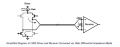
The picture below is from the National Semiconductor LVDS Owner's Manual, Rev 2.0 Spring 2000. Similar diagrams can be found in other LVDS app notes. It shows a typical LVDS interface.
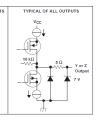
While I don't know for sure, the MOSFETs that are pictures on the left are either ON or OFF. I do not think they operate in the linear region. They are used as switches to steer the 3.5 mA current one way or the other through the 100 ohm parallel termination resistor at the receiver.
This picture is from the TI data sheet for the SN55LVDS31 LVDS line driver, and shows what the output stage of the line driver looks like. Note that only 2 of the 4 outputs transistors are shown, one-half of the H-bridge.
LVDS (Low Voltage Differential Signal) is a fast DIGITAL mode. The concept is that the transistors can switch much faster if the do not go into saturation.
In audio and other ANALOG modes differential connections are used to reduce noise effects because it is possible to reject common mode noise that is in phase on both of the differential inputs.
But by the questions you ask it seems that you first need to study and understand things more basic than differential connections.
You don't need more help: you need to work harder to understand the help you've already been given.
This has all been explained to you multiple times, and people have pointed you to online materials that also explain it well. The topic has been simplified as much as it can be, and it cannot be made any more simple for you.
We can explain it to you-- and we have-- but we cannot understand it for you. YOU, not we, have to do that.

 Facebook
 Google
 GitHub
 Linkedin