Understanding battery charger IC datasheets

LowQCab

Joined Nov 6, 2012
5,101
The LTC4412, or similar, probably won't be necessary,
depending upon Battery selection, and the design of the Charger.

I can't make a Battery suggestion because I don't have a
clue what you're building, or how it will be used.
.
.
.
 

Thread Starter

Joe Stavitsky

Joined Apr 5, 2020
141
The LTC4412, or similar, probably won't be necessary,
depending upon Battery selection, and the design of the Charger.

I can't make a Battery suggestion because I don't have a
clue what you're building, or how it will be used.
.
.
.

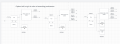
Sorry, I thought I had been pretty clear. Let me try a block diagram. 1659415546785.png
 

LowQCab

Joined Nov 6, 2012
5,101
Your preference adds up to ~6.3-Amps total Current.
Now You need to decide if You want to make sure that You have enough Power to
run run all those USB-Ports at their Maximum-Output, all at the same time,
or,
realistically, You will probably never use half of them at the same time,
and that will probably be somewhat less than full Load on each of them.

The latter will allow You to "get-away-with" using a smaller, ( Lower-Current ), Power-Supply,
or,
it will allow more minutes of run-time when You are on "Batteries-only-Power".

I'm not an expert on this, but I think the Specifications for Current-Delivery for
the USB-Ports is a good-bit higher than 0.5A and 0.9A .
Where did these Current numbers come from ?
.
.
.
 

Thread Starter

Joe Stavitsky

Joined Apr 5, 2020
141
Your preference adds up to ~6.3-Amps total Current.
Now You need to decide if You want to make sure that You have enough Power to
run run all those USB-Ports at their Maximum-Output, all at the same time,
or,
realistically, You will probably never use half of them at the same time,
and that will probably be somewhat less than full Load on each of them.

The latter will allow You to "get-away-with" using a smaller, ( Lower-Current ), Power-Supply,
or,
it will allow more minutes of run-time when You are on "Batteries-only-Power".

I'm not an expert on this, but I think the Specifications for Current-Delivery for
the USB-Ports is a good-bit higher than 0.5A and 0.9A .
Where did these Current numbers come from ?
.
.
.

Yes, I've been through the USB PD docs. The actual max currents are in the 10A range. They expect you to be able to charge a laptop from one of those ports.

The current I've specified comes from a commercial powered hub I bought. Your argument that I wont' use more than 2 of them at the same time is reasonable.
 

LowQCab

Joined Nov 6, 2012
5,101
This is, of course, only one possible option ..................
Your "System" is powered by a built-in-Battery.
The cabinet for your System has a Jack on the outside for an external Power-Supply.
When the Power-Supply is "plugged-in",
it charges the Battery and provides enough additional Current to run the System,
both at the same time.

This is so very simple, that I'm thinking that there is some other problem
that You are concerned with that I am not aware of.

Why does this not make sense to You ?

Are You worried about having the ability to swap-out Batteries while the system is running ?
( this is not a problem, but it needs to be "specified" in the design,
because certain other factors must then be taken into consideration )
.
.
.
 

Thread Starter

Joe Stavitsky

Joined Apr 5, 2020
141
This is, of course, only one possible option ..................
Your "System" is powered by a built-in-Battery.
The cabinet for your System has a Jack on the outside for an external Power-Supply.
When the Power-Supply is "plugged-in",
it charges the Battery and provides enough additional Current to run the System,
both at the same time.

This is so very simple, that I'm thinking that there is some other problem
that You are concerned with that I am not aware of.

Why does this not make sense to You ?

Are You worried about having the ability to swap-out Batteries while the system is running ?
( this is not a problem, but it needs to be "specified" in the design,
because certain other factors must then be taken into consideration )
.
.
.
No, I have no need to swap batteries in and out. My one and only concern is that supply power _never_ drops below some minimum value as long as batteries have some minimum charge.

I got started looking into my own design because I bought a supply with batteries on Amazon for $30 with a USB3 input. It provided sufficient power on batteries alone, and was able to charge batteries while powering the Pi, but when I disconnected external power it momentarily dropped about 200mV which crashed the Pi.

I must admit I'm still pretty confused by your suggestion that I go without any charge IC whatsoever. If what you're saying is accurate, why do those ICs even exist? Why is there even such a concept as "power path?"
 
Last edited:

LowQCab

Joined Nov 6, 2012
5,101
There are many highly specialized Chips that "may" or "may-not" be suitable for a particular application.
But, You have to understand exactly what factors need to be taken into consideration FIRST.

I keep begging You for a comprehensive outline,
a list of expectations,
a list of hard-requirements,
and a list of "it-would-be-great-ifs",
but I still don't have a clue as to what You're trying to accomplish with this project.

Everything is a compromise to some degree or another.

To make those compromises the most advantageous that they can be, a PLAN must be created.

A PLAN will allow You to weigh the relative values of all
the various options available, against each other.

The PLAN may change many, many times, this is to be expected.

Following a PLAN will result in the most satisfactory final-product that You are capable of,
which is, of course,
based on your current experience-level and resourcefulness.

A few places to start might be ..........

How many minutes must the Battery be capable of supplying ~25-Watts of Power ?,
2-minutes ?, 10-minutes ?, 30-minutes ?, 2-hours ?, 20-hours ?

What is the maximum physical-size/weight of the Battery that is acceptable ?,
( just remember that Power X Run-Time = more weight, size, and $$$ )

Does weight matter ?
( Li-Pos are half the weight of an SLA-Gel-Cell, but 2 to 3 times the cost )

Can the Charger/Battery be contained in its own remotely located Box ?
( if You need a big Battery, putting it on the floor under your desk makes a lot of sense )
.
.
.
 

Thread Starter

Joe Stavitsky

Joined Apr 5, 2020
141
:eek:
There are many highly specialized Chips that "may" or "may-not" be suitable for a particular application.
But, You have to understand exactly what factors need to be taken into consideration FIRST.

I keep begging You for a comprehensive outline,
a list of expectations,
a list of hard-requirements,
and a list of "it-would-be-great-ifs",
but I still don't have a clue as to what You're trying to accomplish with this project.

Everything is a compromise to some degree or another.

To make those compromises the most advantageous that they can be, a PLAN must be created.

A PLAN will allow You to weigh the relative values of all
the various options available, against each other.

The PLAN may change many, many times, this is to be expected.

Following a PLAN will result in the most satisfactory final-product that You are capable of,
which is, of course,
based on your current experience-level and resourcefulness.

A few places to start might be ..........

How many minutes must the Battery be capable of supplying ~25-Watts of Power ?,
2-minutes ?, 10-minutes ?, 30-minutes ?, 2-hours ?, 20-hours ?

What is the maximum physical-size/weight of the Battery that is acceptable ?,
( just remember that Power X Run-Time = more weight, size, and $$$ )

Does weight matter ?
( Li-Pos are half the weight of an SLA-Gel-Cell, but 2 to 3 times the cost )

Can the Charger/Battery be contained in its own remotely located Box ?
( if You need a big Battery, putting it on the floor under your desk makes a lot of sense )
.
.
.

OK, I apologize. I'm starting to see what you're missing and I did indeed not supply the information. As far as battery physical parameters are concerned, I am hoping to fit them in the same enclosure as the Pi is currently in. It is 1 in by 7 in by 13 in and currently approximately 30%-50% full with the Pi and some USB peripherals. I need a realistic minimum of 2 hours Battery power and an absolute minimum of one hour.

I would strongly prefer to put the PSU in the box as well, but I will consider leaving it out if it is sufficiently small. If you need a specific max size I will need to measure and get back to you.

Again, sorry I didn't supply this info earlier. You've been extremely helpful and I'm trying to forward any info you request as quickly as I can.

Eta: regarding Battery weight, I need to carry this on my person for some time. So 10 lbs is probably pushing it. 20 absolute max.
 
Last edited:

LowQCab

Joined Nov 6, 2012
5,101
Thank You so much ...........
Now let's start figuring-out your ACTUAL likely maximum Load from any and all USB-Peripherals ........

I'm guessing that 700ma is just about right for the Raspberry-Pi.

For the display, ~200ma is probably the Maximum-Back-Lighting-LED-Load, ( that's seriously bright !!! ),
and there is bound to be a PWM-Brightness-Adjustment.
The Display should be set up to "Auto-Dim" after ~30-seconds of no Human interaction,
and then turn completely "Off" after maybe ~1-minute of no Human-interaction.
This can be further refined so that when the Power-Supply-Voltage is close to
a certain maximum Supply-Voltage-Set-Point, the Display will stay at full-Brightness all the time.
The higher Voltage is an indicator that the Mains-Powered-Supply is currently operating, ( plugged-in ).
You could also install a "Photo-Cell" ( LDR-Light-Dependent-Resistor, same thing ),
to automatically Dim the Display when the ambient Light-levels are low,
and brighten it when Light-levels are high, like when outside in the Sun.
This last technique would work well if you have a protective cover, or "Lid" on the Box
that would darken the display when closed.
This can save You ~200 to ~250ma when no-one is looking at the Display.
That's ~400 to 500 mAh of Battery Capacity, ( for a 2-hour period ).

-----------------------------------------------------------------------------------------------------------------

Everything else appears to be "USB-Loads" ............
What, exactly,
are the Current-Requirements for each of the particular USB-Peripherals that You intend to use ?

Thumb-Drives only need around ~10ma each, ~20ma-max.

Using this project for charging other Batteries,
while the Project is, it's-self, running on Batteries,
is not a good plan from an overall-efficiency point of view.
But it can be done.
Charging a Cell-Phone is not too much of a problem,
but other types of devices may have much larger Batteries,
like for instance, a Tablet.

Make a List of the USB-Peripherals that You may find yourself wanting to use at some point.
Find-out how much Current each one uses, ( or at least a close idea ).
Then add them all up.
This is a REQUIRED first step.
.
.
.
 

Thread Starter

Joe Stavitsky

Joined Apr 5, 2020
141
Make a List of the USB-Peripherals that You may find yourself wanting to use at some point.

Trust me, I want to do this correctly. I _need_ to do this correctly. But an exhaustive list of USB peripherals is just not going to happen. I have no idea whatsoever what I'm going to buy or make tomorrow. We can only make worst case assumptions as you originally suggested and hope for the best. If that means restarting the design from scratch at some future point, that's how the cookie crumbles.

For the USB hub, assume 2x 2A annd 2x 0.9A.
 

LowQCab

Joined Nov 6, 2012
5,101
Ok, Thank-You,
That puts the Current over 7-Amps, for 2-hours,
that's ~14+Amp/Hours required of the Battery.
.
I don't think You realize what You are asking for, but here is a start ..................
.
This Battery may not fit into your existing Box, but it's very close .................
In any case, your Box MUST BE Aluminum for Heat-Sinking, no plastic,
Bud-Industries makes some nice Cast-Aluminum-Boxes .........
https://www.digikey.com/en/products...?s=N4IgTCBcDaIEIFcAmACAkgBQMoFoDMAnHniALoC+QA
.
Battery ........
Chinese Batteries, in general, have very poor Quality-Control, and extremely dubious Specifications,
I will always recommend against them, even though there are a few reputable Chinese companies.
.
MaxAmps "description-Part-Number",
( they don't use part-numbers, almost all of their Batteries are custom-made ) ......................
https://www.maxamps.com/lipo-17000-2s-7-4v-battery-pack
.
"" LiPo 17,000 2S 7.4v Battery Pack, No Plug, 12-AWG ""
~$214.oo
Completely guaranteed Performance, and Life-Expectancy.
.
Size = 6.25" X 3" X 0.9", ( 158mm X 79mm X 23mm ),
.
Weight = ~1.5 pounds, ( 660 grams ),
.
( ask MaxAmps about optional "built-in" BMS Circuit-Board ), ( Battery-Management-System ),
( It may be more cost-effective than a DIY-Battery Protection-System ),
If You want a pre-warning Low-Battery-Alarm, and Switch-Output-Signal,
a DIY Low-Voltage-Cut-Out Battery-Protection-Circuit will be required.
.
MaxAmps, Heavy-Duty, 20-Amp-Peak / 5.1-Volt, Buck-Regulator ~$43.oo,
.
Battery-Charger ..............
>>>>Battery must be Charged, and held at, EXACTLY 3.8V + 3.8V = 7.6-Volts, ( +/- 0.1-Volt ) . <<<<
This Charging-Voltage will reduce overall Battery-Capacity by around ~10%,
but it will probably quadruple Battery Life-Expectancy, ( 2 to 3-Years or more ).
.
Battery-Charger external AC-Power-Supply .....................
DigiKey,
AC/DC Switching-Power-Supply, 12-Volts, 7.5-Amps, 90-watts,
https://www.digikey.com/en/products...a4BxzAWgIwFYAiBNAygTgAZkUwCB2NAgcSQDkMQBdAXyA
~$45.oo
.
Bullet-Proof DIY Switch-Mode-Voltage-Regulator, ~$60 to ~$100.oo, in parts cost.
Very questionable 10,000-Watts !!!, Chinese Switch-Mode-Voltage-Regulator on Ebay, ~$20.oo,
( remember how much money You saved when it goes up in a puff of Blue-Smoke, for no apparent reason ).
.
.
.
 

Thread Starter

Joe Stavitsky

Joined Apr 5, 2020
141
Ok, Thank-You,
That puts the Current over 7-Amps, for 2-hours,
that's ~14+Amp/Hours required of the Battery.
.
I don't think You realize what You are asking for, but here is a start ..................
.
This Battery may not fit into your existing Box, but it's very close .................
In any case, your Box MUST BE Aluminum for Heat-Sinking, no plastic,
Bud-Industries makes some nice Cast-Aluminum-Boxes .........
https://www.digikey.com/en/products/detail/bud-industries/IPS-3933/2499348?s=N4IgTCBcDaIEIFcAmACAkgBQMoFoDMAnHniALoC+QA
.
Battery ........
Chinese Batteries, in general, have very poor Quality-Control, and extremely dubious Specifications,
I will always recommend against them, even though there are a few reputable Chinese companies.
.
MaxAmps "description-Part-Number",
( they don't use part-numbers, almost all of their Batteries are custom-made ) ......................
https://www.maxamps.com/lipo-17000-2s-7-4v-battery-pack
.
"" LiPo 17,000 2S 7.4v Battery Pack, No Plug, 12-AWG ""
~$214.oo
Completely guaranteed Performance, and Life-Expectancy.
.
Size = 6.25" X 3" X 0.9", ( 158mm X 79mm X 23mm ),
.
Weight = ~1.5 pounds, ( 660 grams ),
.
( ask MaxAmps about optional "built-in" BMS Circuit-Board ), ( Battery-Management-System ),
( It may be more cost-effective than a DIY-Battery Protection-System ),
If You want a pre-warning Low-Battery-Alarm, and Switch-Output-Signal,
a DIY Low-Voltage-Cut-Out Battery-Protection-Circuit will be required.
.
MaxAmps, Heavy-Duty, 20-Amp-Peak / 5.1-Volt, Buck-Regulator ~$43.oo,
.
Battery-Charger ..............
>>>>Battery must be Charged, and held at, EXACTLY 3.8V + 3.8V = 7.6-Volts, ( +/- 0.1-Volt ) . <<<<
This Charging-Voltage will reduce overall Battery-Capacity by around ~10%,
but it will probably quadruple Battery Life-Expectancy, ( 2 to 3-Years or more ).
.
Battery-Charger external AC-Power-Supply .....................
DigiKey,
AC/DC Switching-Power-Supply, 12-Volts, 7.5-Amps, 90-watts,
https://www.digikey.com/en/products...a4BxzAWgIwFYAiBNAygTgAZkUwCB2NAgcSQDkMQBdAXyA
~$45.oo
.
Bullet-Proof DIY Switch-Mode-Voltage-Regulator, ~$60 to ~$100.oo, in parts cost.
Very questionable 10,000-Watts !!!, Chinese Switch-Mode-Voltage-Regulator on Ebay, ~$20.oo,
( remember how much money You saved when it goes up in a puff of Blue-Smoke, for no apparent reason ).
.
.
.

Yeah, after reviewing the situation I've come to realize your assessment that I don't realize what I'm asking is totally correct. I'm going to need to revise my strategy.

Your guidance is absolutely invaluable in this and upcoming projects.

ETA: One "simpler" solution is a gas gauge connected to the Pi. That way when the batteries get low the Pi can start disconnecting USB ports. In fact, any strategic solution will entail the OS booting without the USB ports turned on, and then turning them on as the situation warrants.

PS - why LiPo rather than LiIon?
 
Last edited:

LowQCab

Joined Nov 6, 2012
5,101
Li-Po, and Li-Ion, are basically the same thing.
The differences are not well defined,
but generally, Li-Po refers to having a very high Peak-Current capability,
( some "RC-Hobby" style Li-Pos can deliver over ~100-Amps-Peak, routinely ),
and generally, Li-Ion refers to smaller, "light-duty" Batteries, like an 18650,
designed for smaller, long-term, Loads, like a Cell-Phone or similar.

Unless You are just charging another Battery,
turning-Off a USB-Port can result in obvious, or not so obvious, Data-Corruption,
so think about this first before implementing it.

The above Battery setup would scoff at such a trivial consideration,
and would handle all You could throw at it
for ~6 to ~8-hours or more, without a skipping a beat,
and before even getting close to needing an AC-Power connection again.

A "Fuel-Gauge" may create a lot of unnecessary complexity,
just accurately watch the Battery Voltage.
With a 2-hours till Charge time-frame,
there's probably a good ~10-minutes or more
worth of "Low-Battery" warning time before the "Automatic-Battery-Cut-Off" kicks-in.
A short ~100ms "Beep" every Second, along with a flashing LED,
is what I would suggest as warning-notification of an impending Shut-Down.
This will give You time to decide the best course of action to take.
.
.
.
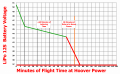
Estimated Discharge Curve  .png
 
Top