Facebook
 Google
 GitHub
 Linkedin

Hi Guys,
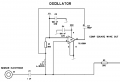
I have a very simple oscillator circuit working on the bench:
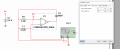
Does anyone have any clues to help with getting this simulated circuit running? I feel I'm missing something quite fundamental.
Thanks,
Dan
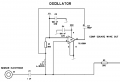
I have a very simple oscillator circuit working on the bench:
- Vcc is 5V, V+ is 2.5V.
- This circuit operates at around 16MHz and produces a 0V biased sine-wave at the electrode.
- On the right hand side of C1, the sine wave is biased around 2.5V.
- The amplitude of the sine wave lessens, as the loading of the electrode to ground increases.
- R2 feeds into a detection circuit to measure the amplitude of the waveform off to the right hand side of the schematic.
- This circuit continues to oscillate after I remove C1 and R2.
Does anyone have any clues to help with getting this simulated circuit running? I feel I'm missing something quite fundamental.
Thanks,
Dan
Attachments
-
 28.7 KB Views: 3