Understanding an absolute-difference circuit

PRASS

Joined Feb 22, 2018
31
That's strictly an analog circuit, nothing digital about it.
Yes.
A diode can be used in an analog circuit (and is used in many of them) without making it digital.
Do you really think that any circuit with a diode is digital?
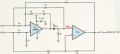
I am making note of the IC1B operation when V2>V1.
What else do you call a Analogue signal if it gets rectified into a ????? signal.
Or we could say what happens when a AC gets rectified ?????
 

ericgibbs

Joined Jan 29, 2010
21,448
hi menyman,
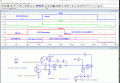
Hope you can follow this LTS sim OK.
R12 is the resistor in question.
The Switch connects R12 in the feedback loop for a given period.
The Vb[V2] voltage is applied as a +1v pulse, during the pulse R12 is switched In and Out.

From the sim results I would conclude that R12 is there to set Vout [Voo] to 0V when there are no input voltages on V1 or V2.

E
AAA 1125 10.02.gif
 

crutschow

Joined Mar 14, 2008
38,530
What else do you call a Analogue signal if it gets rectified into a ????? signal.
Or we could say what happens when a AC gets rectified ?????
It's called a rectified analog signal.
The result is generally some form of unidirectional or DC voltage.

Digital signals carry the information in discrete steps (typically binary or 1 and 0).
Signals with indefinite or arbitrary values are analog.

Look of the definitions of analog and digital.
 

Thread Starter

Menyman

Joined Jan 31, 2021
6
Hi Guys,

Again thanks for helping analyzing the circuit.
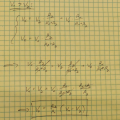
After a second look I believe it should be a lot easier to look at if we'll just go with the op amps rules, we can see that the negative feedback takes care of everything:

1612368691326.png

1612368709844.png
 

PRASS

Joined Feb 22, 2018
31
It's called a rectified analog signal.
The result is generally some form of unidirectional or DC voltage.

Digital signals carry the information in discrete steps (typically binary or 1 and 0).
Signals with indefinite or arbitrary values are analog.

Look of the definitions of analog and digital.
Hi crutschow,

So a signal that doesn't go below 0V-+ & only goes into positive is a rectified analogue signal lol.
I suppose a AC is negitive digital signal in that case ????
& a DC is a constant linear analogue ????

All I know is that the internals of a opamp are through gated transistors & a transistor that is gate controlled by a analogue signal creates a DC output or even a PWM.

May I please ask what your qualification is ?
 

crutschow

Joined Mar 14, 2008
38,530
May I please ask what your qualification is ?
Only if you tell me yours. :p
So a signal that doesn't go below 0V-+ & only goes into positive is a rectified analogue signal
Yes.
I suppose a AC is negitive digital signal in that case ????
No.
& a DC is a constant linear analogue ?
If the DC varies and the value represents a signal, then it's analog.
All I know is that the internals of a opamp are through gated transistors & a transistor that is gate controlled by a analogue signal creates a DC output or even a PWM.
The DC output is analog.
PWM is a digital representation of an analog value.

So what's your definition of analog and digital?
 
Top