Ultra-simple Isolated Low-Power Supply Without Transformer?

Status
Not open for further replies.

LesJones

Joined Jan 8, 2017
4,509
If your power supply is the 19 volt laptop supply then it is already isolated. You can confim thet this is the case with the actual power supply you are using by measuring the resistance between its mains input and output with your meter set to the highest resistance range. To do this connect the 3 input wires together. (Live Neutral and earth.) Connect the Positive and negative output wires together then measure the resistance between the input and the output. There may be a low value capacitor between the input and output but this will only provide a path between input and output for high frequency noise. It would have a very high reactance at mains frequency. The only situation you would need your second isolation barrier is if this power supply was also providing power to a laptop and you wanted to provive isolation between your device and the laptop. (Or devices connected to the laptop via USB , serial or parallel ports.) (The network connector will be isolated by high frequency transformers in the laptop.)
Another way to provide an isolated power supply would be to use two permanent magnet motors coupled together and insulated from each other both at the mounting and coupling between the shafts. One would act as a motor the other would act as a generator.
Here is the drawing of the example situation to try to get you to understand the isolation voltage difference.
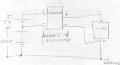
example001.jpg
This is just an example. There are many situations where isolation is required. As you won't tell us what your situation is only you can tell us how much isolation you required.
Les.
 

Thread Starter

johnyradio

Joined Oct 26, 2012
615
If they are too small, you wouldn't get sufficient output voltage/power.
Voltage/power? Isn't voltage controlled by the DC supply? Don't the iso-caps limit current?
BTW does the 555 need to be bipolar for the iso-caps to behave properly?
There are many situations where isolation is required
Thx for your tips. The isolation I need here is not for mains-safety. As you mentioned my laptop supply is already isolated from mains. This isolation is for a different purpose, which has to do with operational isolation between different circuit blocks. The solution offered by crutschow seems perfect for my needs.
 

rod-e

Joined Jun 17, 2016
22
Just use an isolated DC-DC converter. The smallest are 1W, and cost around $5 or so (supplier dependent of course). Your target spend of $1 is unrealistic. Electronics is about compromise, and if you need an isolated supply then you have to be prepared to pay for it.
 

Thread Starter

johnyradio

Joined Oct 26, 2012
615
Just use an isolated DC-DC converter. The smallest are 1W, and cost around $5 or so (supplier dependent of course). Your target spend of $1 is unrealistic. Electronics is about compromise, and if you need an isolated supply then you have to be prepared to pay for it.
I don't need a module, just a schematic. I will put the circuit onto my own PCB.

I don't need one Watt I only need 1/2 watt or less.

What's wrong with the isolated Supply posted by @crutschow ?
1726187717387.png
 

ronsimpson

Joined Oct 7, 2019
4,712
What's wrong with the isolated Supply posted by @crutschow ?
Because I don't know and will never know what kind of isolation is needed I can only guess.
Start out with "gnd" and "Reg_Com being at the same voltage. Turn on (or off) the magic thing that needs isolation on the right side of the above schematic. Lets say Reg_Com goes from 0V to 100V in 1uS. Or that supply gets shorted out and goes from 100V to 0V in 10nS. Current flows through C2, C2. Maybe lightning hits and C2, C3 needs to charge up to 1000V in 1nS. I have concerns as to what happens to D1-4 and C1.
If the difference in voltage changes fast, current in C2 will flow to/from U1 and latch up the output.
If the difference in voltage changes downward fast C2, C3 will get their current from C1 causing it to charge to a very high level.
 

rod-e

Joined Jun 17, 2016
22
The circuit you show has DC isolation, but not AC isolation because of the capacitors. You can build your own miniature DC-DC converter, but it will cost more than those you can buy. TI makes some IC packages that include a tiny transformer and all the electronics, and they have high-voltage isolation, but they're not cheap. I can't recall the part number, but you can find them on the TI site.

You've said that the usage in unimportant to those replying, but that's incorrect. Without knowing exactly what you're trying to achieve we are in the dark.
 

Thread Starter

johnyradio

Joined Oct 26, 2012
615
Because I don't know and will never know what kind of isolation is needed I can only guess.
Start out with "gnd" and "Reg_Com being at the same voltage. Turn on (or off) the magic thing that needs isolation
If by magic thing you mean the device which is being powered by this isolated supply, I gave the part numbers above. It's a current sensor, and a microcontroller.
The supply for this converter is a low current low voltage source. 5 volts at a quarter of an amp . Assume that current is supplied by quarter amp battery. Mains is nowhere in this system, end to end. Also assume that the battery supplies a DC to DC converter, so the load will be prevented from drawing excessive current from the battery.

Battery -> dcdc converter -> v isolating converter being discussed in this thread -> a microcontroller and a current sensor.

As I mentioned in a previous comment 200 volts of isolation is needed.

I thought @crutschow converter that he posted was isolated, but now people are saying it's not.

Therefore it seems the h bridge converter which I described above, including a link to the article and the schematic, is a viable transformerless isolated supply, according to the max article.
 

LesJones

Joined Jan 8, 2017
4,509
Just 1 point about crutscow's circuit. The maximum suppy voltage for a LM 555 is 16 volts so it would not be suitable to use with a 19 volt supply. If you drop the input voltage or find suitable alternative the LM555 it should solve your problem.
Edit.
Les. Re your post #47 crutchows circuit is isolated for a DC difference but NOT for an AC difference. It has been mentioned that you need to consider the AC component when the 200 volt difference is turned on or off.
 
Last edited:
If you are just trying to DC float the supply output from the input then capacitive coupling would work. make a squarewave (like from a NE555) capacitive couple the square wave and ground reference with series capacitors. Bridge rectify and smooth the output of the capacitors. That should fit the budget.
 

MisterBill2

Joined Jan 23, 2018
27,684
OK, the "simple" isolated supply not using a transformer will consist of two battery packs, one supplying power to the load while the other is charged from the mains. an isolated change-over switch will exchange connections at time intervals based on the anticipated power consumption. The battery charging system can be as simple as a resistor and a diode.

This scheme can easily provide several thousands of volts worth of isolation, and it is adaptable to whatever voltage and current are selected.
 

Thread Starter

johnyradio

Joined Oct 26, 2012
615
It sounds to me like you are using a non-isolated current sensing method when an isolated one like a hall effect sensor would make the problem go away. But, of course, I am only guessing.
You're guessing correctly And I've been thinking about this since yesterday. I'm embarrassed to say that I think I don't need isolation for the current sensor power supply. I am using a hall effect. Rather it's the circuit that's being sensed which needs to remain isolated, and it will be with a hall effect. Thank you for confirming.

But I'm still interested in how to make a low power isolated supply without a transformer.
two battery packs, one supplying power to the load while the other is charged from the mains. an isolated change-over switch will exchange connections at time intervals based on the anticipated power consumption. The battery charging system can be as simple as a resistor and a diode.
I don't need means isolation, but otherwise Very cool.

Like this?
battery -> switch -> battery -> load

If you are just trying to DC float the supply output from the input then capacitive coupling would work. make a squarewave (like from a NE555) capacitive couple the square wave and ground reference with series capacitors. Bridge rectify and smooth the output of the capacitors. That should fit the budget.
Sounds like @crutschow 's circuit above. I'm still trying to wrap my head around what's blocked and what's not blocked. Series cap blocks DC and passes AC. Let's say I have a coin cell And I want a galvanically isolated charger on each battery, and feed both chargers with the same DC supply. Will the capacitively coupled 555 on each cell block DC current flow between the batteries?
 
Last edited:
Status
Not open for further replies.
Top