We were all noobs once, with only a rudimentary knowledge of electronics.
Small (depeding on how small) and <$1 are going to be extremely challenging to meet. But there are other possibilities if just a few mW is all you need:
A Gunn diode in a microwave cavity could be used to direct microwave energy at a microwave aerial. A microwave diode can very easily convert this to DC.
Ok, this is really a transformer, but you could use the energy transfer principle used in cordless phone chargers and in RFID tags and contactless smartcards.
If you want to power some sort of environmental sensor maybe it could wake up now and then and do it's stuff, and the rest of the time remain in low power sleep mode while power is accumulated in a capacitor from a small solar cell with a LED shining on it.
A few methods have been proposed for harvesting environmenntal energy for ultra-low power devices such as enviromental sensors, such as harvesting energy from motion or vibration, or from WiFi.
Smart luggage tags typically run for a year on a lithium coin cell. If you could put up with changing the battery every few months or year maybe that could be your energy transfer mechanism!
But as others have already concluded, the time might have come to radically reassess what you're trying to achieve an how you're going about it.
The TI UCC12050, with integrated trafo, is $2.70, for 500mW. That's outside my budget, but about 5 x more power than i need. So i think i'm not crazy to target $1. https://www.ti.com/lit/ds/symlink/ucc12050.pdf
Idea: A simple non-regulated isolator followed by a simple non-isolated regulator.
To have the micro on the power line you need to have isolation on all inputs and outputs. Now days many micros talk WiFi for the output, that is isolated. If there are buttons, they will need to be double isolated to humans. Not hard. Inputs might only need an opto-isolator I can't see what you are building. I am asking where the isolation needs to be.
For the UCC12050 you need to get 5V off the power line. For a non isolated micro you need to get 5V or 3.3V off the power line. I think that needs to happen either way.
-----edited------
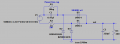
I built one of these recently. 5V at 27mA. The output has ripple but that can be fixed. Normally I use this type of supply for LEDs or battery chargers, sometimes micros that control the power line. Whatever it powers is sitting on the power line!
R3=load. C1 is a special capacitor.
So can you state what the common-mode voltage is between the power and the circuit, and is there a significant AC component to that voltage?
Is it just DC difference you want to isolate or is there more?
I'm trying to determine if a capacitive isolation technique might work.
To have the micro on the power line you need to have isolation on all inputs and outputs. Now days many micros talk WiFi for the output, that is isolated. If there are buttons, they will need to be double isolated to humans. Not hard. Inputs might only need an opto-isolator I can't see what you are building. I am asking where the isolation needs to be.
For the UCC12050 you need to get 5V off the power line. For a non isolated micro you need to get 5V or 3.3V off the power line. I think that needs to happen either way.
-----edited------
I built one of these recently. 5V at 27mA. The output has ripple but that can be fixed. Normally I use this type of supply for LEDs or battery chargers, sometimes micros that control the power line. Whatever it powers is sitting on the power line!
R3=load. C1 is a special capacitor. View attachment 331364
Is that a capacitive dropper followed by a rectifier? Is the capacitive dropper intended for AC mains? I won't be working with mains. My input will be DC.
Let's say that your power source is a 5 volt battery with the negative teminal connected to the positive of a 1000 volt battery whose negative terminal is connected to ground. The negatve rail of the the device that you want to supply power to is at ground potential. The common mode voltage or DC difference will be 1000 volts. You would get better help if you told us the FULL DETAILS of what you are trying to achieve. With full details we would be able to work out what the DC differnce is.
say that your power source is a 5 volt battery with the negative teminal connected to the positive of a 1000 volt battery whose negative terminal is connected to ground. The negatve rail of the the device that you want to supply power to is at ground potential.
If i understand your description, your supply and load grounds are connected. That's not galvanic isolation, which i need.
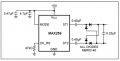
It seems optocoupler isolation can't provide power through the isolation barrier. A trafo or capacitor can. After a bit more research, it looks like capacitive isolation with an H bridge is the only transformerless way to get galvanic isolation for a power supply.
But the MAX256 is a $5 IC, and more power than i need. I can't find a cheaper device with integrated oscillator. I think i can implement a half H bridge supply with a mosfet array + a driver IC + 555.
Gate Current
To calculate required gate current, Microchip says
The amount of current a gate driver needs depends on the desired transition time and the total gate charge. It can be calculated by dividing the total gate charge by the desired transition time.
For example:
Given: N-Channel MOSFET
VGS = 10V
t (transistion) = 25nsec
Find: Gate drive current, IG.
From the MOSFET manufacturer’s specifications, QG = 50nC at
VGS = 10V. Using IG = QG/t(transition):
IG = QG/t(transition) = 50 x 10-9/25 x 10-9 = 2.0A
In the case of the CSD87502Q2 (above):
VGS = 5V
t (transistion) = 11nsec (this is the "rise time" from the datasheet. Not sure if that's what i want here.)
Find: Gate drive current, IG.
From the MOSFET manufacturer’s specifications, QG = 2.4nC at VGS = 5V.
Using IG = QG/t(transition):
IG = QG/t(transition) = 2.4 x 10^-9 /5 x 10^-9
= 0.48 A Ig
Total cost
So for 150 mA capacitive iso supply: mosfet array + a driver IC + 555 = about $0.75, if my numbers check out.
Was hoping for something much cheaper
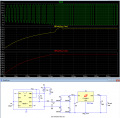
Below is the LTspice sim of a regulator using a 555 oscillator and isolated by capacitors to generate 5V at the desired power level:
The 555 operates from a 19V DC supply (you mentioned using a laptop supply).
The regulator can be any small 5V linear regulator (7805 type, whichever is cheapest).
Doubt you can do a circuit much cheaper than that.
Does that do what you want?
In post #30 I am trying to explain to you the term voltage difference. In that example you have the 5 volt supply source which sits at +1000 volts with respect to ground, your isolation device goes between the 5 volt battery and your 5 volt load. The negative of your 5 volt load is at ground potential. So the difference between the battery negative and the load negative is 1000 volts. We are trying to get you to tell us what the voltage difference is between your supply negative and the load negative. In your case is this difference just a DC voltage or does it also have an AC component. If the difference has an AC component then capacitor isolation will NOT work as capacitors conduct AC.
Edit. I have just noticed that crutschow has posted a schematic using capacitor isolation. In that circuit C2 and C3 provide the isolation barrier
Below is the LTspice sim of a regulator using a 555 oscillator and isolated by capacitors to generate 5V at the desired power level:
The 555 operates from a 19V DC supply (you mentioned using a laptop supply).
The regulator can be any small 5V linear regulator (7805 type, whichever is cheapest).
Doubt you can do a circuit much cheaper than that.
Does that do what you want?
Wow, thanks for simulating this. So no half bridge needed! Electrically, do the caps here function similarly to the caps in the h-bridge ckt? Def seems cheaper. So the 555 is supplying the current? Google says 555 can give 200mA, which is perfect.
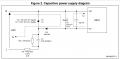
But would the following work with a 555, and be cheaper yet?
Having trouble understanding that, since they are isolated. So how can we talk about a voltage difference between isolated systems. Btw, this will be a single-sided positive supply, not sure if that's relevant.
That would be cheaper, but have poorer regulation and would waste more power in the shunt Zener regulator, than the series 5V regulator I used.
That would put added stress on the 555 load that it may not like.
You can save a couple diodes with my circuit, if you like, by using just two diodes for half-wave rectification, instead of the four diode bridge.
Below is the LTspice sim of a regulator using a 555 oscillator and isolated by capacitors to generate 5V at the desired power level:
The 555 operates from a 19V DC supply (you mentioned using a laptop supply).
The regulator can be any small 5V linear regulator (7805 type, whichever is cheapest).
Doubt you can do a circuit much cheaper than that.
Does that do what you want?
Outstanding.
What's the formula to calculate C2 and C3, please?
I assume Volts Isolation is just the voltage of the caps?
If the regulator can handle a half-rectifier, and it's cheaper, will do that too.
I just used a value, that worked well in the simulation, no calculations.
It may be possible to reduce their value, if that significantly reduces the cost.
What behavior of the circuit do the caps control? I mean, if you vary the capacitance widely, what will change in the circuit? Will it cause the waveform to distort? Normally, a series cap is a high-pass filter. but here are there are two. What is this configuration called? "Series" seems like the wrong word.

 Facebook
 Google
 GitHub
 Linkedin