Two Stage, 3 Transistor, Amplifier Question

Thread Starter

mbird

Joined Jan 29, 2009
35
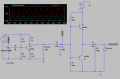
I was playing with Common Emitter and Push Pull amplifiers and tried to make a simple amplifier for computer speaker jack to speaker.
I settled on trying a Common Emitter to do voltage gain followed by a Push Pull to do current gain and connect them in stages and then to the speaker.

I was wondering if anyone could comment on the design and make suggestions on improvements, what's right/wrong, what could/should be changed, if the whole concept is wrong, etc.

Some things I noticed:

-I need to add some diodes to fix the Push Pull stage's distortion (but I leave them off here for now because when I add them I get a squashed output -- so I will experiment with that and post schematic and trace separately if it I don't get it working).

-The output from the CE is voltage amplified as I expected but then it is decreased when coming out of the Push Pull stage (see net labels OutCE vs OutPushPull).

This is just home/hobby/experimenting to learn more about how amplifiers (and transistors in general) work so nothing mission critical. Thank you for any ideas.
twostage00.png
 

pdavis68

Joined Nov 27, 2013
46
First of all, I'm not terribly knowledgeable about transistor electronics, but I build vacuum tube amps and a lot of the concepts are similar. You definitely want the diodes to remove the crossover distortion. Also, from looking at the waveform at Q3, that doesn't look so clean. You might want to play with the bias.

What's the purpose of R1 and R9? Try removing them and seeing what happens?
 

pdavis68

Joined Nov 27, 2013
46
To clarify: R9 isn't doing much: 100K in parallel with 8R, so about 8R. On the other hand, R1 in parallel with R5 = 50K. Not what you want. R1 will be a problem.
 

Thread Starter

mbird

Joined Jan 29, 2009
35
What's the purpose of R1 and R9? Try removing them and seeing what happens?
Hi --
Yes, R1 and R9 seem unnecessary so I removed them.
I still wonder about the problem in that CE amplifies the voltage as expected but then it goes back down after it comes out of the PushPull stage?
Thank you!
 

Thread Starter

mbird

Joined Jan 29, 2009
35
Did you rerun the sim with R1 removed? I doubt this will have any effect, but try changing R4 and R5 to 10K.
Hi --
Yes I did a re-run and also tried 10K instead of 100K for r4 and r5 but the trace remains very similar to the original.
 

#12

Joined Nov 30, 2010
18,224
RCE, R1, and R9 have no purpose. Remove them.
Look up, "rubber Zener" to show you how to make an adjustable voltage spacer where you're thinking about 2 diodes.
Then look at the idea that you're trying to drive 8 ohms to +/- 5V.
That's 5/8 of an amp which is outside the range of the 2N39xx transistors.
Then look at the current drive like this: R2 in series with the base of Q1 will give you about 1ma of current into the base during the peak positive excursion. If Q1 has a gain of 300, you're still only half way to having enough current to drive 625 ma into the 8 ohm load.
One way to fix it is to add another layer of transistors to get your current gain up or reduce your Q3 collector resistor to 6.25 ma @ 1 volt, or 16 ohms.
Oops. That won't work to jack up the current in Q3 so it must be that you need more current gain in the output stage.

Track the logic?
Your output stage is feeble. You need a do-over.
 

Thread Starter

mbird

Joined Jan 29, 2009
35
Track the logic?
Your output stage is feeble. You need a do-over.
Yes -- makes sense (and I see now that I am not fully turning on q1 and q2 and so seeing lower voltage from the output of the Push Pull than I expected). I will redo based on what was mentioned in this and the above posts.
Thank you!
 

hobbyist

Joined Aug 10, 2008
892
Just for starters, figure that the output transistors are small signal transistors, so because they are designed for small signal gain, you would need power transistors on your output stage.

However, if you are tasked with the challenge of using small signal transistors on the output stage, no problem, it gives a good opurtunity to learn how to design under constraints. Which transistor circuit design is all about.

Alright, figure you don't want to exceed 500mW of power dissipation on all these transistors.
That is going to set the constraints on your output voltage, and input voltage, because you are given 8 ohms as your load.

So now look over all the parameters that are non changeable.
Supply voltage is given as 12 volts.
Load is given 8 ohms.

Using basic ohms law calculations, figure a acceptable output voltage swing you would like to work to, across the 8 ohm load. Choose a value, then divide the voltage swing by 8 ohms load to solve for output current needed. When that is solved, then subtract the output voltage swing from the supply voltage, and this will give you the voltage drop across the transistor Q1 on that excursion, now take that volt drop across Q1, and multiply it by the output current, and this will give you a calculated value of power dissipation through Q1. If it exceeds 500mW, then readjust volt output or current output until you get a feasable value of power diss. through Q1, 500mW or less.

Once you have a satisfactory value solved for Vout and Iout, then you can build your output pushpull stage, remember your pushpull stage is not a signal amplifier, in other words what goes in pretty much comes out, as far as voltage, however it is used to supply large amounts of current amplification, so even though it doesn't amplify the signal voltage coming in, by much, it will drive that same signal through a much smaller output impedance, causing a greater power output.

Then when that stage is built, now you can determine the input stage, you assume a voltage gain value, by taking the output voltage and dividing it by a gain of some chosen value, then that value will become your input voltage, then you design your CE amp. to amplify that input voltage by that gain.

Now that is how your circuit is setup to do, you will find that when you accomplish this, you will still have some crossover distortion on the output across the 8 ohm load, thats because your trying to design a class AB amplifier but your just combining a class A amp with a class B amp, to attain this. When designing a class AB amp for minimal crossover distortiion, the class B amp needs compensation to bias it into very low conduction, but for your playing around with transistor amps, your circuit should work just fine for getting a small signal amplified across a low 8 ohm load, if you follow the steps I shown here.

Have fun in your design.
 

WBahn

Joined Mar 31, 2012
32,823
Is it just me, or does the fact that the lower power rail and the other side of the load are both at the same potential (0 V) cause some concern? It would appear that the quiescent conditions for Voutce would be around 4 V (based on two 100 kΩ resistors in parallel on the bottom of a voltage divider with a single 100 kΩ resistor on top), which looks consistent with the simulation.

But shouldn't the quiescent voltage at the output (Voutpushpull) be zero and, since it appears to be operating a bit over 2 V, does that indicate something amiss with the design that would at least lead to increased distortion?

I'm not an audio designer by any stretch of the imagination, so operating in this way may be just fine.

To reduce the crossover distortion, could something like a Vbe multiplier be used?

Is having Vsignal biased around 2 V realistic? I would think that a computer speaker jack would be AC coupled and so would not have a DC bias on it.
 

hobbyist

Joined Aug 10, 2008
892
mbird:

I'm just a transistor hobbyist, but I did a video blog on using an 8 ohm speaker for an output, and demonstrated designing a transistor circuit using 2n3904 transistors to drive a small ohmage load, . I didn't use a class B amplifier, but an emitter follower stage for the output to match low output impedances to high output transistor amp CE stages.

if your interested it can be found on this link

http://forum.allaboutcircuits.com/blog/my-hobby-way-of-designing-a-small-signal-amplifier.695/
 

#12

Joined Nov 30, 2010
18,224
(based on two 100 kΩ resistors in parallel on the bottom of a voltage divider with a single 100 kΩ resistor on top),
That has already been addressed by two people and the TS. Posts 2,3,4,5, and 6. R1 shall be deleted.

To reduce the crossover distortion, could something like a Vbe multiplier be used?
I suggested that under the pseudonym, "rubber Zener" post#7

In post #12, hobbyist designed a Class A amplifier. It demonstrates building current gain in consecutive stages, but is very different from the TS circuit.
 

WBahn

Joined Mar 31, 2012
32,823
That has already been addressed by two people and the TS. Posts 2,3,4,5, and 6. R1 shall be deleted.


I suggested that under the pseudonym, "rubber Zener" post#7

In post #12, hobbyist designed a Class A amplifier. It demonstrates building current gain in consecutive stages, but is very different from the TS circuit.
Okay, but what about the other two points I raised:

1) But shouldn't the quiescent voltage at the output (Voutpushpull) be zero and, since it appears to be operating a bit over 2 V, does that indicate something amiss with the design that would at least lead to increased distortion?

2) Is having Vsignal biased around 2 V realistic? I would think that a computer speaker jack would be AC coupled and so would not have a DC bias on it.
I think the second one is largely moot, since the capacitor should block the DC bias anyway.

My main concern with the first one is that a DC signal IS appearing on the load. Doesn't that indicate that the circuit is not operating as you would like it to?
 

#12

Joined Nov 30, 2010
18,224
Okay, but what about the other two points I raised:
I apologize for not addressing every single thing you inquire about. I tried to limit my responses the things I actually know about. Other people regularly post here and might answer your additional queries.
But shouldn't the quiescent voltage at the output (Voutpushpull) be zero and, since it appears to be operating a bit over 2 V, does that indicate something amiss with the design that would at least lead to increased distortion?
The fact that the simulation seems to show an average DC voltage of about 2 volts applied to RSpeaker seems wrong because capacitor C2 is supposed to avoid that result, and I believe it would avoid that result in a real, physical circuit. This seems to be in the realm of the simulator, which I am woefully ignorant about. Again, apologies for limiting my responses to things I am familiar with.
My main concern with the first one is that a DC signal IS appearing on the load. Doesn't that indicate that the circuit is not operating as you would like it to?
I hope that people who use simulators can explain how a simulation shows a DC current (of about 2V/8 ohms) passing through a capacitor (C2).
 

WBahn

Joined Mar 31, 2012
32,823
I apologize for not addressing every single thing you inquire about. I tried to limit my responses the things I actually know about. Other people regularly post here and might answer your additional queries.
The fact that the simulation seems to show an average DC voltage of about 2 volts applied to RSpeaker seems wrong because capacitor C2 is supposed to avoid that result, and I believe it would avoid that result in a real, physical circuit. This seems to be in the realm of the simulator, which I am woefully ignorant about. Again, apologies for limiting my responses to things I am familiar with.

I hope that people who use simulators can explain how a simulation shows a DC current (of about 2V/8 ohms) passing through a capacitor (C2).
Thanks. Please don't take my queries so personally. I was just hoping that you could shed some light on those points as I believe you have quite a bit more practical experience with these types of circuits that I do, which is quite limited, or that other members might be able to do so.
 

dannyf

Joined Sep 13, 2015
2,197
I will be making several changes based on all the feedback above!
In that circuit, Q2 is really redundant, and all you have is a singled ended output stage.

The key in such designs is first trying to figure out your application. If it is a linear application, you will need to figure out how to deal with cross-over distortions.

If it is a digital, you will need to figure out if you need SE or sink/source capabilities. If so, a totem pole output may be needed.

It looks like that you are looking for a linear amplifier. In that case, the simplest and closest to what you have now would be something like jlh1969, or jlh1969m.
 

crutschow

Joined Mar 14, 2008
38,503
I hope that people who use simulators can explain how a simulation shows a DC current (of about 2V/8 ohms) passing through a capacitor (C2).
I know many of you like to jump on any instance where a simulation appears to show a bad or impossible result but here it's just a matter of stronger glasses when looking at the plot. :rolleyes:
The bottom value of the ordinate is -1.8V, thus the average V(outpushpull) is zero volts (along with the load current).
 
Last edited:
Top