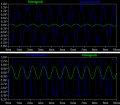
I know many of you like to jump on any instance where a simulation appears to show a bad or impossible result but here it's just s a matter of stronger glasses when looking at the plot.
The bottom value of the ordinate is -1.8V, thus the average V(outpushpull) is zero volts (along with the load current).
I know many of you like to jump on any instance where a simulation appears to show a bad or impossible result but here it's just s a matter of stronger glasses when looking at the plot.
Thanks for that updated schematic (and both the posts you sent will make great learning so thanks for those!)
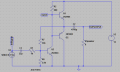
Your schematic (see TwoStage2x.asc file in above post) works great for input with peak of 0.1V (as in your schematic) but I want to have it for a computer output jack and when I change the input to have -1.5 to 1.5 then the output is clipped (below is your schematic with 0.1 VPP and 1.5 VPP). Can you advise on that?
You will probably find out if you scope the collector of Q3, you'll find the squarewave distortion, being fed into the output stage, the input signal is overdriving Q3, Q3 has around 700mV bias on its base terminal, so your input signal is greater than the base voltage, which is not good for an amplifier to perform.
Thank you to everyone who contributed to this post! Thanks to your time and willingness to share I now have so much great info to learn from! I will continue to explore and enjoy the hobby!
Thank you to everyone who contributed to this post! Thanks to your time and willingness to share I now have so much great info to learn from! I will continue to explore and enjoy the hobby!
If your in this for the hobby side of it, here is my hobby way desgin procedures to calculate component values for the classic class AB amp.
I came up with this after extensive reading books, breadboarding and experimenting, to get it down to a science with formulas then tweaking the values after the build, to get the best performance I could get at the hobby level.
Design procedures: the pic at the top shows the circuit.
VCC= 12v.
VEQ4 = (VCC / 2) = 6v.
VBQ4 = (VEQ4 + Vbe)= 6.7v.
The VBQ5 needs to be lower by (VbeQ4 + VbeQ5) = 1.4v
So VBQ5 will need 2 diode voltage drops to attain this, hence 2 diodes in this circuit.
Now you can choose what value of emitter current for Q4 you want, or determine this value by output current constraints. For just getting a working circuit with no design constraints, you can do it this way, just to get some practice in understanding the topology of this classic circuit.
Since a 2n series transistor has around 625 mW PD max. lets stay within a safe region and operate the transistor around 300mW.
To solve for emitter / collector current we know that we want 1/2 Vcc at the emitter of Q4, so that puts around 6v across Q4.
Using the power equation (P = E x I) then rearranging gives current value as (I = P / E) so at 300mW IEQ4 ~= 50mA. (where E in this equation is the 6v. drop across Q4 (VCE))
For starters, choose 50mA, for IEQ4
IEQ4= 50mA.
Iload pk-pk= (IEQ4 / 1.2) what that shows is load current pk-pk is 20% lower than emitter current of Q4,Q5.
Iload pk-pk= 8.3mA.
IbQ4= (IEQ4 / Beta min.) data sheet shows around 60 @ 50mA.
IbQ4= (50mA / 60) ~=830uA..
Now the collector current ICQ3, will bias the Q4,Q5 network, this current needs to be at least 10 times greater than IBQ4.
ICQ3= (10 x IBQ4)= 8.3mA.
Top base resistor of Q4, call it RCQ3, = {(Vcc - VBQ4) / ICQ3}
RCQ3= 638 ohms. make it standard 620 ohms. or what ever value you have available in that range.
Now try to get some gain with this amp.... Av= (RC / RE) and REQ3= (RCQ3 / AvQ3)
So, choose AvQ3 to be 10, and see if it can be realized when you prototype it.
REQ3= 62 ohms.
VEQ3= (ICQ3 x REQ3)= 514mV.
VBQ3= (VEQ3 +Vbe)= 1.21v.
Data sheet shows Beta min around 100 @ 10mA.
Now IBQ3 = (ICQ3 / 100) = 83uA
The base resistor connected to Q3, call it RBQ3, is calculated as follows.
The top side connects to the output voltage which is 6v. (VEQ4)
The bottom side connects to the base voltage of 1.21v. (VBQ3)
So the volt drop across this resistor ,(VRBQ3),= (VEQ4 - VBQ3)= 4.79v.
Now RBQ3 can be calculated as (VRBQ3 / IBQ3)= 57K ohms, make it standard 56K ohms.
------------------------------------------------------------------------------------
Now values are follows:
IEQ4,Q5= 50mA.
RCQ3= 620 ohms
REQ3= 62 ohms
RBQ3= 56K ohms
-------------------------------------
Now after simulating it on a computer, always need to build it empirically, and do static and dynamic tests on it, to see if any tweaking needs applied.
:
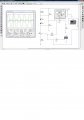
Now I just ran this on my Multisim , and the results I got was the standing bias voltage at the emitters of Q4/Q5 was around 4.9v. I wanted to get around 1v. pk. across the 8 ohm load, so I inputed a 1khz signal with a 300mV pk into Q3 and I got a good no distortion output of around 1.3v pk.
Now I would like to have the bias at the emitters around 6v. so I just adjusted the base resistor RBQ3 higher until the bias voltage was around 6v. at the emitters of Q4/Q5.
Then checked the scope and the voltage waveform remained at pk 1.3v. with no distortion.
So after you calculate component values, you still need to tweak values to get optimum performance, when you do an actual build of the circuit.

 Facebook
 Google
 GitHub
 Linkedin