Two motion sensors, one 12V LED strip

Thread Starter

TogetherInElectricDreams

Joined Jan 23, 2019
242
Hello everyone, I have two large cupboards that desperately need addional lighting. Due to where the switch/plug is located it would be much better if I could run the LED with motion sensors. The reason I need two is that the cupboards while adjoined are separate so my plan is to drill through and put the LED strip across both cupboards but I need two sensors because the sensor would only turn the light on for one cupboard. I know this is possible but I don't know how to do it so I'd appreciate someone helping me with a plan of what I join to where. I have the LED strip, two motion sensors with jack connections and a 12V adaptor.

I have some basic knowledge with electronics but struggle to read schematics so feel free to explain like I'm 5.

Appreciate any help/advice or suggestions.

Thank you in advance.
 

Tonyr1084

Joined Sep 24, 2015
9,744
That's doable. However, I have a closet with a light in it. The light is wired through a microswitch. When the door is opened the light comes on. When the door is closed the light goes out. It should be easy enough to set up two switches to act as OR switches. When one OR the other is switched on the lights are on. give me a few minutes and I'll bang out a drawing.
 

Tonyr1084

Joined Sep 24, 2015
9,744
The microswitches may need something to touch the trigger buttons. Aside from that it should be very straight forward. No need to mess with PIR sensors that detect movement and hold the light on for 5 minutes after the door has been closed. Or maybe even longer. An hour or so, depends on how you set up the PIR.

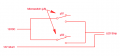
Below are two drawings. One shows the actual microswitch and the other shows the schematic representation of the µS.
Screenshot 2024-11-15 at 8.11.47 AM.png
Screenshot 2024-11-15 at 8.18.06 AM.png
[edit] Ignore the red color. Forgot to click away from the drawing before I did the screen capture. [end edit]
[edit #2] the switches are shown in their normal closed position. When a switch is activated that switch (or both switches if both doors are opened) will provide 12VDC to the LED Strip. [end edit #2]
 

sghioto

Joined Dec 31, 2017
8,634
I have the LED strip, two motion sensors with jack connections and a 12V adaptor.
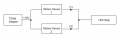
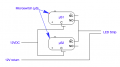
Using diodes D1 and D2 to isolate the two motion sensors is one way.
Diode type depending on the how much current the LED strip draws.
Post a link to the motion sensor for confirmation as it's possible the diodes can be eliminated.
1731685679978.png
 

MisterBill2

Joined Jan 23, 2018
27,315
Are those motion sensors 12 volt DC powered or 120 Volts AC powered?? If they are DC powered then the circuit in post #4 should work, but only if you also connect the negative terminals of the sensors and the LED strip back to the supply negative. Open loop circuits seldom function as intended.
 

Tonyr1084

Joined Sep 24, 2015
9,744
Two microswitches and ease of replacing them versus setting up PIR's, the switches make more sense.

I DO have a closet with a PIR installed on a socket with a corded lamp. When you walk in the light comes on. Stays on as long as it detects motion. But as soon as it no longer detects motion a countdown of 30 seconds shuts the light off. This is 110VAC switch and lamp.
 

MisterBill2

Joined Jan 23, 2018
27,315
Some motion sensors are quite simple to set up, while those I have used were all mains powered and took a fair amount of effort to install. The small DC ones I have seen should be fairly simple to apply..
 

Thread Starter

TogetherInElectricDreams

Joined Jan 23, 2019
242
Two microswitches and ease of replacing them versus setting up PIR's, the switches make more sense.

I DO have a closet with a PIR installed on a socket with a corded lamp. When you walk in the light comes on. Stays on as long as it detects motion. But as soon as it no longer detects motion a countdown of 30 seconds shuts the light off. This is 110VAC switch and lamp.
Hi Tony, I actually agree with you. I think I was over thinking this. Please could you send me a link to what the microswitches? Are they something I could get off Amazon?
 

Thread Starter

TogetherInElectricDreams

Joined Jan 23, 2019
242

Thread Starter

TogetherInElectricDreams

Joined Jan 23, 2019
242
Using diodes D1 and D2 to isolate the two motion sensors is one way.
Diode type depending on the how much current the LED strip draws.
Post a link to the motion sensor for confirmation as it's possible the diodes can be eliminated.
View attachment 335885
THanks so much for the diagram. This is the PIR. https://www.amazon.de/-/en/gp/product/B0CRHR8LL1/ref=ppx_yo_dt_b_search_asin_title?ie=UTF8&psc=1

Would this work with microswitches? That seems like it might be a better idea. If I use the motion sensors and need the diodes please could you send a link so I know what to buy? Do I need a splitter for the 12v adaptor?
 

Thread Starter

TogetherInElectricDreams

Joined Jan 23, 2019
242
The microswitches may need something to touch the trigger buttons. Aside from that it should be very straight forward. No need to mess with PIR sensors that detect movement and hold the light on for 5 minutes after the door has been closed. Or maybe even longer. An hour or so, depends on how you set up the PIR.

Below are two drawings. One shows the actual microswitch and the other shows the schematic representation of the µS.
View attachment 335879
View attachment 335880
[edit] Ignore the red color. Forgot to click away from the drawing before I did the screen capture. [end edit]
[edit #2] the switches are shown in their normal closed position. When a switch is activated that switch (or both switches if both doors are opened) will provide 12VDC to the LED Strip. [end edit #2]
I found this microswitch, If this is a good one to use, please could you walk me through how I go about wiring everything? I find schematics hard to follow but I can follow a "red LED wire to NC microswitch" type instruction. Thank you for this solution. I have the PIRs but think I'll get this instead, will make miles more sense.
 

Tonyr1084

Joined Sep 24, 2015
9,744
Was going to answer your question but looks like sghioto already has it covered. So, yes, like that. And that seems like a good choice. That metal bar can be bent so that you can mount the switch out of sight and having that arm touch the door when closed.
 

Tonyr1084

Joined Sep 24, 2015
9,744
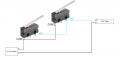
The way those switches work, when the bar is shown in the position it is (not actuated, not pressed) means C & NC (Common & Normally Closed) are in conduction. So when you open a door the switch falls to its non-actuated condition, applying current to the LED's. Either door open or even both doors open at the same time, the LED's will light up. sghioto shows the two switches in parallel. The "C's" are tied together and the "NC's" are tied together. When the doors are closed the switch is in the actuated condition and the C & NC are not in contact, turning the LED's off.
 

MisterBill2

Joined Jan 23, 2018
27,315
THanks so much for the diagram. This is the PIR. https://www.amazon.de/-/en/gp/product/B0CRHR8LL1/ref=ppx_yo_dt_b_search_asin_title?ie=UTF8&psc=1

Would this work with microswitches? That seems like it might be a better idea. If I use the motion sensors and need the diodes please could you send a link so I know what to buy? Do I need a splitter for the 12v adaptor?
Both mains powered and 12 volt DC motion sensors are often Passive Infra-Red technology, with the same logic scheme but quite different implementations of the same technology. For the one security light at my residence I am planning on changing to a microwave sensor because as the weather gets cooler the effective sensitivity increases, and I do not need to switch on the lights when somebody walks past on the sidewalk, minding their own business in a harmless way.
 

Tonyr1084

Joined Sep 24, 2015
9,744
There are three ways you can wire it. You can wire 120VAC to each switch. They turn on and off the 12V LED Power Supply (PS). That's NOT a good way to do it. Having 120VAC floating around inside a cupboard or cabinet is a bad idea. Easy for someone to get a shock, pull their hand away suddenly and could catch and tear skin on anything sharp enough to cut.

The better way is to have the 12V PS always powered. The PS then goes to the switches and then to the LED's. That's far safer. The down side is having the PS always powered.

The best way - the way I'm heading with six upper cabinets in my dining room is to have a switch on the wall between the upper and lower cabinets. MY configuration is to have TWO switches between the cabinets and two outlets inside the upper cabinets. One controls Over The Cabinet Lighting and another controls the Inside the cabinets lighting. The benefit here is that I can turn the lights on before opening the cabinets IF needed. No sense in having cabinets light up mid day when they are highly ineffective.

Well, that's MY opinion. Others may vary.

Plus, I have cats that know how to open cabinet doors. But they never close them. We went to South Dakota for a few days. When we came home the cabinets were open and if they would have been turned on because of an open door then they would have been on for possibly 5 days.
 

Tonyr1084

Joined Sep 24, 2015
9,744
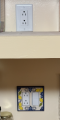
Screenshot 2024-11-20 at 8.10.39 PM.png
This first shot shows the two switches between the cabinets (see the next picture for clarity). Next to the two switches is a regular outlet used for whatever plugs in. Coffee pot, hot plate, etc. The two outlets in the upper cabinet (upper part of the picture) are wired 14-3 (one neutral, two switched hots) wired to the two switches. The upper switch is wired to the upper outlet in the upper cabinet. The lower switch is wired to the outlet just beneath the first. It is my intention to get some 12V LED strips and their power bricks and plug them into the outlets.
Screenshot 2024-11-20 at 8.10.53 PM.png
Here's a closeup of the two switches between the cabinets. The upper switch will be dedicated to Over-The-Cabinets lighting and the lower switch will be dedicated to Under-The-Cabinets lighting. I can turn on OTC Lighting or UTC Lighting. Or both. All the AC is behind the wall, except for the power cords for the power bricks. To get the brick plugs to lay flat I'll cut and splice low profile plugs to the power lines of the bricks.
 

MisterBill2

Joined Jan 23, 2018
27,315
The issue with open doors switching on the lights is why motion sensors are a better choice.

Also, the complaint about mains power on micro-switches is based on the inexcusable reality of poor wiring arrangements. Putting it more bluntly, "exposed mains wiring that creates a shock hazard is a poor choice, no matter what."
All this backs up the fact that 12 volt motion sensors, as the TS started with, are the better choice.
On top of the other reasons, motion sensors usually switch off when there is no motion, thus avoiding any issue with doors being left open.
 

Thread Starter

TogetherInElectricDreams

Joined Jan 23, 2019
242
Those switches will work wired like this:
View attachment 336313
THis is outstanding. Thank you so much for giving my question so much time and attention. I cannot express my appreciation enough.
Edit: One question, what wire would I use to join the NCs and Cs? I have a red and black wire, sorry if it sounds dense but I assume wire is just wire and it's only positive or negative based on the thing it's connected to? Every day is a learning day right? lol!
Edit 2: So I looked more closely at the diagram again and I think I understand...so I use a red positive wire to join the NCs from the positive feed of the LED but what's not clear is the colour of the wire between the two COMs, is it also red? Thank you again.
 
Last edited:

Thread Starter

TogetherInElectricDreams

Joined Jan 23, 2019
242
The issue with open doors switching on the lights is why motion sensors are a better choice.

Also, the complaint about mains power on micro-switches is based on the inexcusable reality of poor wiring arrangements. Putting it more bluntly, "exposed mains wiring that creates a shock hazard is a poor choice, no matter what."
All this backs up the fact that 12 volt motion sensors, as the TS started with, are the better choice.
On top of the other reasons, motion sensors usually switch off when there is no motion, thus avoiding any issue with doors being left open.
You have a point and I do wonder if I should go with my original plan but it's not that big of an issue. We can't leave the cupboard doors open because they will block the hallway so we shouldn't have issues with them being left open, it's never been an issue before. We previously had motion sensor lights but I got absolutely sick of having to charge them so wanted a more permanent solution.
 
Top