Facebook
 Google
 GitHub
 Linkedin
I have Technics SL-D2 turntable that has an interesting problem that led me to this forum to try and understand the circuit controlling speed.
I replaced all of the electrolytic capacitors thinking my problem was there with no effect. All pots/switches are clean. I re-flowed solder to many of the joints that even remotely looked suspect (such as the stator coil). No effect. I also replaced 2SC1846Q based on advice from an audio forum. That had no effect either. I did not replace any of the film caps.
The turntable will start up perfectly and lock speed as indicated by the strobe:
https://www.dropbox.com/s/kclugyl3wa2c4b0/20190123_173439.mp4?dl=0
After 20 minutes or so speed lock is lost as the video shows. Strangely, I can thumb the platter as a brake and speed lock is restored temporarily. Or shut off the turntable and turn it quickly back on and speed lock resumes - but only for 10 or so seconds. Only a long time (overnight) can I run the unit for 20 minutes again.
One other observation I just observed - when I took the bottom off the unit so I could see the circuit board while the platter was spinning, I could hear a very slight pulsating thump/pop that only occurred when the speed lock was lost. I'm trying to find out what part (capacitor?) could produce the sound (it is very very faint, but does occur and only when the platter loses speed lock.
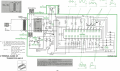
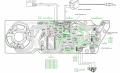
Below is a schematic to the motor control. I am trying to understand which parts could take up to 20 minutes (heat up) before losing spec, making that rythmic tut-tut sound (which speeds up as the platter speeds up) and be responsible for the turntable going 'open loop' (platter speeds up and nothing controls it). Perhaps the IC (AN630U) - in which case there is nothing I can do to fix this board.
I replaced all of the electrolytic capacitors thinking my problem was there with no effect. All pots/switches are clean. I re-flowed solder to many of the joints that even remotely looked suspect (such as the stator coil). No effect. I also replaced 2SC1846Q based on advice from an audio forum. That had no effect either. I did not replace any of the film caps.
The turntable will start up perfectly and lock speed as indicated by the strobe:
https://www.dropbox.com/s/kclugyl3wa2c4b0/20190123_173439.mp4?dl=0
After 20 minutes or so speed lock is lost as the video shows. Strangely, I can thumb the platter as a brake and speed lock is restored temporarily. Or shut off the turntable and turn it quickly back on and speed lock resumes - but only for 10 or so seconds. Only a long time (overnight) can I run the unit for 20 minutes again.
One other observation I just observed - when I took the bottom off the unit so I could see the circuit board while the platter was spinning, I could hear a very slight pulsating thump/pop that only occurred when the speed lock was lost. I'm trying to find out what part (capacitor?) could produce the sound (it is very very faint, but does occur and only when the platter loses speed lock.
Below is a schematic to the motor control. I am trying to understand which parts could take up to 20 minutes (heat up) before losing spec, making that rythmic tut-tut sound (which speeds up as the platter speeds up) and be responsible for the turntable going 'open loop' (platter speeds up and nothing controls it). Perhaps the IC (AN630U) - in which case there is nothing I can do to fix this board.