TSOP 31230-FREQUENCY DETECTION QUESTION-PROBLEM

Thread Starter

optus

Joined Oct 25, 2019
92
Let me see if i understood things clearly.on the transmitter side i will place an IR diode that would be operated at some frequency generated by first chip.On the reciever side i will place an TSOP that would detect only that frequency created by first chip and will ignore all other frequencies?
 

AlbertHall

Joined Jun 4, 2014
12,625
Not quite. The encode chip sends an address code plus a data code. The decoder will ignore any signals that do not have the correct address code. When it sees that address it will then decode the data bits.

This the way that the TV remote will not affect the HiFi even if they use the same IR frequency.
 

ericgibbs

Joined Jan 29, 2010
21,444
hi optus,
As a practical example I have two IR remotes, one for the TV and the other for the SKY box, they are mounted one above the other.
Only the remote for the TV operates the TV functions, the SKY remote the SKY box.

Both the TV and SKY detector LED's flicker when I use either remote, but only the correct unit is operated.

E
 

Thread Starter

optus

Joined Oct 25, 2019
92
Ok,but what is the correct way to build this circuit? IR led with resistor on encoder side and TSOP on the decoder side and that should work?
 

AlbertHall

Joined Jun 4, 2014
12,625
Yes. For best range use a TSOP that matches the encoder frequency.

I am currently making a self-learning IR receiver with which I can use any IR remote I have lying around. I am using a 38kHz TSOP receiver and it works with all the remotes I have (I have no idea what frequencies they use).
 

Thread Starter

optus

Joined Oct 25, 2019
92
Yes. For best range use a TSOP that matches the encoder frequency.

I am currently making a self-learning IR receiver with which I can use any IR remote I have lying around. I am using a 38kHz TSOP receiver and it works with all the remotes I have (I have no idea what frequencies they use).
It seems like a very nice project.I hope that you will achieve your goals.
As i can see from the datasheet of this encoder its frequency is 38 kHZ .That means i should use a 38 kHz TSOP?
 

Thread Starter

optus

Joined Oct 25, 2019
92
So i went online to explore these two IC'S(HT 12A & HT12D) and find them too expensive for my project.Is there any other way to exclude 38 khz freq. or at least deminish it's influence on my 30 kHz TSOP??Is it possible to build some filter(low/high pass) with passive components?
 

AlbertHall

Joined Jun 4, 2014
12,625
So i went online to explore these two IC'S(HT 12A & HT12D) and find them too expensive for my project.Is there any other way to exclude 38 khz freq. or at least deminish it's influence on my 30 kHz TSOP??Is it possible to build some filter(low/high pass) with passive components?
Not if you are using the TSOP kind of IR receivers. The 38kHz modulation is filtered internally within the chip and the only the envelope of that signal is output. You have no access to the 38kHz signal to filter it. There are three ways:
1. Try it and see if it is actually a problem.
2. Transmit a coded signal and then have the receiver check that the correct code is received and ignore incorrect codes. That is what the HT series do for you. You could also do this with a microcontroller at both the TX and RX.
3. Build your own discrete 30kHz IR receiver then you can do as you like with filtering.
 

Thread Starter

optus

Joined Oct 25, 2019
92
Not if you are using the TSOP kind of IR receivers. The 38kHz modulation is filtered internally within the chip and the only the envelope of that signal is output. You have no access to the 38kHz signal to filter it. There are three ways:
1. Try it and see if it is actually a problem.
2. Transmit a coded signal and then have the receiver check that the correct code is received and ignore incorrect codes. That is what the HT series do for you. You could also do this with a microcontroller at both the TX and RX.
3. Build your own discrete 30kHz IR receiver then you can do as you like with filtering.
Thank you for your fast respond.
Unfortunately i don't have much exp.with this kind of things.HT' s are bit expensive for this small project,and i dont have any knowledge of programing so microcontrolers are excluded.Only thing then is to buil my own receiver.Is this a complicated task?
 

Thread Starter

optus

Joined Oct 25, 2019
92
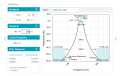
As for option 3, check out any one of the filter design sites.

For Analog Devices: https://www.analog.com/designtools/en/filterwizard/

Enter these specifications:
View attachment 194057
Then follow the process.

I think you will decide that using digital codes and off the shelf IR components will be easier and cheaper.
Thank you for your reply
It seems something is wrong with this calculator because when i put these values everything went red and i cannot go further.
 

AlbertHall

Joined Jun 4, 2014
12,625
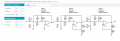
The bursts of the carrier are down to about 1ms, equivalent to a modulation frequency of 500Hz. How would that filter in #54 deal with that.
 

Papabravo

Joined Feb 24, 2006
22,083
I am confused now...Is this a good representation from Bertus or not?
A typical IR remote uses bursts of 38 kHz interspersed with nothing. This creates what looks like a signal with approximately a 500 Hz. fundamental. The filter will attenuate that frequency by a considerable amount. That is what bandpass filters do. I think you need a deeper understanding of how IR remotes actually work.
 

jpanhalt

Joined Jan 18, 2008
11,087
If it works, it's good. If it doesn't, then it's not so good. So far as a simulation, it is accurate.

As everyone has pointed out, it will be very difficult to get a well-functioning IR remote control using just carrier wave.
 
Top