Trying to create simple DC ramp circuit

MrAl

Joined Jun 17, 2014
13,709
Hello,

I'd be careful with the design in post #12 as that kind of design is really made for a single die design not really for individual separate transistors with little or no thermal coupling. You should at least check for current variation as temperature gradients appear and disappear over time.
 

ebp

Joined Feb 8, 2018
2,332
Adding smallish resistance between the emitters of the current mirror transistors and the supply rail will improve accuracy of mirroring with unmatched transistors, but it has its limits, one of which is how close the collector can get to the rail. There are some moderately well matched dual transistors that are fairly cheap in 6-pin SOT-23 or SC-70 packages. With through-hole transistors in TO-92, one option is to select-on-test and then "glue" the flat faces of the two devices together. There was a time when you could get thermal coupling devices for transistors in tin cans, but I suspect they have disappeared from the market. Q3's temperature will change a bit during the charging cycle impairing linearity, but that isn't important in this case other than as a point of curiosity.

"Measure the voltage from Base of Q3 to ground."
We already know what that voltage is - "one Vbe" less than the supply voltage, so about 29.4 V according to Crutschow's simulation. That is perfectly acceptable. The relationship of Q3's base voltage relative to its emitter voltage is fixed by Q4's base voltage relative to its emitter voltage. That is the fundamental "thing" that underlies the entire function of a BJT current mirror.
 

Thread Starter

Dean Rantala

Joined Sep 27, 2018
40
Okay... so I completely re-did this.

First, I got rid of the tiny chinese breadboard jumper wires I was using (with the plastic tip ends) and replaced all the connections with solid 16ga copper pieces cut-to-length. I *have* had issues with my MCU's in the past using these wires as well.

Next, I soldered a few things up that were possibly giving me crappy connections and... presto! Working great. And...

Now it is passing current. Before, it worked.. but while voltage would climb, I really could not load the circuit at all. Even a 5K load would never get above 9-ish volts.

Maybe it was my fault, perhaps I did have Q1/2 backwards.. perhaps it was the wires, who knows.

However....

Now Q1 gets hot as hell (as I suspected it would) and I am going to find a higher-power PNP transistor to stick in it's place. Other than that, I think all will be good. Gonna replace Q1 with something beefier and run one more test with the dummy 200ohm load and will report back.

- Dean
 

Thread Starter

Dean Rantala

Joined Sep 27, 2018
40
Swapped out Q1 for a 2SA1837.. Thought I would need a heatsink for it, but does just fine without. Have cycled the circuit a few times now without issue.

Also added a diode to the final output to ensure no back-voltage does anything funny. Originally, I was testing with the actual pre-amp board (removed from receiver) connected directly for the actual testing. That board DOES have it's own filter capacitors (1000uf).. Perhaps that could have caused issues before? Anyway, I will leave the diode there.
 

MrAl

Joined Jun 17, 2014
13,709
That can have an effect, but since his timing is not critical, I doubt that it will be a real problem.
Hi,

Thanks for the reply.

Well i am not sure about that. Note also that Q3 handles the current while Q4 not much.

With discrete transistors the more typical way is to add a Q3 emitter resistor (see edp's post right after mine) and double the base bias voltage by using two diodes (or two transistors as diodes) in series. What this does is establish a voltage across the emitter resistor and thus the current level. Still not perfect but now the current variation is linear with diode voltage variation so it should be less sensitive.
Still better is to use a zener, but then the overhead voltage becomes significant and so applications becomes more limited.

Yes, all still subject to what can be tolerated in the application, however we could be talking more than 10 orders of magnitude of sensitivity difference between the two methods.
 
Last edited:

crutschow

Joined Mar 14, 2008
38,526
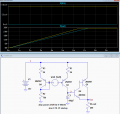
To address the valid concerns about offsets, here's the circuit simulation with two added 2kΩ emitter resistors to minimize the effects of Vbe offset between Q3 and Q4.
The ramp time changes by less than a second between no offset (blue trace) and an added 100mV offset (yellow trace), which corresponds to about a 50°C difference in temperature between the two transistors.

upload_2018-10-2_9-0-47.png
 
Last edited:

MrAl

Joined Jun 17, 2014
13,709
To address the valid concerns about offsets, here's the circuit simulation with two added 2kΩ emitter resistors to minimize the effects of Vbe offset between Q3 and Q4.
The ramp time changes by less than a second between no offset (blue trace) and an added 100mV offset (yellow trace), which corresponds to about a 50°C difference in temperature between the two transistors.

View attachment 160839
Hi,

Oh yes that looks much better with the added 2k resistors.
I guess you tried it without the two extra resistors first :)
 
Top