trying to build a theremin

Thread Starter

TL314

Joined Mar 29, 2015
64
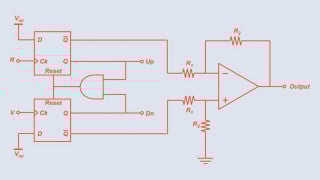
Im trying to build a theremin for a project for class, the teacher said I have to build 2 different ones so I did a optical one that I finished and now im trying to build this one but I cant seem to get it to work.


I bought (2) 4093 logic gates in case of oscillation in 1 gate. And I have a 8ohm speaker hooked to the output.
But it doesnt seem to work.
 

Papabravo

Joined Feb 24, 2006
22,082
Your RC time constants for your relaxation oscillators might be a bit fast. I think you are trying for an audio output and you won't get too much audio output at 667 kHz.
 

Thread Starter

TL314

Joined Mar 29, 2015
64
Your RC time constants for your relaxation oscillators might be a bit fast. I think you are trying for an audio output and you won't get too much audio output at 667 kHz.
Any ideas for a solution?
I did relize i had a fixed 20k resistor when i needed a variable so im on my way back tonthe electronics store.
 

Papabravo

Joined Feb 24, 2006
22,082
The period of a relaxation oscillator is:

\(f = 2.2RC\)
You want this value and the value of the adjustable oscillator to be in the audio frequency range. Unfortunately that requirement leads to very large resistor and capacitor values. I'm not sure this approach is practical. A more practical solution would be a single oscillator and a frequency divider like a CD 4040 or CD4060

https://www.fairchildsemi.com/datasheets/CD/CD4060BC.pdf
 
Last edited:

AnalogKid

Joined Aug 1, 2013
12,126
I think there is a misunderstanding about how this circuit works. First, don't change the chips, and don't change the time constants. Also, the equation in post #4 is correct for a 555, but not for a circuit based on something as uncontrolled as the transition voltages of a CMOS Schmitt Trigger.

This is sort of like an antenna-variable FM single-sideband receiver, with the adjustable oscillator acting as the beat-frequency oscillator and the 4077 as the mixer. The 4077 mixes the two oscillator signals and outputs a complex signal that has both the sum of the two freqs and the difference. Your ear can't hear the sum, but even though the two oscillators are running at hundreds of kilohertz, the difference between them can be down in the audio range.

Even without the 10K series resistor, a 4077 will not drive any kind of speaker. It will drive the input of a standard amplified PC speaker, a stereo amplifier Tape or Aux input, etc.

The two oscillator frequencies are high because the change in capacitance caused by your hand being near the antenna is very small. To get that to do something, that small change has to be a noticeable percentage of the other capacitor in the oscillator. That only happens if the fixed capacitor also is small, which means a high freq oscillator.

I hope the circuit works; I'm impressed by the idea.

ak

ps. Theremin was a Russian spy.
 
Last edited:

Thread Starter

TL314

Joined Mar 29, 2015
64
I think there is a misunderstanding about how this circuit works. First, don't change the chips, and don't change the time constants. Also, the equation in post #4 is correct for a 555, but not for a circuit based on something as uncontrolled as the CMOS transition voltages of a schmidt trigger.

This is an antenna-variable beat frequency oscillator, with the adjustable oscillator acting as the received carrier and the 4077 as the mixer. The 4077 mixes the two oscillator signals and outputs a complex signal that has both the sum of the two freqs and the difference. Your ear can't hear the sum, but even though the two oscillators are running at hundreds of kilohertz, the difference between them can be down in the audio range.

Even without the 10K series resistor, a 4077 will not drive any kind of speaker. It will drive the input of a standard amplified PC speaker, a stereo amplifier Tape or Aux input, etc.

The two oscillator frequencies are high because the change in capacitance caused by your hand being near the antenna is very small. To get that to do something, that small change has to be a noticeable percentage of the other capacitor in the oscillator. That only happens if the fixed capacitor also is small, which means a high freq oscillator.

I hope the circuit works; I'm impressed by the idea.

ak
I need a amp speaker but dont have 1 so i started building another theremin but still need to try and figure out everything with that one. Do you think a amped speaker is all i need? I just need some sound lol
 

Søren

Joined Sep 2, 2006
472
Yes, you need a speaker with amplifier or similar. If you can't find one, you could make a simple one yourself with eg. a TIP120 and a couple of resistors - it won't sound good (but neither will this pseudo-theremin, I'm sure) and it won't be loud (depending on supply voltage and current), but if you haven't got other options at hand, it will at least be able to give you some sound :)

I'm just a bit puzzled by the 100g weight you connected to the output of the circuit (1N is 1 Newton, approximately 100g).

Perhaps it was meant to be a 1nF (lower case "n" for nano) capacitor, to act with the 10k resistor, as a low pass filter with its -3dB point a shade under 16kHz.

OK, I got it, but I wondered a bit first - it's quite important that we use the correct nomenclatures, if we want to be understood.
 

Dodgydave

Joined Jun 22, 2012
11,395
your frequencies are approx 75Khz and 300khz, so your not going to hear 225khz, the resistors or capacitors need to be increased by 10 times to bring the frequency down to hearing range of 2 - 10khz.
 

Thread Starter

TL314

Joined Mar 29, 2015
64
your frequencies are approx 75Khz and 300khz, so your not going to hear 225khz, the resistors or capacitors need to be increased by 10 times to bring the frequency down to hearing range of 2 - 10khz.
So i need to change my resistors and caps? As well as add a amped speaker??
 

Alec_t

Joined Sep 17, 2013
15,117
I agree with AK's analysis of the circuit operation (post #7) and see no need to change the components shown, other than to add an amplifier to feed the speaker.
 

AnalogKid

Joined Aug 1, 2013
12,126
your frequencies are approx 75Khz and 300khz, so your not going to hear 225khz, the resistors or capacitors need to be increased by 10 times to bring the frequency down to hearing range of 2 - 10khz.
I don't think so. First, I don't see where you are getting a 4:1 difference in freqs. Without the antenna, or with it attached but with nothing near it, the lower osc can be adjusted to be identical to the upper one for no audio output. Moving near the antenna adds capacitance to the upper oscillator, lowering its frequency to create an audible difference frequency after the mixer.

ak
 

AnalogKid

Joined Aug 1, 2013
12,126
with the values shown they produce the frequency difference too high to hear, have you got a frequency counter...
Don't need one. Forget the antenna for a moment. With the values given, it is very easy to tune one oscillator so that its frequency is 1000 Hz higher or lower than the other one. For example, if the upper osc is at 500 KHz and the lower one is at 501 KHz, the output of the mixer will be a complex signal containing both 1,001,000 Hz and 1,000 Hz, plus other more complex frequencies. The output lowpass filter as a corner freq of 16 KHz, so it will pass the 1,000 Hz (difference) signal to the external amplifier. The XOR gate acts as a switched inverter; you also can use a D flipflop. This is from Wikipedia:

Another form of mixer operates by switching, with the smaller input signal being passed inverted or uninverted according to the phase of the local oscillator (LO). This would be typical of the normal operating mode of a packaged double balanced mixer, with the local oscillator drive considerably higher than the signal amplitude. The aim of a switching mixer is to achieve linear operation over the signal level, and hard switching driven by the local oscillator. Mathematically the switching mixer is not much different from a multiplying mixer, just because instead of the LO sine wave term we would use the signum function. In the frequency domain the switching mixer operation leads to the usual sum and difference frequencies, but also to further terms e.g. +-3*fLO, +-5*fLO, etc.

http://en.wikipedia.org/wiki/Frequency_mixer

ak
 
Last edited:

Thread Starter

TL314

Joined Mar 29, 2015
64
No all thaf stuff is n the lab and im at home, what kind of comp speaker should i buy? All i see are usb powered ones.
 
Top