Trouble understanding calculations

Thread Starter

bushrat

Joined Nov 29, 2014
209
Hello everyone,
I have been away from electronics for a while, a lot of changes in life, and it appears I have forgotten few things.
I been trying to measure some inductors (inductance), basically ball-park values, just to know what i am working with.
I build this simple circuit on breadboard:
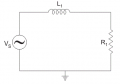
upload_2017-11-7_22-55-42.png
In theory, if my Vs is 10 Vpp, and my R1 is 50 ohms, I can find inductance of inductor by adjusting the frequency untill voltage across R1 is 5 Vpp.
XL = 2 π f L
L = XL / (2 pi f)
f = XL / (2 pi L)

Well, it's not working properly. when i measure the known inductors, my readings are different, for example:
R1 = 50 ohms
L = 12 mH
f should be 663 Hz, but I have to reduce the frequency to 260 to get 5 Vpp across R1

Am I missing something or is my equipment not working properly?
I am using digital oscilloscope with 10 M ohm probe, and rather old sig generator.
Or should I add 50 output impedance from sig generator to my calculations?
 
Last edited:

DickCappels

Joined Aug 21, 2008
10,661
When XL = R the voltage will be down to 70.7% ( ( 1/(SQRT(2) ) square root of the sum of the magnitudes squared), not 50% because the voltage across the resistor is 90° our of phase with the voltage across the inductance.
 

Thread Starter

bushrat

Joined Nov 29, 2014
209
So what formula should i use with my setup to estimate the value of inductor?
does 50 ohm output inpedance from sig generator plays a role in this too?
 

DickCappels

Joined Aug 21, 2008
10,661
If you use the amplitude of the signal generator's output then output impedance should not come into play.

We can just say that when the inductive reactance is equal to the resistance the output of the divider will be 70.7%.

To find the current in the series circuit take V/Z, where Z = SQRT(X^2 + R^2). The voltage across the resistor is VR = R * I. The voltage across the inductor is VL = X * I
 

Thread Starter

bushrat

Joined Nov 29, 2014
209
Thank you for the quick answer, I will try it out tomorow.
(edit) How will I find the inductance with those formulas?
 

DickCappels

Joined Aug 21, 2008
10,661
Thank you for the quick answer, I will try it out tomorow.
(edit) How will I find the inductance with those formulas?
You can use the same method you used before, but instead adjusting the oscillator to Vout = 0.5 Vin adjust for Vout = 0.707 Vin. At that point you know that X = R, and knowing the frequency you can calculate the inductance for that R and F.

X = R
L = X / (6.28 F)
 

MrAl

Joined Jun 17, 2014
13,702
Hi,

One of the big problems that can come ujp with this experiment is the voltage could change from the ideal because of the series resistance of the inductor. Most inductors have some series resistance, and some smaller inductors have a LOT of series resistance. This is not visible because the inductor looks like just one piece when inside there is wire that has resistance. This can easily be 10 ohms or more for some small signal inductors. Thus, measuring the inductor DC resistance would help with this experiment. There are other problems too i'll get to in a minute here.

If we calculate the voltage amplitudes across R and L with L having no series resistance, we see that the voltages are equal when:
R=w*L

but when we have series resistance as part of the physical inductror (as all real life inductors have) then we get equal voltages when:
R^2=RL^2+w^2*L^2

To extract the inductor value from this we just have to do a little solving for L here, and this leads to:
R^2-RL^2=w^2*L^2
(R^2-RL^2)/w^2=L^2
L=sqrt(R^2-RL^2)/w

This should work as long as RL<R.

So the only difference is that you have to measure RL which is the indcutor series resistnace, and that can bne done with an ohm meter. Note if RL is small, it wont affect it as much.

Unfortunately, this is for a linear inductor with a core that we consider to be isotropic (linear) so with inductors that have magnetically active cores there will still be inaccuracy here becuase the core could affect the inductance greatly, and that is because the inductance changes drastically with DC magnetization or average AC magnetization.

This means that inductors with magnetically active cores are much harder to measure than say air core inductors. Non air core inductors need to be measured in their actual application circuit ideally, because that is the only place where they will show the inductance they have for that application. The amount of difference between application and the off to the side measurement depends on how non linear their core is electrically and how close we get to the operating condictions of the actual circuit it will be used in.

So you see this may be hard or even impossible to do for some inductors, although you may be able to get a ball park idea what the inductance range is if you also vary the DC magnetization.
 

Thread Starter

bushrat

Joined Nov 29, 2014
209
I remember now.. 3 dB drop, half of power, not half of voltage.. makes sense now..

Thank you everyone for helping me out..
 

Thread Starter

bushrat

Joined Nov 29, 2014
209
Ok, I have no idea what happened.. I can tune down to 5 Hz, and Vo does not rise above 5 Vpp.. I verified that the input is 10 Vpp...Something tells me my equipment is not working properly..
 

MrAl

Joined Jun 17, 2014
13,702
Or your inductor has a high internal series resistance
Hi,

Good point. If we have a 10 ohm resistor in series with an inductor with 10 ohms ESR, then even 10vdc would show 5v across the resistor :)

Maybe using the formula for the inductance when there is inductor series resistance would be enough here.
 

MrAl

Joined Jun 17, 2014
13,702
Ok, I have no idea what happened.. I can tune down to 5 Hz, and Vo does not rise above 5 Vpp.. I verified that the input is 10 Vpp...Something tells me my equipment is not working properly..
Hi,

Measure the inductor with an Ohm meter and tell us what the resistance reads.
Measure your resistor too, and report that resistance also.
We might make sense of this.
 

Thread Starter

bushrat

Joined Nov 29, 2014
209
Resistors - 49.7 ohms ( 2 x 100 ohms resistors parallel)
Toroidal inductor 1 - 0.3 ohms, 12-15 mH on the label
Toroidal inductor 2 - 0.4 ohms, 20-25 mH on the label.

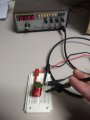
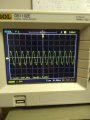
IMG_20171111_093321159.jpg IMG_20171111_093339028.jpg
In pictures, using 12-15 mH toroidal inductor/

Update:
If I connect a capcitor (47nF) directly to sig generator probes and use oscilloscope to measure the 7.07 Vpp, I have to adjust the freq to 64430 Hz, which by calculations, it already has 50 ohms of inpedance. Same applies for inductor. So it appears, that I should not be using external 50 ohms for make a low-pass filter, just connect the components directly to signal generator probes.

Update 2:
I connected signal generator directly to oscilloscope, measured out 10 Vpp. Then i connected sig generator to my parallel resistors (49.7 ohms), and I only got 5.04 Vpp across the resistors, so I guess I have 48.9 ohms of output resistance.
 
Last edited:
Top