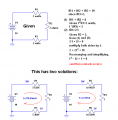
Trick Problem

Ron H

Joined Apr 14, 2005
7,063
I you could, I'd appreciate it. Maybe I'd be able to understand the formula for finding the unknown a bit better.
OK, here it is. The key step I left out is how to solve for the equation for current. There are some clues in some of the previous posts. As you can see at the bottom, it has two solutions, each of which is equally valid.
You can easily work out voltages and power dissipations, but I suspect your prof is more interested in method than in answers.
 

Attachments

hgmjr

Joined Jan 28, 2005
9,027
Algebra bites :(

But in electronics, it's reality. Until you get into time. Then triginometry comes into play. Until you get into high frequencies where you need other stuff. :eek:

It gets worse, lots worse. :rolleyes:

I'm admittedly math-handicapped. Yet I love electronics and computers, which are all math-based. It's this wierd love-hate relationship.

I've achieved great things by having math/physics gurus sitting next to me.
They do the math. I write the programs. Magic happens.
Sgtwookie,

It sounds like we share the same disdain for linear algebra. I think you would really benefit from checking into Millman's Theorem. You could avoid simultaneous equations altogether and solve some of the most complex circuit networks with relative ease.

hgmjr
 

Thread Starter

shannonm1

Joined Apr 13, 2008
13
Also, would you explain to me how the you came up with the step where it says:

Rearranging and Simplifing,
II - 4I + 1 = 0

I understand all the equations up to that point, but I don't understand how you came up with that. Just so you understand, I'm not taking a college course, just a continuing education course. I'm an electrician by trade, and taking a course on machine controls. I understand series, parallel, and series-parallel circuits fine, just the math involved in this is a bit beyond me remembering. I had asked the instructer if he could give me a "harder" problem to try, and he gave me two. The other one took a bit of thought, but wasn't too hard. I appreciate everyone's help, comments, and suggestions!! Thank you!!

BTW, here is the other one if anyone wants a little challange... It looks harder than it is!!


Ron H

Joined Apr 14, 2005
7,063
Ron, what program did you use to create the picture? It does a very nice job.
I used Linear Technology's SwitcherCAD III (AKA LTspice) to draw the schematics, then imported them into Microsoft Paint to add The finishing touches.
Also, would you explain to me how the you came up with the step where it says:

Rearranging and Simplifing,
II - 4I + 1 = 0
I think the other guys misinterpreted your question. The solution to that equation uses the quadratic formula, but to get to that step from the previous equation (which is what I think you are asking), we start with
2 + 2I^2 = 8I (where 2I^2 = 2II, to use your terminology)
divide both sides of the equation by 2
1 + I^2 = 4I
subtract 4I from each side
I^2 - 4I + 1 = 0

Make sense? You better brush up on your algebra.:D
 

Thread Starter

shannonm1

Joined Apr 13, 2008
13
Ok, after a bit of thinking and writing on paper, I understand how the quadratic equation works. But I'm still not quite understanding how to use the formula to find I. I understand how the last equation was reached, just don't know how to proceed from here.

And yes, I definitely do need to study algebra too!!
 

Ron H

Joined Apr 14, 2005
7,063
Ok, after a bit of thinking and writing on paper, I understand how the quadratic equation works. But I'm still not quite understanding how to use the formula to find I. I understand how the last equation was reached, just don't know how to proceed from here.

And yes, I definitely do need to study algebra too!!
What do you not understand about how to apply the quadratic formula to solving for I in our equation?
 

Thread Starter

shannonm1

Joined Apr 13, 2008
13
I see how the final equation was reached. I do understand that. I'm trying to understand how the equation workeds to get my answer for I. What do I put where / how do I use the equation to solve the problem?.
 

Ron H

Joined Apr 14, 2005
7,063
The equation for I:

I^2 - 4I + 1 = 0

Rich (BB code):
 The quadratic formula:

 Ax^2 + Bx +C = 0

Solving for x,

x = (-B +/- sqrt(B^2-4AC))/2A
So, x=I, A=1, B=-4, C=1

Just plug in the values for A, B, and C. Due to the +/-, there will be 2 answers.
 

Thread Starter

shannonm1

Joined Apr 13, 2008
13
I think it's starting to make sense... :D I'm gonna chew on it a bit today at work:) ! Thank you!! I hope not to have to encounter this much more, but it's nice to understand how to do it if the need ever rises!
 
Top